
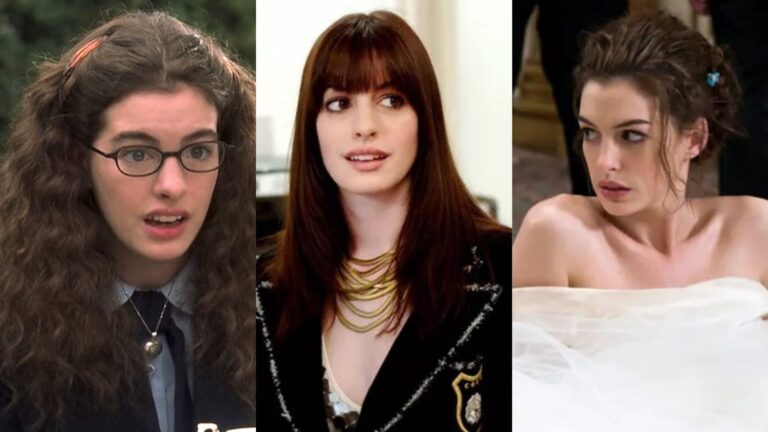
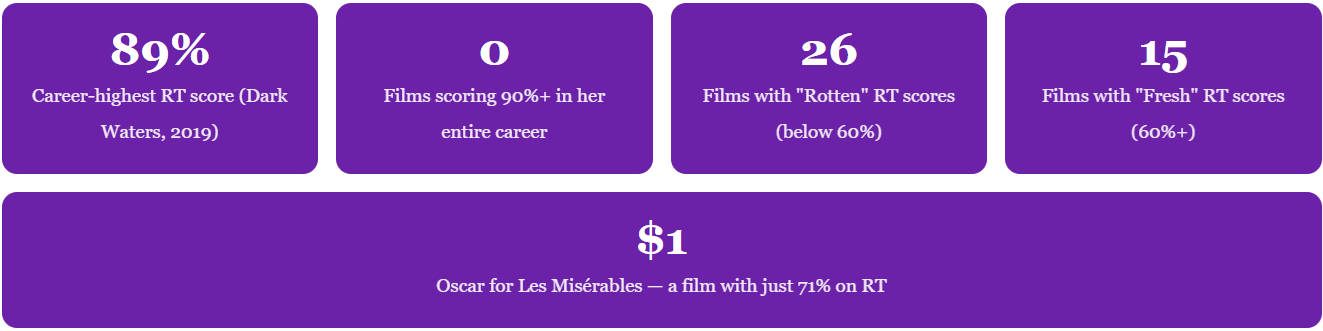
Here is a fact about Anne Hathaway Movies that most entertainment websites skip over: in a career spanning more than two decades and over three dozen films, she has never starred in a movie that scored 90% or above on Rotten Tomatoes.
Not one. Not even The Dark Knight Rises. Not even Les Misérables, for which she won the Academy Award for Best Supporting Actress. Not even The Devil Wears Prada, which made her a cultural touchstone for a generation and remains one of the most rewatched films of the 2000s.
Her highest-rated film — Dark Waters (2019) — sits at 89%. Her ceiling, in twenty-three years of working in Hollywood, is 89%.
And yet she is one of the most famous, most discussed, most culturally present actresses working today. She won an Oscar. Her films have grossed billions. She is attached to upcoming projects that generate significant pre-release excitement. And she exists in a particular category of celebrity where the internet’s relationship with her — loving her, hating her, defending her, mocking her — is itself a cultural phenomenon worth studying.
So what do the Rotten Tomatoes scores actually tell us? Which five films represent the critical peak of her career? And what does the gap between her critical ceiling and her cultural impact reveal about how we measure a performer’s success?
This is the complete guide — every film in the top five broken down properly, the performance within each film analysed honestly, and the broader career picture placed in genuine context.
Anne Hathaway’s Complete Rotten Tomatoes Top 10 — At a Glance
| Rank | Film | Year | RT Score | Genre |
|---|---|---|---|---|
| 1 | Dark Waters | 2019 | 89% | Legal Thriller / Drama |
| 2 | Brokeback Mountain | 2005 | 88% | Romantic Drama |
| 2 | The Cat Returns (voice) | 2002 | 88% | Animated / Fantasy |
| 4 | The Dark Knight Rises | 2012 | 87% | Superhero / Action |
| 5 | Rachel Getting Married | 2008 | 85% | Drama |
| 6 | Colossal | 2016 | 82% | Sci-fi Dark Comedy |
| 7 | Eileen | 2023 | 81% | Crime Thriller |
| 8 | Girl Rising (narrator) | 2013 | 80% | Documentary |
| 9 | The Idea of You | 2024 | 80% | Romantic Drama |
| 10 | Nicholas Nickleby | 2002 | 79% | Period Drama |
Note: This list covers films in which Hathaway stars or plays a significant role. Girl Rising, in which she narrates, is sometimes included in extended lists.
The Plot
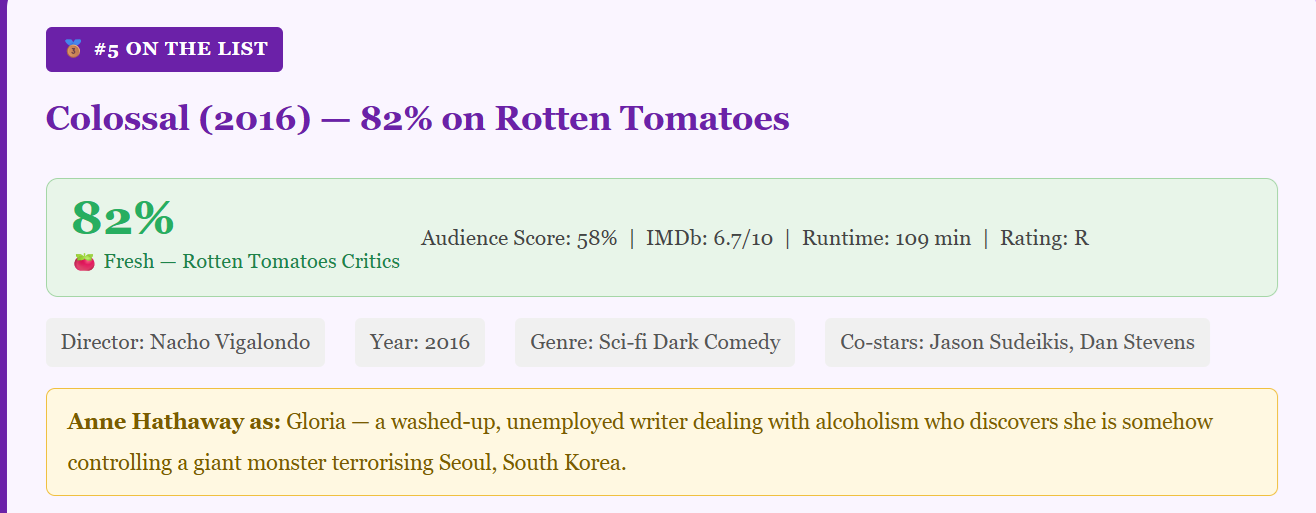
Colossal is the kind of film that gets described in loglines that sound like someone improvised a pitch in the wrong meeting. Gloria (Hathaway) is kicked out of her New York apartment by her exhausted boyfriend, returns to her small hometown, reconnects with a childhood friend named Oscar (Jason Sudeikis), and discovers — through a specific spot in a local park at a specific time — that her body movements are somehow controlling a massive kaiju monster tearing through Seoul.
Things get considerably more complicated when she discovers that Oscar controls a giant robot, and that Oscar’s apparent generosity and warmth conceal something far darker and more controlling. What begins as a wildly absurdist comedy about alcoholism and self-destruction gradually transforms into something genuinely disturbing about control, abuse, and the ways people use other people’s weaknesses against them.
What Makes It Remarkable
Colossal is the most formally inventive film on this list and also the most divisive — hence the notable 24-point gap between its critics score (82%) and its audience score (58%). Critics responded to its tonal ambition and its willingness to use a genre framework (giant monster movie) to explore something deeply uncomfortable about the psychology of manipulation and coercive control. General audiences responded to the fact that the film they were promised — a fun sci-fi comedy — gradually becomes something much darker and more emotionally demanding than any monster movie has the right to be.
Hathaway’s performance is crucial here. She plays Gloria’s self-destructiveness with a specific, unglamorous honesty — the character is messy, funny, irresponsible, and genuinely damaged in ways that resist easy sympathy. When the dynamic shifts and Oscar’s controlling behaviour emerges, her performance shifts too — the comedy evaporates and something more frightened and determined takes its place. This is not the Anne Hathaway of The Princess Diaries. This is a performer taking genuine creative risks with an actress’s most difficult task: playing unlikeable without losing watchable.
The Career Context
Colossal arrived in 2016 during one of the stranger periods of Hathaway’s public narrative — the “Hathahate” era, in which a significant portion of internet culture had decided to dislike her for reasons that said more about the internet than about her actual work. That a film this original and this uncomfortable exists in her filmography from this specific period is worth acknowledging. Most actors under public microscope do exactly the opposite — they play it safe, take comfortable roles, wait for the cultural tide to turn. Hathaway made Colossal.
The Plot
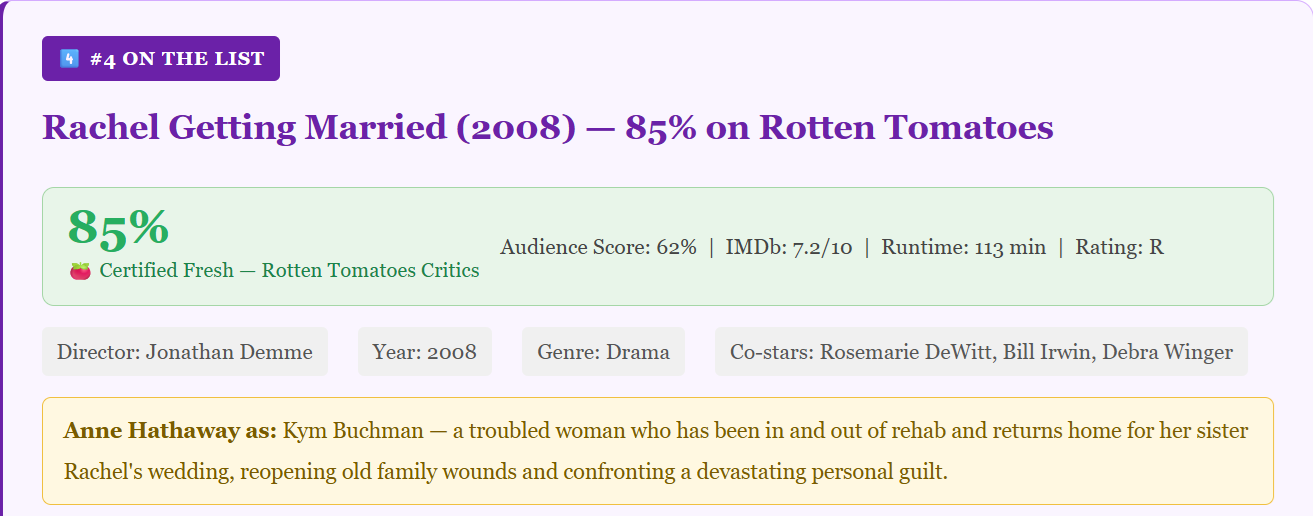
Directed by Jonathan Demme (The Silence of the Lambs, Philadelphia), Rachel Getting Married follows Kym (Hathaway) as she returns home from a rehabilitation facility to attend the wedding of her sister Rachel (Rosemarie DeWitt). The film unfolds almost entirely in real time across the wedding weekend — a decision that gives it the texture of documentary intimacy.
What seems like a family celebration becomes a pressure cooker: old resentments surface, family dynamics that have calcified around Kym’s addiction and her past — including a tragedy she caused that haunts the entire film — come to painful life. The wedding goes on, full of music and dancing and beautiful chaos, while underneath it runs a current of grief, guilt, and the specific exhaustion of loving someone who has hurt you deeply and whom you cannot entirely give up on.
What Makes It Remarkable
This is the film that established Hathaway as a serious dramatic actress beyond any reasonable doubt. Before Rachel Getting Married, she was — in critical and industry perception — a talented commercial actress who had proven herself in Brokeback Mountain but had not yet headlined a serious dramatic film alone. This film required her to carry almost every scene, and she did so with the kind of unglamorous commitment that tends to generate awards attention and permanent critical respect.
Kym is not easy to like. She is self-pitying at moments, manipulative at others, and capable of genuine cruelty toward the people who love her — not because she is a bad person but because she is a deeply broken one. The performance Hathaway gives is one of radical honesty: she does not protect the character, does not telegraph the moments when sympathy should arrive, and does not soften the more difficult truths about what addiction and guilt do to a person and to everyone around them.
Her first Oscar nomination came from this film. It arguably should have won.
The Career Context
The timing of Rachel Getting Married‘s release — in the same year that Hathaway’s then-boyfriend Raffaello Follieri was arrested for fraud — meant that some of the critical attention the film deserved was displaced by tabloid coverage of her personal life. The film still earned her an Oscar nomination, but the cultural noise around her private circumstances meant that a performance of genuine artistic importance was somewhat overshadowed by exactly the kind of gossip she had historically managed to avoid.
The Plot
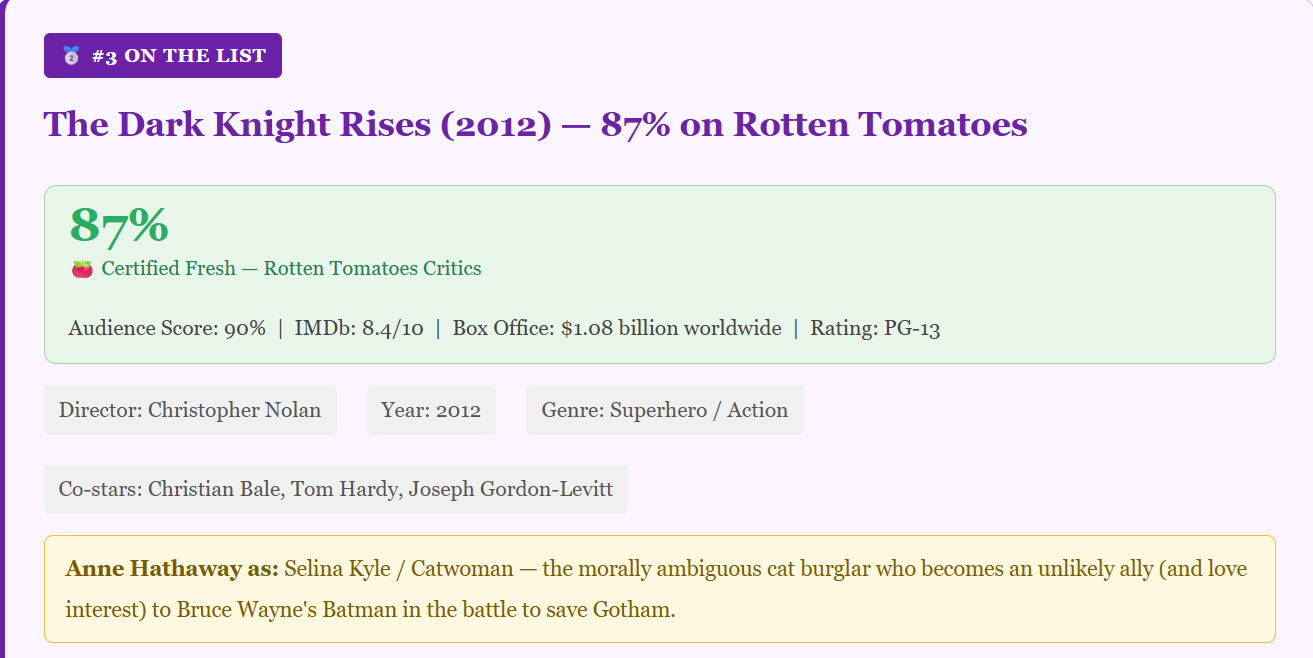
The concluding chapter of Christopher Nolan’s landmark Batman trilogy. Eight years after the events of The Dark Knight, Bruce Wayne (Christian Bale) has retreated from public life and from the cowl. When the masked mercenary Bane (Tom Hardy) arrives with a plan to reduce Gotham to rubble, Wayne is forced back into the suit — and into an uneasy alliance with the skilled, self-interested thief Selina Kyle.
The film is Nolan’s most ambitious in scale — a film genuinely concerned with class warfare, institutional collapse, and the question of what happens to a symbol when the person behind it has given up. Within this enormously complex canvas, Catwoman operates as both a plot function and a thematic mirror: a person who believes in no cause but self-preservation, who gradually finds herself drawn into something larger than individual survival.
What Makes It Remarkable
When Hathaway was cast as Selina Kyle, the announcement was met with significant online scepticism — she was seen as too soft, too commercial, too non-threatening for a role that had previously belonged to Michelle Pfeiffer’s iconic, dangerous interpretation. What she delivered entirely rewrote the conversation.
Hathaway’s Catwoman is not Michelle Pfeiffer’s Catwoman. She is sleeker, more controlled, more consciously performed — a character who has constructed a persona as her primary survival tool. The performance is precise in a way that Nolan’s aesthetics demanded: nothing is improvised, nothing is wasted, and the wit she brings to the role gives the film one of its most reliably entertaining qualities in a narrative that is often heavy with apocalyptic weight.
The film was a global phenomenon — $1.08 billion worldwide — and Hathaway’s Catwoman was, for a generation of audiences, the definitive screen Catwoman. The interesting critical argument about this film is whether 87% accurately reflects what Nolan achieved: many critics consider TDKR the weakest of the trilogy, while audience scores (90%) suggest that general viewers rated it as an equal.
The Plot
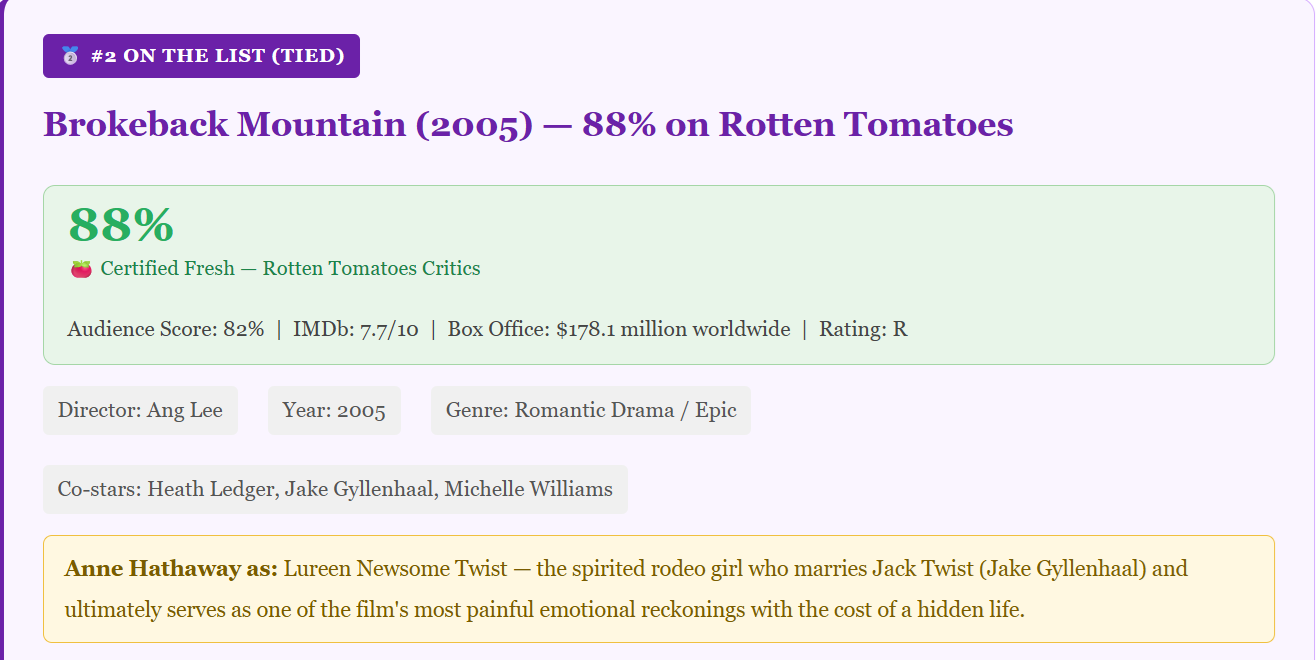
Ang Lee’s landmark American epic follows Ennis Del Mar (Heath Ledger) and Jack Twist (Jake Gyllenhaal) — two sheep herders who meet in Wyoming in 1963 and begin a relationship they spend the next twenty years trying to contain, suppress, and survive. Both marry women. Both pretend to lives they are not living. Both pay a price that the film renders with devastating, quiet accumulation.
Brokeback Mountain won three Academy Awards including Best Director (Ang Lee) and lost Best Picture in one of the most controversial Oscar upsets in recent memory. It is widely regarded as one of the greatest love stories American cinema has produced — not specifically as a “gay” love story, but as a story about love that cannot be lived openly and what that suppression costs everyone it touches.
What Makes It Remarkable
Anne Hathaway’s Lureen is a small role in terms of screen time and an enormous role in terms of emotional consequence. She appears in only a handful of scenes across the film’s twenty-year timeline — but the trajectory of her character is one of the film’s most heartbreaking elements. We see her at the beginning as a vivacious, sexually confident young woman full of energy and aspiration. We see her at the end: polished, composed, running the family business, and delivering a final scene with Ennis (played by Ledger in the scene; the exchange is actually on the phone) in which what she knows — and what she won’t say — charges every word she speaks with devastating implication.
This was, in many ways, the performance that announced Hathaway as something more than a Disney princess. The contrast between her early career (Princess Diaries, Ella Enchanted) and this — a small, achingly precise role in one of the most important American films of the 2000s — represents the pivot point of her entire career trajectory.
The Career Context
Brokeback Mountain did not earn Hathaway an Oscar nomination. Her role, while memorably performed, was too small for the Academy to single out in a cast that included Ledger’s and Gyllenhaal’s career-defining central performances and Michelle Williams’ own Oscar-nominated turn. But the industry noticed. The film opened doors that the Princess Diaries franchise had not, signalling that Hathaway was interested in using her commercial appeal as permission to do something entirely different.
The True Story Behind the Film
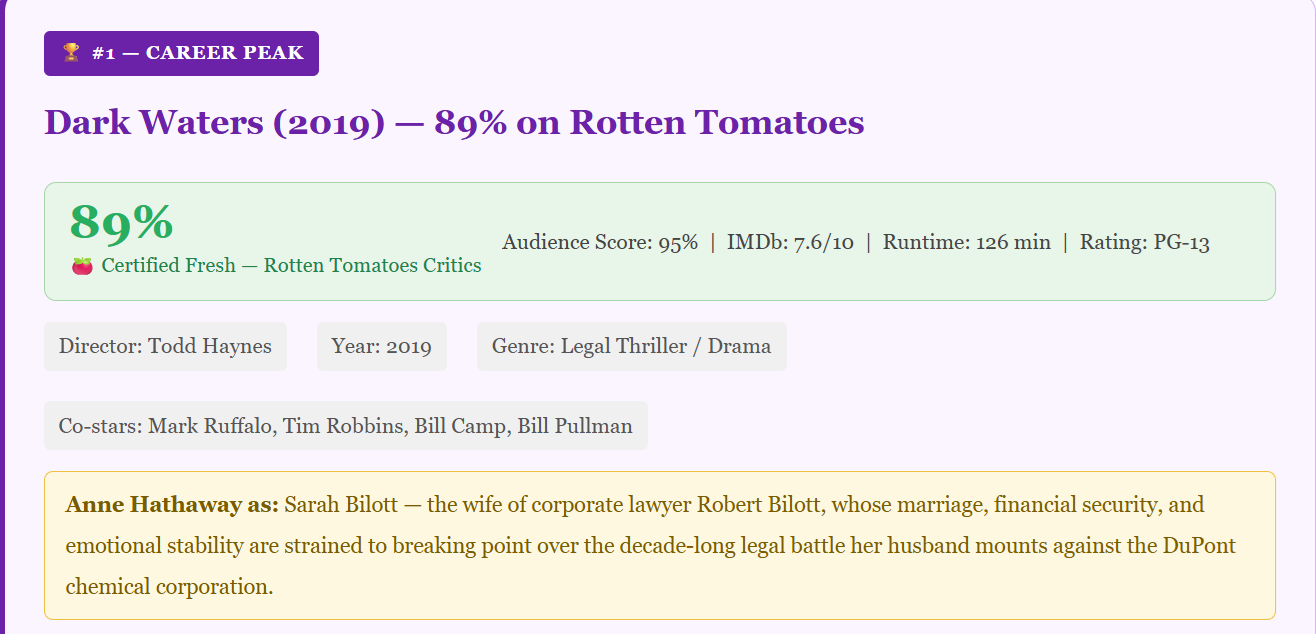
Dark Waters is not a fictional thriller. It is one of the most important environmental stories of the last fifty years, dramatised by director Todd Haynes with a deliberate, methodical seriousness that makes every revelation land harder than any manufactured plot twist could.
In 1998, corporate defence lawyer Robert Bilott (Mark Ruffalo) — an attorney who has spent his career protecting large corporations — is approached by Wilbur Tennant, a West Virginia farmer whose cattle are dying in impossible numbers. Tennant is a friend of Bilott’s grandmother, and out of personal loyalty, Bilott agrees to look into the case. What he finds is the beginning of one of the most significant legal and public health crises in American history.
DuPont, one of the world’s most powerful chemical companies and Bilott’s own firm’s major client, has been manufacturing Teflon using a chemical called PFOA (perfluorooctanoic acid) — a “forever chemical” that never breaks down in the body or environment — while concealing its own research showing that PFOA causes cancer, birth defects, and numerous other serious conditions. It has been contaminating the water and soil of Parkersburg, West Virginia for decades. DuPont knew. DuPont hid the research. DuPont settled what it could and fought what it couldn’t. And nearly all of it happened because the chemical was entirely unregulated — companies were expected to self-police, and DuPont’s self-policing had consisted of hiding the evidence.
The case eventually involved nearly 70,000 blood test participants, a seven-year science panel process, and ultimately a settlement exceeding $670 million. DuPont’s stock dropped 7.15 points in the week the film was released.
What Makes It Remarkable
Dark Waters sits in an honourable lineage of American corporate whistleblower films — The Insider, Spotlight, Silkwood, A Civil Action — films where the procedural machinery of justice is the tension, where the drama comes from watching someone do the necessary, exhausting, unglamorous work of being right when the system wants them to be wrong.
Todd Haynes, whose previous work includes Carol, Far From Heaven, and Safe (another film about environmental illness), brings a visual intelligence to the material that refuses to make a corporate thriller feel comfortable or cathartic. The palette is cold, the editing deliberate, the performances restrained. Ruffalo’s Bilott is intentionally undramatic — the heroism is in the stubborn refusal to quit, not in any single courtroom moment.
Hathaway’s Sarah Bilott is a complicated role to inhabit. She is the supporting spouse in a story that is primarily about her husband, and the film is candid about this constraint — even having her directly address it in dialogue. Some critics felt this reduced her; the more generous reading is that she brings a specific, piercing quality to the film’s most vulnerable domestic moments. As Variety’s review noted, she “goes further than we’re used to in showing you what the loved ones of a hero like this have to endure” — a “piercing dance of agony and loyalty” that gives the film its emotional grounding.
The Numbers That Matter Beyond RT
Dark Waters has a 89% critics score and a remarkable 95% audience score — the highest audience approval of any film in her career top five. That convergence of critics and audience is rare for any film in Hathaway’s filmography, and it reflects the film’s dual function: rigorous enough to satisfy critics looking for serious cinema, straightforward enough in its moral stakes to satisfy audiences who simply want a story of good people fighting powerful wrongdoers.
The real-world impact was also unusual for a film of this type. DuPont’s stock dropped in the week of the film’s release. The term “forever chemicals” entered mainstream discourse. The class of PFAS chemicals depicted in the film has since become a significant regulatory and public health issue globally. When a film’s subject matter has a measurable real-world impact, the RT score is almost beside the point.
The Fascinating Pattern: What Anne Hathaway’s Rotten Tomatoes Scores Actually Reveal
Now that we have examined all five films individually, it is worth stepping back and looking at the pattern that emerges. Because the pattern is genuinely interesting — and genuinely unusual for a performer of this stature.
She Has Never Starred in a Film Above 90% — and That’s Not the Tragedy It Sounds Like
Most articles about Hathaway’s Rotten Tomatoes scores frame the absence of a 90%+ film as a career failure. This framing deserves scrutiny. Consider what 90%+ typically requires in contemporary Hollywood: either a prestige arthouse film with a narrow critical constituency, a genre film that lands with perfect execution, or a franchise entry that arrives with built-in goodwill.
Hathaway’s career has not primarily been built in any of these lanes. She has done prestige films (Rachel Getting Married, Brokeback Mountain), franchise blockbusters (The Dark Knight Rises), and experimental work (Colossal) — but she has consistently worked in the space between pure arthouse and pure commercial cinema. That middle space is precisely where RT scores tend to cap out in the mid-to-high 80s.
The Critic-Audience Gap Is the Real Story
Honourable Mentions: The Films Just Outside the Top 5
The Idea of You (2024) — 80% on Rotten Tomatoes
Her most recent major critical success — a Prime Video romantic drama about a 40-year-old single mother who falls for a boy band star. The film was called her best performance in years by many reviewers, and her 80% score (some sources cite 88% in early counting) marked her best RT result in five years, since Dark Waters. A genuinely charming romantic performance that reminded many audiences why they fell for her in the first place.
Eileen (2023) — 81% on Rotten Tomatoes
A quiet, stylised crime thriller co-starring Thomasin McKenzie, based on Ottessa Moshfegh’s novel. Hathaway plays a glamorous, mysterious woman who enters the life of a young prison secretary with transformative and destructive consequences. Critics praised it as one of her most controlled and dangerous performances. Its 53% audience score suggests the film was — like Colossal — significantly more ambitious than its marketing implied.
The Devil Wears Prada (2006) — 75% on Rotten Tomatoes
The cultural behemoth. The film that defined her as a star, grossed $326 million globally, and remains one of the most-watched films of the 2000s. Its 75% RT score — and especially its 82% audience score — reflects a film that was excellent commercial entertainment without quite reaching the artistic heights of her most critically acclaimed work. That it is not in her RT top five is the most counterintuitive fact in her entire filmography.
Related Posts from Popcorn Review
Follow Popcorn Review
- 📸 Instagram: @pop_cornreview
- 📌 Pinterest: Pinterest / PopcornReview
- 👍 Facebook: Popcorn Review on Facebook
- 🐦 X / Twitter: @popcorn_revieww
Sources
- Rotten Tomatoes — Anne Hathaway Complete Filmography Scores
- Screen Rant — Anne Hathaway’s Best Rotten Tomatoes Scores Ever
- Screen Rant — The Harsh Reality of Anne Hathaway’s RT Career
- Wikipedia — Dark Waters (2019 film)
- Variety — Dark Waters Review
- Roger Ebert — Dark Waters Review
- Rotten Tomatoes — Brokeback Mountain
- Movieweb — Anne Hathaway’s Best Movies, Ranked by RT
- Koimoi — Top 5 Anne Hathaway Movies Ranked by Rotten Tomatoes
FAQ: Anne Hathaway & Rotten Tomatoes
The Final Word: What Anne Hathaway’s Rotten Tomatoes Scores Tell You — and What They Don’t
Anne Hathaway’s Rotten Tomatoes profile is, in one sense, a story of a ceiling — a career-high of 89% and a filmography dominated by scores in the 30–60% range. The films the industry and the audience have most loved (The Devil Wears Prada, Les Misérables, The Princess Diaries) are not the films her best RT scores represent.
But that gap, in another reading, is precisely the point. The films in her top five — Dark Waters, Brokeback Mountain, The Dark Knight Rises, Rachel Getting Married, Colossal — represent an actress willing to be used differently, to be unglamorous or morally complex or artistically risky in ways that her commercial persona could easily have prevented. The 89% ceiling is not a failure. It is the ceiling of a performer who works in the complicated, expensive, audience-facing middle of Hollywood cinema — which is the most difficult place to make critically excellent work, and where very few people even try.
The Rotten Tomatoes score can tell you what critics thought of a film. It cannot tell you whether The Devil Wears Prada changed how a generation thought about ambition and workplace femininity. It cannot tell you that Fantine’s “I Dreamed a Dream” — from a film with 71% on RT — is the performance people show each other on phones in 2026, still crying. It cannot tell you what it meant to a teenager in 2001 to see a girl awkward and uncertain and then, slowly, finding herself — even if The Princess Diaries only managed 49%.
Rotten Tomatoes is a useful tool. It is not a complete biography. Anne Hathaway’s career, examined honestly, is a fascinating, complicated, genuinely impressive body of work — and the five films at its critical peak represent something that goes beyond what any number can fully capture.
Which Anne Hathaway performance do you think is her absolute best — whether or not it shows up in the RT top five? Drop your pick in the comments. 🎬

Popcorn in hand and a opinion ready — Emily covers movie reviews, box office buzz, and all things cinema at Popcorn Review.

