
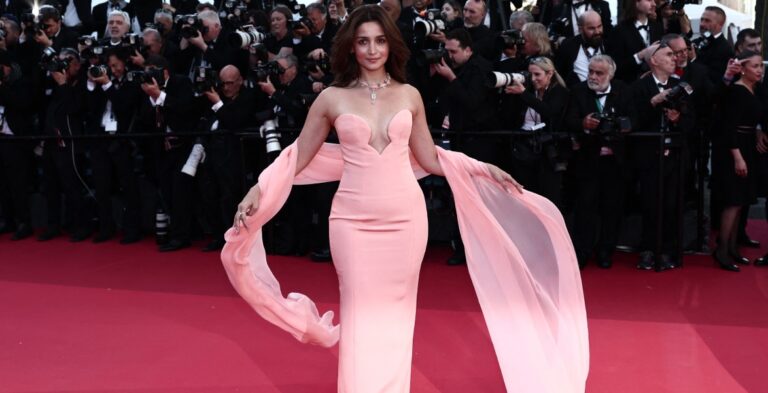
Alia Bhatt Cannes Film Festival, wearing a custom Tarun Tahiliani ivory couture saree-gown that global fashion accounts immediately began reposting. She attended the Bharat Pavilion inauguration. She walked the red carpet in a dramatic gown. She gave an interview to The Hollywood Reporter India in which she said something genuinely bold about Indian cinema. She returned to Mumbai with Ranbir Kapoor looking effortlessly stylish. And she replied to a troll with a single line that became one of the most celebrated celebrity responses of 2026.
By any measure, it was a successful Cannes.
And yet: the internet spent most of the past week arguing about it.
The arguments were layered, contradictory, and occasionally unhinged. They touched on fashion, paparazzi dynamics, feminist hypocrisy, Western validation, Karan Johar, Ranbir Kapoor’s Animal, the L’Oréal controversy, Aishwarya Rai’s PR team (allegedly), and the broader question of what Indian celebrities are supposed to achieve at a French film festival.
Here is the complete story — every strand of the debate, honestly untangled.
First: What Alia Actually Did at Cannes 2026
Let’s establish the facts before we get to the arguments, because several of the debates were based on misreadings of what actually happened.
What Alia wore: Two standout looks. First, for the Bharat Pavilion inauguration, a custom ivory couture ensemble by Tarun Tahiliani — a saree-gown silhouette featuring a structured corseted bodice with a deep sweetheart neckline, intricate tonal embroidery with floral motifs, and the specific architecture of Indian craft meeting modern couture. Fashion outlets described it as “peak modern Maharani energy” and “India successfully exporting silhouette recognition.” Second, on the main red carpet, a dramatic gown that photographed beautifully against the Cannes light.
Why she was there: To represent a beauty brand — specifically L’Oréal Paris, whose India ambassador appearances at Cannes have been a fixture of the festival’s Indian celebrity presence for years. Not as a filmmaker. Not with a film in competition. As a brand ambassador.
What she said: In an interview with The Hollywood Reporter India, she made a direct, clearly considered argument about Indian cinema’s relationship to gender. She called for “gender-agnostic” filmmaking — movies where the story is the star, not the gender of whoever’s leading it.
“Why do we have to alienate anybody? Whether a film has a man or a woman at its centre should be irrelevant. What should matter is the storytelling.”
She referenced the global success of Barbie and the anticipated Devil Wears Prada 2 as examples of female-driven stories that attract enormous audiences. She acknowledged the industry statistic that roughly 75% of India’s movie-going audience is male — and questioned whether that figure should dictate the kinds of stories being told.
What happened on the red carpet: A clip went viral. We’ll get to that.
Controversy #1 — The Photographers Clip: What Actually Happened
The incident that first set the internet alight was a short video clip from the Cannes red carpet that circulated with the caption claiming Alia Bhatt was “ignored” by photographers while posing.
In the clip, Alia is posing on the carpet while a section of photographers appears to be looking elsewhere — some at another celebrity arriving, some adjusting equipment, some simply not photographing her at that specific moment. The clip was shared widely with commentary ranging from “she got a reality check” to “this is humiliating” to “nobody cared.”
The internet response was swift and divided along predictable lines:

The reality — as writer Shunali Khullar Shroff pointed out in a widely shared Instagram post — is that Cannes red carpets are often chaotic and people were attaching unnecessary meaning to a brief moment involving distracted photographers. The photographers who appeared to be looking elsewhere were doing so because the red carpet has simultaneous arrivals and a shifting scrum of camera positions. At no point did Alia Bhatt leave the carpet without being photographed. The images exist. They are everywhere. Global fashion accounts were reposting her saree-gown within hours.
The “ignored” narrative was, largely, a manufactured one — built from a decontextualised clip, spread by people who were already disposed to believe it, and then amplified by the specific internet tendency to celebrate moments where successful women appear to be “brought down a notch.”
That last part is the uncomfortable observation that Shunali Khullar Shroff’s post made directly, and that several commentators echoed: the enthusiasm with which some sections of the internet embraced the “ignored” narrative said more about their relationship to Alia Bhatt’s success than about anything that happened on a red carpet in Cannes.
Alia’s Response: The Three Words That Won the Internet
Here is where the story gets beautiful.
After the clip went viral, a user commented on Alia Bhatt’s own Cannes Instagram post: “Nobody noticed you.”
Alia Bhatt replied:
“Why pity love? You noticed me :)”
That was it. Her response quickly went viral, with fans praising her for handling the negativity gracefully.
Five words. A smiley face. The complete deflation of a troll who had put significant energy into a comment designed to wound, answered with such casual, precise confidence that the only possible response was silence.
It also contained a genuine logical point — the troll proved their own premise wrong by commenting. If nobody noticed her, the troll, sitting at their device composing a dismissive comment about her Cannes post, had definitely noticed her. The circularity is airtight. The smile at the end made it devastating.
Within hours, “Why pity love? You noticed me” was being shared as a template for responding to online negativity, appearing in Instagram bios, and generating genuine admiration from people who had previously been neutral or even skeptical about Alia Bhatt’s public persona.
Controversy #2 — The Gender Speech and the Animal Elephant in the Room
The second — and more substantive — debate was about Alia Bhatt’s interview statement calling for gender-agnostic Indian cinema.
The argument itself is coherent and defensible. She pointed towards the global success of films led by women, referencing titles like Barbie and The Devil Wears Prada 2, and argued that audiences across the world have embraced female-driven stories, making it important for Indian cinema to rethink old assumptions around commercial success.
Many people agreed. The argument is not new — female filmmakers, female stars, and critics have been making versions of it for years. Alia Bhatt is one of India’s most commercially significant female leads. Her films — Gangubai Kathiawadi, Highway, Raazi, Darlings — have consistently demonstrated that women-led stories can generate critical acclaim and commercial returns. She has skin in this game. It is not a performative position.
But then came the irony that the internet, with its keen nose for contradiction, could not resist pointing out.
While Alia Bhatt raises these questions at one of the world’s most prestigious film festivals, her husband Ranbir Kapoor’s last major release was Animal, Sandeep Reddy Vanga’s polarising, testosterone-soaked blockbuster that became a massive box office phenomenon. The film was everything Alia seems to be arguing against: unapologetically built for and around male fantasy, generating fierce debate about exactly the kind of gendered filmmaking she is now questioning on a global stage.
The “Animal irony” criticism is superficially satisfying but intellectually weak. Being married to an actor does not mean you endorse every creative and commercial choice he makes. Alia Bhatt being a producer and actress who advocates for gender-agnostic storytelling is entirely consistent with her husband choosing to lead a film that was its opposite. Marriages are not creative manifestos. People who are married have individual views.
The criticism that landed more meaningfully was the one that asked: is calling for gender-agnostic cinema at Cannes, while representing a beauty brand rather than bringing a film to the festival, the most effective platform for this argument? Is it a genuine creative position or a sophisticated piece of brand positioning?
That question does not have a clean answer. Both can be true simultaneously.
Controversy #3 — The L’Oréal Question and Western Validation
Alia Bhatt showed up at Cannes 2026 with a hand-painted Indian designer gown, a dupatta-draped red carpet moment, and a L’Oréal campaign controversy trailing behind her.
The L’Oréal dimension of Alia’s Cannes 2026 presence attracted its own debate — specifically around the broader question that writer Shunali Khullar Shroff raised about Indian celebrity culture at Cannes and its relationship to Western validation.
The argument goes: Indian celebrities attend Cannes as brand ambassadors for international beauty companies, receive extensive coverage as if they are attending as filmmakers, and the coverage implicitly frames a French festival’s attention as a form of legitimacy that should be earned domestically through the quality of one’s work. This framing devalues the incredible achievements of Indian cinema and artists and implies that Cannes approval is more meaningful than Indian audience approval.
This is a fair critique that applies equally to almost every Indian celebrity who attends Cannes as a brand ambassador. It has been made before. It will be made again next year. Its specific application to Alia Bhatt in 2026 is not obviously more justified than its application to any other Indian celebrity who has attended the festival in a brand capacity.
What does separate Alia’s Cannes from pure brand appearances: she actually spoke substantively about Indian cinema. She did not simply pose and promote skincare. She used the platform to make an argument. Whether you agree with the argument is a separate question from whether engaging with it was a legitimate use of the Cannes platform. It was.
How the Defences Responded
Amid the growing chatter, writer Shunali Khullar Shroff shared a detailed Instagram post defending Alia Bhatt and criticising the internet’s reaction to the viral clip. The post argued that Cannes red carpets are often chaotic and that people were attaching unnecessary meaning to a brief moment involving distracted photographers. The original Instagram post defending Alia argued that the internet often seems eager to celebrate moments where successful women appear to be “brought down a notch.” It also questioned society’s obsession with Western validation, especially when it comes to Indian celebrities appearing on global platforms.
Soni Razdan — Alia’s mother, actress and writer — also spoke publicly. Actor Soni Razdan has spoken out after her daughter Alia Bhatt became the subject of online trolling following her appearance at the 79th Cannes Film Festival, saying that social media has a lot of hate.
Multiple other industry figures and commentators pointed out that the specific intensity of the online response to Alia’s Cannes appearance reflected something beyond normal celebrity criticism — a pattern of particularly sustained negative attention directed at her that goes back several years and has its roots in the specific resentments that attach to very successful people who arrived at that success through what some perceive as advantaged pathways (the Karan Johar connection, the filmmaker father, the Bollywood family).
The Deeper Question: Why Is Alia Bhatt Such a Specific Target?
Alia Bhatt occupies a particular position in the Bollywood ecosystem that makes her unusually vulnerable to the specific type of online hostility she received at Cannes. She is:
| Factor | Why It Creates Hostility |
|---|---|
| Genuinely very talented | Creates resentment from those who want her to fail and then can’t explain the performances away |
| Heavily associated with Karan Johar | A section of Bollywood’s internet audience has strong feelings about the perceived nepotism of that ecosystem |
| Married to Ranbir Kapoor | Draws in the entire Animal fandom’s complicated feelings about gender in Bollywood |
| National Award winner | Her wins are persistently questioned by people who feel other performances were more deserving |
| Very successful commercially | Her success makes the “nobody noticed her” narrative feel more satisfying to those who want it to be true |
| Advocates for women’s stories while being very famous | Perceived as preachiness from someone who doesn’t need to fight the battles she describes |
None of these factors, individually or collectively, justify what several users questioned — whether the trolling had gone too far and whether people had crossed personal boundaries. But they explain why Alia Bhatt in particular becomes the focal point of this type of internet energy.
The Honest Verdict: What Cannes 2026 Was Actually About
Alia Bhatt’s Cannes 2026 was, in the objective view: a successful brand appearance, two beautiful fashion moments, a substantive interview that generated real debate, and one of the best troll responses of the year.
The photographers did not ignore her. The pictures of her are everywhere. The saree-gown was genuinely beautiful and generated genuinely significant international fashion coverage.
Her gender-agnostic speech was a real argument, worth having, with a real irony attached to it (the Animal thing) that she has not yet publicly addressed and probably doesn’t need to.
The internet’s response to her Cannes 2026 appearance revealed, as it tends to do, considerably more about the audience than about the subject. The enthusiasm for the “ignored” narrative among people who already disliked her. The Animal gotcha from people who were looking for hypocrisy. The defence from people who correctly noted that a viral clip of distracted photographers is not a geopolitical event.
And somewhere in the middle of all of it: “Why pity love? You noticed me :)”
That is the line that will be remembered from Alia Bhatt’s Cannes 2026. Not the gown, not the speech, not the photographers. The reply. The casual, unanswerable, smiling reply.
“Why pity love? You noticed me :)”
— Alia Bhatt, responding to “Nobody noticed you” on Instagram, Cannes 2026
That is Alia Bhatt in 2026. Whatever you think of her. Whatever the internet was arguing about. She noticed herself. That, apparently, is enough.
What do you think — did Alia Bhatt’s Cannes 2026 appearance deserve the backlash it received? And is her gender-agnostic cinema argument fair given the Animal irony? Drop your honest take in the comments. 👇
Outlook India — Alia Bhatt Calls for Gender-Agnostic Storytelling at Cannes 2026
Sunday Guardian Live — Soni Razdan Reacts After Alia Bhatt’s Cannes Trolling
Free Press Journal — Alia Bhatt’s Gender Agnostic Statement Receives Mixed Response
The Statesman — Alia Bhatt Uses Cannes 2026 to Push for Gender-Agnostic Cinema
Bollywood Hungama — Alia Bhatt’s Tarun Tahiliani Look at Bharat Pavilion
Alt Bollywood — Alia Bhatt’s Cannes 2026 Saree Look Breakdown
Asia News Network — Stop Chasing the Male Audience: Alia Bhatt at Cannes 2026
FAQ

Popcorn in hand and a opinion ready — Emily covers movie reviews, box office buzz, and all things cinema at Popcorn Review.

