
📋 In This Article
- Exactly What Arijit Said — His Own Words
- The Border 2 Theory: What the Reddit Post Claimed
- Bhushan Kumar’s Response — Word for Word
- The 2023 Warning Nobody Listened To
- The Armaan Malik Connection
- How the Bollywood Music Payment System Actually Works
- Expert Analysis: Music Biographer Shantanu Mukherjee
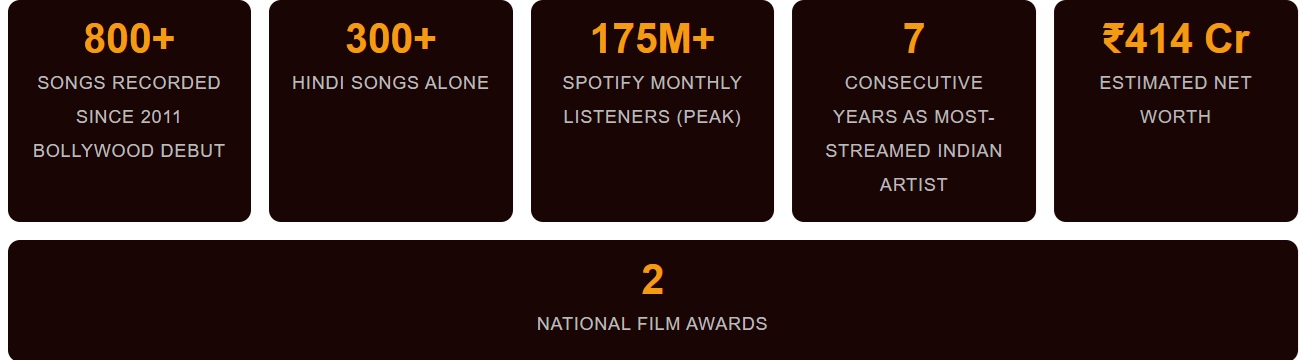
- Arijit’s Career in Numbers
- The Vacuum He Leaves Behind
- FAQs
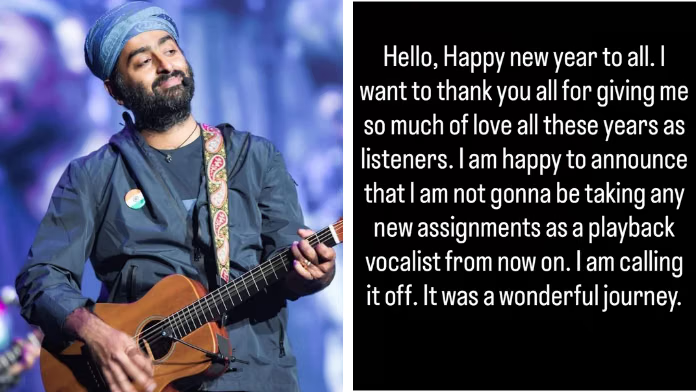
At some point on January 27, 2026, Arijit Singh posted on social media and ended an era in six words: “I am calling it off.” He added: “It was a wonderful journey.” No press conference. No dramatic interview. No named targets. Just a calm, final-sounding statement from the man whose voice had been the emotional soundtrack of Bollywood for over a decade.
Within hours, the internet had found a villain. A Reddit blind item posted late that night claimed it was all Border 2’s fault — that Arijit had been forced to sing a patriotic song he didn’t want to record. Within 24 hours, the internet had found a counter-argument — Bhushan Kumar’s flat denial. Within 48 hours, someone had dug up Arijit’s own words from 2023, in which he had described, with uncomfortable precision, exactly how the Bollywood music industry treats its singers. “You are killing an artist,” he had said then. At the time, nobody in the industry appeared to listen.
This is the article that separates what we actually know — what Arijit said, what Bhushan Kumar said, what music biographer Shantanu Mukherjee told The Federal — from what is speculation, Reddit rumour, and convenient narrative. It is also the article that takes seriously the idea that the most honest explanation for Arijit Singh Retirement Playback Singing was there in plain sight three years before the announcement, if anyone had been paying attention.
Exactly What Arijit Said — His Own Words, Not Paraphrased
The first post: “I am calling it off. It was a wonderful journey.”
What followed in subsequent posts and clarifications built a more complete picture. Arijit gave multiple reasons, and it is important to note that he explicitly said there was not one single reason:

On creative boredom as one reason:

On what comes next:

On pending commitments and upcoming releases:

He also added that he was excited to hear new voices emerge — suggesting his exit carries some element of intentional space-making for the next generation of singers. Three things are clear from these statements: first, this is not a retirement from music, only from film playback. Second, he did not blame anyone publicly. Third, he had been thinking about this for a long time — the language of someone who has made a decision after reflection, not in a moment of anger.
The Border 2 Theory: What the Reddit Post Actually Claimed
Late on the night of January 27, 2026 — the same day as the announcement — a blind item appeared on Reddit that rapidly became the dominant public narrative around Arijit’s exit. It alleged the following:
Social media immediately identified the song in question as Ghar Kab Aaoge — a reprise of the iconic Sandese Aate Hain from the 1997 film Border, recorded for Sunny Deol and Varun Dhawan’s Border 2. Arijit had contributed vocals to the song alongside Sonu Nigam, Vishal Mishra, and Diljit Dosanjh. The specific question asked on Reddit: “If this isn’t true, why wasn’t Arijit present at the Border 2 music program?”
This detail — his absence from the promotional event — added circumstantial texture to the claim. Separately, social media users pointed out that T-Series appeared to be promoting Sonu Nigam and newer singer Aditya Rikhari more prominently than Arijit in recent months, raising questions about the state of the relationship between India’s biggest music label and its biggest voice.
Bhushan Kumar’s Response — Word for Word
Hindustan Times contacted Border 2 co-producer Bhushan Kumar directly. His response left no room for ambiguity:

In a separate statement to India.com, Kumar was equally blunt: “This is all nonsense.”
The 2023 Warning Nobody Listened To
Here is the detail that reframes everything. Three years before his retirement announcement, Arijit Singh had already said exactly what was wrong with the Bollywood music system — and done so with specific, quotable clarity. In 2023, when Armaan Malik publicly stepped back from playback singing, Arijit supported him and described the payment system in terms that were, in retrospect, a preview of his own decision:

He then described the mechanism precisely:
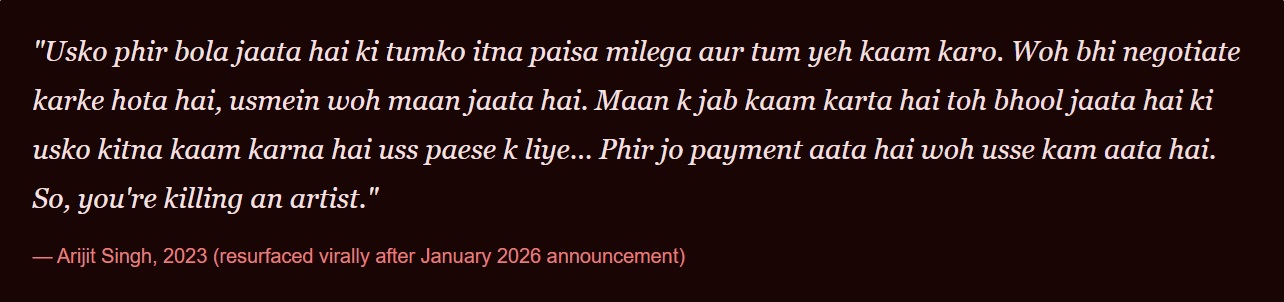
The sequence he described: a singer is told they will be paid a certain amount for certain work. They negotiate, agree, begin. During the process, they lose track of how much work they agreed to do for that fee. When payment arrives, it is less than expected. The singer has already done the work. There is no recourse. And this happens repeatedly, across multiple projects, across years — until it becomes the texture of the entire relationship between a singer and the industry.
He also called for a structural solution — a session payment system where singers are paid for every recording session regardless of whether the final product is used:

Nothing changed. Two and a half years later, he announced he was done.
The Armaan Malik Connection
Arijit Singh’s 2023 support for Armaan Malik is worth examining on its own terms, because it reveals a pattern that the industry prefers not to acknowledge. When Armaan Malik — himself one of Bollywood’s most prominent younger voices — stepped back from playback singing in 2023, he did not offer a detailed public explanation. Arijit’s support was immediate and pointed. He named the system, not individuals. He described outcomes — underpayment, overcommitment, the erosion of artistic control — rather than personalities.
The fact that two of Bollywood’s most significant contemporary singers, at different stages of their careers, arrived at similar conclusions about the same structural problem within two to three years of each other is not a coincidence. It is data. The industry’s response was, essentially, to not respond — to wait for the moment to pass, find other voices to promote, and continue operating as before. Arijit’s 2023 statement resurfacing after his 2026 announcement is the internet’s way of noting that the warning was issued and ignored.
How the Bollywood Music Payment System Actually Works — And Why It Favours Labels
⚠️ How Singers Are Disadvantaged
- No standard session payment structure — every deal is negotiated individually
- Singers rarely own the recordings — copyright sits with the label (typically T-Series, Sony, Zee Music)
- Payment often tied to film release rather than recording completion — delays mean delayed payment
- Scratch vocals (recorded during composition) often used in final product without separate compensation
- No union equivalent of SAG-AFTRA in the Indian music industry to set minimums
- When a star singer’s brand is used to sell a song, the singer does not share in downstream revenue
🏢 Why Labels Hold All the Power
- T-Series alone controls an estimated 35–40% of the Indian music market
- Labels own distribution — a singer who refuses loses access to the largest distribution networks
- Film producers almost always defer to the label’s singer preferences — the label is their distributor
- An individual singer’s leverage is only as strong as their current commercial value — and that fluctuates
- Arijit Singh had maximum leverage. Most singers have almost none.
Arijit Singh’s exit matters more as a structural statement than as a personal one precisely because he had more leverage than almost anyone. He could have continued. He chose not to. For singers with less power — and there are thousands of them — the system he described in 2023 is not a frustration they can act on. It is simply the terms of employment they either accept or exit entirely.
Expert Analysis: What Music Biographer Shantanu Mukherjee Told The Federal
The most substantive external analysis of Arijit’s exit came from Shantanu Mukherjee — former editor-in-chief of Stardust, and biographer of Hema Malini, Mithun Chakraborty, and Sanjay Dutt — in a conversation with The Federal. His perspective is worth quoting at length because it places Arijit in a longer tradition of Indian music:
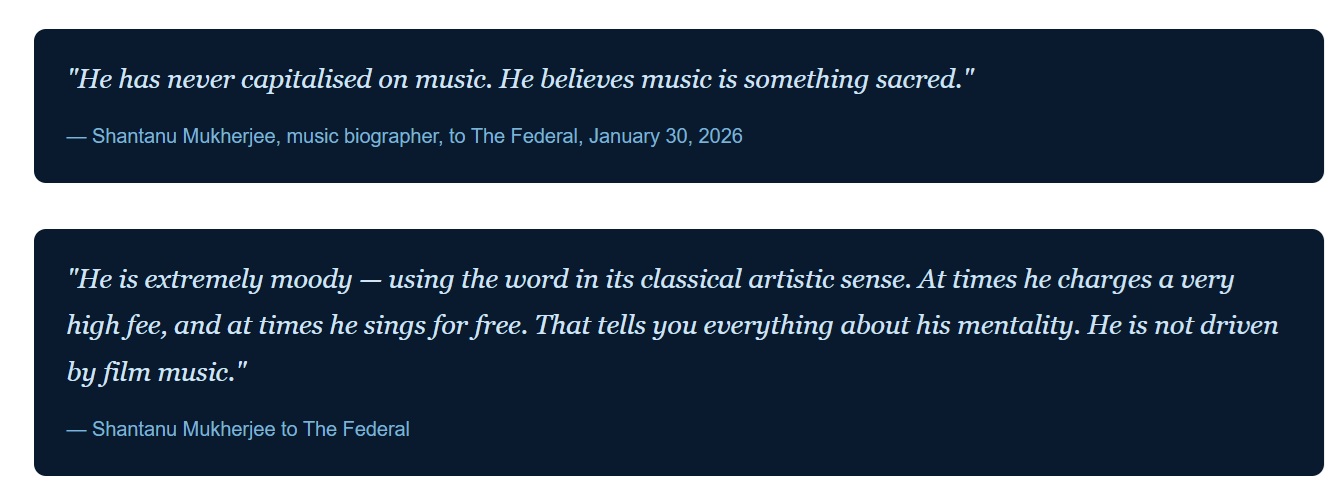
Mukherjee drew a specific and illuminating parallel — between Arijit’s trajectory and the experience of Bade Ghulam Ali Khan and Kishore Kumar:

A female musician who has worked with Arijit described him, in the same piece, as guided by “a higher calling” — someone whose next chapter “would likely be divine.” Mukherjee’s own prediction for the industry: Arijit’s absence will create a vacuum. “When Ranbir Kapoor is on screen, I will miss Arijit’s voice.” And his conclusion: “Playback singing, for him, may have reached its limit. Music, clearly, has not.”
That distinction — between playback singing and music — is the one Arijit himself drew in his own statement. It is the most important sentence in the entire story, and it gets lost in the noise about Border 2. He did not say he was done making music. He said he was done making music for films. For a man who describes music as sacred and himself as “a small little artist,” the film industry may simply have been too small a house for what he actually wants to do.
Arijit’s Career in Numbers
🎵 Career Timeline — Key Moments
| 2005 | Appeared on Fame Gurukul — eliminated early; went largely unnoticed |
| 2011 | Bollywood breakthrough — Tum Hi Ho (Aashiqui 2, 2013) became his signature |
| 2013 | Aashiqui 2 soundtrack dominates; National Film Award for Tum Hi Ho |
| 2016 | Becomes most-streamed Indian artist on Spotify — holds the title 7 consecutive years |
| 2019 | Tottenham Hotspur Stadium concert — 60,000 capacity; record for Indian artist in Europe |
| 2023 | Publicly supports Armaan Malik; warns about payment exploitation (“you are killing an artist”) |
| 2025 | Padma Shri awarded by Government of India |
| Jan 27, 2026 | Announces retirement from playback singing: “I am calling it off” |
| 2026 onwards | Pending commitments to be fulfilled; return to Indian classical music; independent projects |
The Vacuum He Leaves Behind — And Why It Cannot Be Filled by One Voice
Bollywood’s immediate instinct after the announcement was to identify the next Arijit Singh. The names circulated quickly: Jubin Nautiyal, Darshan Raval, Aditya Rikhari, Vishal Mishra. Each is talented. None of them is a structural replacement for someone who recorded 800+ songs across 15 years, in multiple languages, across every genre from romantic to patriotic to devotional — and who did so while maintaining a level of emotional authenticity that made each song feel specifically inhabited rather than technically executed.
Mukherjee’s point about the Kishore Kumar parallel is instructive here. When Kishore Kumar died in 1987, Bollywood did not find a new Kishore Kumar. It found a generation of new voices — Kumar Sanu, Udit Narayan, Sonu Nigam — each of whom filled part of the space, none of whom filled all of it. The vacuum eventually became the new normal, and the industry adapted. It will adapt again. But adaptation is not replacement, and the adjustment period will be visible in Bollywood soundtracks for several years.
The more interesting long-term consequence may be what Arijit himself called for: space for new voices to emerge. When one voice dominates to the degree that his did — accounting for a significant percentage of all romantic playback in Hindi cinema in any given year — there is simply less room for anyone else to establish a distinctive sound. His exit, whatever its immediate causes, creates the conditions for genuine diversity in Bollywood’s sonic palette for the first time in over a decade.
FAQs
What exactly did Arijit Singh say when he quit playback singing?
On January 27, 2026, he posted: “I am calling it off. It was a wonderful journey.” He later clarified there were “several reasons” — citing creative boredom primarily. He stated he plans to return to Indian classical music and will complete pending commitments. He was explicit: he is not retiring from music, only from film playback. Some 2026 releases are still expected from him.
Did Border 2 really push Arijit to quit?
The theory came from a Reddit blind item claiming Arijit was forced to sing Ghar Kab Aaoge — a reprise of Sandese Aate Hain — for Border 2 despite creative disagreements. Bhushan Kumar, Border 2’s co-producer, flatly denied it when contacted by Hindustan Times: “Please call and ask Arijit, it’s all rubbish.” No evidence has been produced to support the forced-participation claim. Most credible analyses point to long-term creative burnout and structural industry frustrations as the real drivers.
What was Arijit’s 2023 “killing an artist” statement about?
In 2023, while supporting Armaan Malik’s step back from playback, Arijit described how the Bollywood music payment system underpays singers: they agree to a fee, do more work than the fee covers, and receive less than agreed. He said: “Jo payment aata hai woh usse kam aata hai. So, you’re killing an artist.” He also called for a structured session payment system. This statement resurfaced virally after his 2026 announcement and is widely seen as the most honest preview of his eventual exit.
Will Arijit Singh completely stop making music?
No. He has been clear: “I won’t stop making music.” He intends to return to Indian classical music, pursue independent projects, and perform live concerts. The retirement is from film playback assignments only. Some releases from existing commitments are still expected in 2026.
What have music industry experts said about his exit?
Music biographer Shantanu Mukherjee told The Federal that Arijit “has never capitalised on music — he believes music is something sacred,” and described him as “not driven by film music.” Mukherjee predicted his absence will create a “vacuum” with few in the new generation able to fill it, specifically noting: “When Ranbir Kapoor is on screen, I will miss Arijit’s voice.” His conclusion: “Playback singing, for him, may have reached its limit. Music, clearly, has not.”
Who can replace Arijit Singh in Bollywood?
No single replacement exists. Names frequently cited include Jubin Nautiyal, Darshan Raval, Aditya Rikhari, and Vishal Mishra. But as with Kishore Kumar’s death in 1987, the industry is more likely to see a generation of voices fill different parts of the space rather than one person claiming the whole. Arijit’s departure may also create room for genuine diversity in Bollywood’s sound for the first time in over a decade — which he himself acknowledged he was excited about.
📲 Follow Popcorn Review for More Bollywood Music & Celebrity News
📸 Instagram 📌 PinterestDaily Bollywood news, OTT releases, South Cinema, and celebrity stories. Follow us so you never miss a story.
🎬 You Might Also Like
- Arijit Singh Retirement: India Just Lost Its Biggest Voice — Full Story
- Actors Who Suddenly Stopped Announcing Films: Real Stories
- Deepika Padukone’s 8-Hour Workday Demand: Spirit, Kalki 2 & the Full Story
- Atlee on Jawan 2 and Don 3: His Exact Words & What’s Actually Happening
- 15 Best Bollywood Suspense Thriller Movies to Watch in 2025–2026
- More Bollywood Coverage →
Sources: Times of India — Arijit’s Statement + Bhushan Kumar · Zee News — Bhushan Kumar Denial · DNP India — 2023 “Killing an Artist” Quote + Reddit · The Federal — Mukherjee Expert Analysis · India.com — Border 2 Theory Breakdown · NewsX — Analysis: Creative Burnout vs Border 2 · Wikipedia — Arijit Singh

Content writer at Popcorn Review, specializing in movie reviews, box office insights, and film analysis. Passionate about bringing cinema stories to life.

