
📋 In This Article
Some news hits you in the chest before your brain has time to process it. That’s exactly what happened on the night of January 28, 2026, when Arijit Singh — 38 years old, Padma Shri awardee, and the most-followed artist on Spotify in the entire world — quietly posted a few lines on social media and, in doing so, announced his retirement from playback singing.
No press conference. No farewell concert. No dramatic industry statement. Just him, his words, and an internet that went silent for about thirty seconds before absolutely losing it.
The Arijit Singh retirement announcement didn’t come at the end of a fading career, or after a controversy, or following years of declining relevance. It came at the absolute peak. Which is what makes it so hard to process — and so deeply, characteristically Arijit.
The Announcement That Changed Everything
It began, fittingly, as a New Year message. Arijit posted on his social media accounts with what seemed like a warm note to fans — until you hit the line nobody was expecting.
“I want to thank you all for the immense love you’ve given me over the years as listeners. I’m happy to share that I will not be taking on any new assignments as a playback vocalist from now on. I’m calling it a day. It has been a wonderful journey.”— Arijit Singh, January 28, 2026
He followed that almost immediately with a second post, which in many ways captures who he is as a person far better than any interview ever has:
“God has been extremely kind to me. I am a lover of good music, and going forward, I will keep learning and creating more on my own as a small artiste. Thank you once again for all your support.”— Arijit Singh, January 28, 2026
“A small artiste.” The man who had just been confirmed as the most-followed musician on the entire Spotify platform — ahead of Taylor Swift, ahead of Ed Sheeran, ahead of every Western pop star on earth — called himself a small artiste. That tells you everything about why people love him the way they do.
The Arijit Singh retirement was confirmed: he would complete existing recording commitments, but would accept no new playback singing assignments going forward. India’s voice had spoken its last line.
Why Did Arijit Singh Really Retire? The Reasons He Gave
In the days that followed the announcement, Arijit did something unusual for a celebrity who’d just made headline news: he actually explained himself. Not in a polished PR statement, but in candid, direct social media posts that felt like he was talking to friends.
He cited three things:
1. Creative Boredom
Arijit admitted he had reached a point of stagnation within the Bollywood playback system — a place where creativity doesn’t always thrive. He said he was bored, not of music itself, but of the cycle of recording for films on someone else’s schedule, under someone else’s creative vision, singing someone else’s emotional brief. After more than a decade of this, at 300+ songs deep, that makes a strange kind of sense.
2. The Desire to Return to His Roots
He was direct about what he wanted to do instead: go back to Indian classical music, the foundation on which he built everything. His training under guru Rajendra Prasad Hazari had always stayed close to his heart — and now, for the first time in years, he’d have the time and freedom to return to it properly. As he put it: “I wanna go back to making music. I wanna start again.”
3. Making Space for New Voices
Perhaps the most generous reason — and the most telling — was his desire to step aside so newer singers could find their footing. He said he was excited to hear a new voice come up and give him “real motivation.” For an artist who had dominated Hindi film music so comprehensively for a decade that music directors would simply default to calling him first, this wasn’t just humility. It was self-awareness.
From Reality TV Dropout to Spotify’s No. 1: The Arijit Singh Story
To understand the full weight of the Arijit Singh retirement, you need to know where he came from — because it wasn’t a straight line, and it wasn’t a comfortable one.
Born on April 25 in Jiaganj, Murshidabad district, West Bengal. Grew up in a family with deep roots in music — his maternal aunt trained in classical music, his grandmother sang, his uncle played the tabla, and his mother both sang and played tabla. Music wasn’t a hobby in the Singh household; it was the air.
Participated in the reality singing competition Fame Gurukul. He didn’t win. He went home. And then he spent the better part of six years working in the background — as a session musician, a background vocalist, learning the craft from the inside out while the industry didn’t yet know his name.
Made his Hindi cinema playback debut with Phir Mohabbat for the film Murder 2. A quiet beginning for what would become anything but a quiet career.
Everything changed with Tum Hi Ho from Aashiqui 2. The song went everywhere. His first Filmfare Award for Best Male Playback Singer followed. Within months, every major music director in Bollywood wanted him. The decade of dominance had begun.
Won two National Film Awards for Best Male Playback Singer — first for Binte Dil from Padmaavat, then for Kesariya from Brahmāstra: Part One — Shiva. The second is now his most-streamed song on Spotify, with over 683 million plays.
Received the Padma Shri from the Government of India — one of the country’s highest civilian honours. Headlined Tottenham Hotspur Stadium in London, becoming the first Indian musician to do so at a UK stadium. The sold-out show made global headlines.
Became the most-followed artist on Spotify globally, surpassing Taylor Swift and Ed Sheeran. Hit 175+ million followers. Declared the most-streamed Indian artist on Spotify for seven consecutive years (2019–2025). And then, retired.
The Songs That Defined a Generation
The tricky thing about writing a list of Arijit Singh’s defining songs is that there are too many of them. He has recorded somewhere between 300 and 700 songs across Hindi, Bengali, Marathi, Tamil, Telugu, and Malayalam cinema. Narrowing it down is almost unfair. But if you had to point to the ones that genuinely changed the emotional fabric of a decade of Bollywood — these are it.
🎵 The Essential Arijit Singh — 10 Songs That Hit Different
- Tum Hi Ho — Aashiqui 2 (2013)The beginning of everything
- Channa Mereya — Ae Dil Hai Mushkil (2016)Heartbreak as high art
- Agar Tum Saath Ho — Tamasha (2015)657M+ Spotify streams
- Kesariya — Brahmāstra (2022)683M+ streams · National Award
- Tujhe Kitna Chahne Lage — Kabir Singh (2019)645M+ streams
- Raabta — Agent Vinod (2012)The song before the storm
- Apna Bana Le — Bhediya (2022)609M+ streams
- Gerua — Dilwale (2015)SRK + Arijit = unmissable
- Ae Dil Hai Mushkil — Ae Dil Hai Mushkil (2016)Yearning personified
- Shayad — Love Aaj Kal 2 (2020)319M+ streams
What made these songs special wasn’t just Arijit’s voice — it was what he did between the notes. The pauses. The slight breaks in breath that sounded like someone trying to hold it together. The way he’d drop just a fraction in volume at the most emotionally loaded line, instead of going bigger. He understood that restraint, in the right hands, is the most powerful tool a singer has.
The Numbers: Just How Big Was Arijit Singh?
Sometimes the only way to make people understand scale is to just line up the numbers and let them speak.
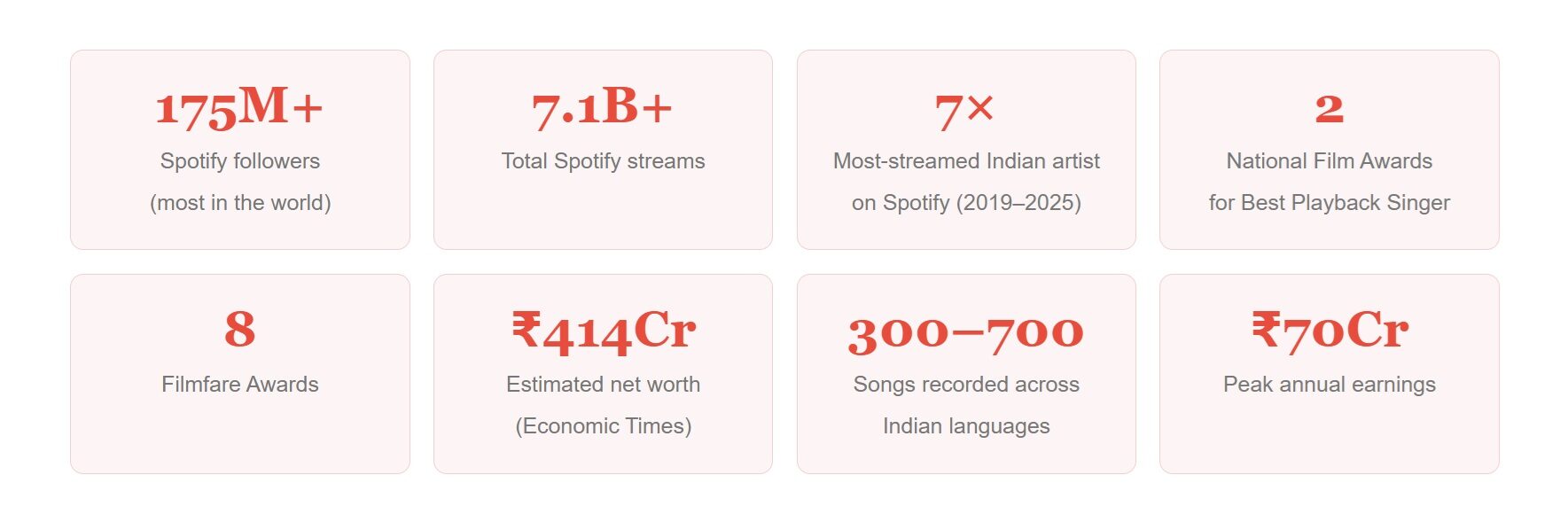
To put the Spotify number in perspective: as of early 2026, every artist in the global Spotify top ten has over 80 million followers, and the top nine all exceed 100 million. Arijit Singh sits at number one with over 170 million — ahead of Taylor Swift and every other artist on the platform. He did this not with a global pop machine behind him, not with billion-dollar marketing campaigns, but by singing in Hindi, Bengali, and Tamil to an audience that found him on their own terms.
His Last Song as a Playback Singer: Matrubhumi
There is something quietly perfect about the way Arijit Singh’s playback career ended. His final song — Matrubhumi, a patriotic track from Salman Khan’s upcoming film Battle of Galwan — was released during Republic Day week, just days before his retirement announcement. A tribute to India’s soldiers. Released on the day India celebrates its constitution.
This is also significant for another reason: Salman Khan and Arijit Singh had a famously complicated relationship. Years ago, an off-mic moment at an awards show turned into a public falling out, and for years, Arijit’s voice was conspicuously absent from Khan’s films. That they reconciled — that Matrubhumi exists at all — means his playback career ended with a resolved note, not a sour one. That matters.
So What Comes Next for Arijit Singh?
Here is the thing the retirement headline misses: Arijit Singh is not disappearing. He made that very clear in the weeks following the announcement, in a warm, long note to fans on X that felt more like a letter than a social media post.
“Although I have stopped taking new assignments, the list of pending songs are not less you know. I will have to complete a lot of songs. Don’t involve into explaining people, how many times will you? there are so many unfinished songs, they are gonna keep releasing until they are done. Hello beautiful people! I just want to tell you all that I love you. Thank you so much for your kindness in this ruthless world.”— Arijit Singh, February 24, 2026 (on X)
So what can we actually expect? Quite a bit, as it turns out:
Pending Bollywood Songs (Throughout 2026)
Reports suggest Arijit has over 30 complete and incomplete unreleased tracks sitting with various composers. Confirmed upcoming releases include songs from Dhurandhar 2, Border 2, and his Salman Khan track from Battle of Galwan. There’s also a track from Ek Din, starring Junaid Khan and Sai Pallavi. His voice will keep showing up in cinemas throughout the year.
Independent Music Under Oriyon Music
Arijit’s own label, Oriyon Music, is where his creative future now lives. This is where he has full control — no film schedules, no composer briefs, no marketing departments. Expect more experimental, personally driven music that probably sounds nothing like what Bollywood has been asking of him for a decade.
A Return to Indian Classical Music
He was trained in it. He loves it. And now he has time for it. His guru, Rajendra Prasad Hazari, instilled in him a balance between classical and modern training — a balance that Bollywood’s demands may have tilted in one direction. Expect him to tilt it back.
Possible Directorial Work
In 2018, Arijit quietly directed a Bengali film called Sa — a lyrical coming-of-age story about a young boy’s relationship with music. It passed under most people’s radar, but it revealed something about him: he thinks like a storyteller, not just a singer. Reports suggest a second directorial project may be in the works.
How India — and the World — Reacted to the Arijit Singh Retirement
The honest answer is: slowly at first, and then all at once.
The initial reaction in the comments sections of his posts was disbelief. People genuinely could not reconcile “most-followed artist on Spotify” with “retirement.” These two facts existed in their minds in separate rooms and refused to be introduced to each other.
Then came the tributes. Amul — India’s most beloved dairy brand and the maker of the most culturally accurate butter-art tributes in the country — released an illustrated homage. Music platforms curated “Forever Arijit” playlists overnight. Radio stations dedicated entire broadcast days to his catalogue. Streaming banners went up. Fan accounts that had been posting lyric edits for years suddenly shifted to posting memories.
Social media timelines became something between a memorial wall and a celebration. The trending hashtags weren’t angry or confused. They were grateful — which says a lot about how Arijit had always conducted himself. He never gave anyone a reason to be bitter about him. So when it was time to say goodbye, nobody was. They were just sad.
Industry colleagues, music directors, and actors who had worked with him for years were notably quiet in a respectful way — few wanted to make his retirement about themselves. That restraint, too, felt like a tribute in its own right.
The Legacy of Arijit Singh: What He Changed About Indian Music
This is the part that will take years to fully understand, because you can’t see the size of a wave until you’re standing at some distance from it.
But here is what we can say now: before Arijit Singh, the dominant aesthetic in Bollywood playback singing tilted toward power — big voices, ornate flourishes, technical displays of range. After Tum Hi Ho in 2013, the industry pivoted. Quietly, comprehensively, and irreversibly. Vulnerability became valuable. The crack in the voice became a feature, not a flaw. Restraint became the new ambition.
Music directors who had spent careers writing for expansive, theatrical voices started writing smaller, more intimate melodies — because they knew Arijit would fill the space between the notes with something no technical singer could manufacture. He didn’t just record the songs that defined the 2010s. He changed the conditions under which those songs were written.
He also proved something that the global music industry is only just starting to acknowledge: that an Indian artist singing in Hindi could become the most followed musician on the most important streaming platform in the world, without crossing over to English, without chasing Western validation, without changing a single thing about what he does. He just kept being himself, and the world came to him.
The Arijit Singh retirement doesn’t end that story. It seals it. The songs are permanent. The records are permanent. The memories that millions of people attached to his voice — the heartbreaks soundtracked by Channa Mereya, the late-night drives with Agar Tum Saath Ho on loop, the weddings where Tum Hi Ho played during the pheras — those are permanent too.
He’s 38. He’s done more in his career than most artists accomplish in three lifetimes. And now he wants to go back to being a small artist, learning, creating, doing things his own way.
Honestly? Good for him.
FAQs: Arijit Singh Retirement
Has Arijit Singh officially retired from playback singing?
Yes. In January 2026, Arijit Singh posted on Instagram and X confirming he will no longer take on new playback singing assignments. He will complete existing commitments, meaning songs already recorded before his announcement will still be released throughout 2026 and possibly into 2027.
Why did Arijit Singh retire?
He cited creative boredom with the Bollywood playback system, a desire to return to Indian classical music and independent music-making, and a wish to create space for new voices to emerge. He said he wants to go back to being a “small artist” with more creative freedom.
Will Arijit Singh still release music after his retirement?
Yes. He has confirmed over 30 unreleased tracks still pending with various composers, which will continue dropping throughout 2026. He also plans to make independent music under his label Oriyon Music, and may return to Indian classical music performance.
What was Arijit Singh’s last playback song?
Matrubhumi, a patriotic track from Salman Khan’s upcoming film Battle of Galwan, released during Republic Day week 2026 — fitting, given the subject matter and the reconciliation it represented between the two.
How many Spotify followers does Arijit Singh have?
As of March 2026, Arijit Singh is the most-followed artist on Spotify globally, with over 175 million followers — ahead of Taylor Swift and Ed Sheeran. He became Spotify’s most-followed Indian artist for seven consecutive years (2019–2025) and crossed the 100 million follower mark before any other Indian artist.
What is Arijit Singh’s net worth?
According to The Economic Times, Arijit Singh’s net worth is approximately ₹414 crore. He earned an estimated ₹70 crore annually at the peak of his career, from playback fees (₹8–25 lakh per song), live concerts (up to ₹14 crore per show), streaming royalties, and brand endorsements.
Did Arijit Singh win a Padma Shri?
Yes. Arijit Singh was conferred the Padma Shri — one of India’s highest civilian honours — by the Government of India in 2025.

Popcorn in hand and a opinion ready — Emily covers movie reviews, box office buzz, and all things cinema at Popcorn Review.

