
📋 In This Article
- The 2025 Numbers: How Bad Was It, Really?
- 2025’s Biggest Losers: The Films That Cost Studios Most
- Franchise Fatigue: Now Confirmed by Data
- The Three Structural Shifts Changing Hollywood Forever
- The Netflix–Warner Bros. Merger: Cinema’s Existential Threat
- Paramount Sold. NBCU Split. The Studio System is Restructuring
- The 2026 Slate: Which Films Carry the Most Risk
- Reasons for Hope: What Could Save 2026
- The Bollywood Parallel: India’s Own Box Office Anxiety
- FAQs
Big Films Studios Are Nervous heading into 2026 is not abstract. It is not the vague anxiety of an industry worried about changing tastes or shifting demographics. It is the specific, data-backed alarm of an industry that missed its own lowered targets for the second consecutive year, watched 17,000 of its workers lose their jobs in a single calendar year, saw its most powerful streaming competitor announce an $82.7 billion bid to acquire one of its most historic studios — and then looked at its 2026 release calendar, packed wall-to-wall with franchise sequels and IP extensions, and asked itself a question it has been avoiding for years: what if audiences simply stop showing up?
This is not a story about movies being bad. Some of the best-reviewed films of 2025 performed adequately. The problem is more structural, more permanent, and more resistant to solution than any single good film can address. Hollywood built a system that depends on audiences choosing the cinema over everything else competing for their attention and money. That system is breaking down. The numbers say so. The studio executives know it. And 2026 — with its enormous slate of expensive franchise films — is the year that will determine whether the industry finds a new model or simply accelerates toward a reckoning it has been deferring since 2020.
The 2025 Numbers: How Bad Was It, Really?
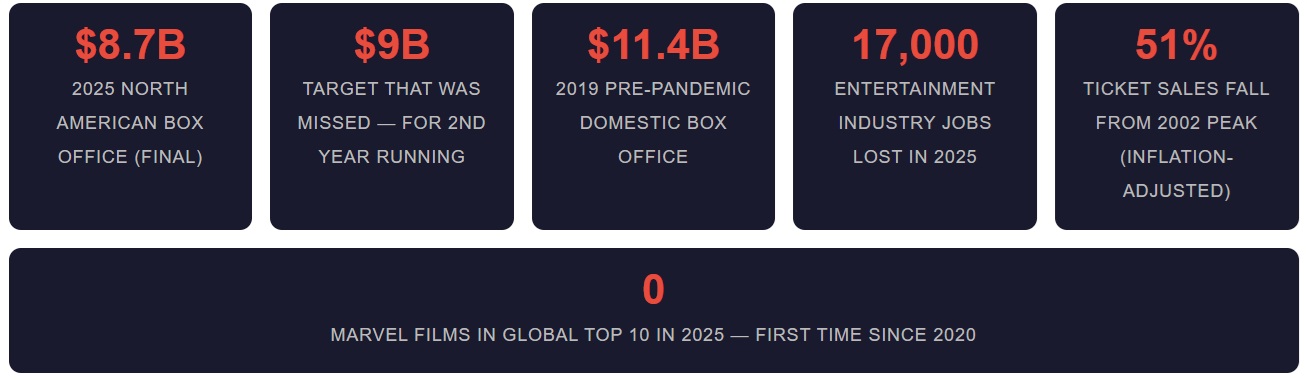
The North American domestic box office ended 2025 at approximately $8.7 billion. Before the pandemic, the domestic market routinely generated $10–11 billion annually. The industry had spent several years treating $9 billion as the baseline target for recovery — not ambition, but bare minimum. Missing it twice in a row is no longer deniable as a blip.

What makes the $8.7 billion figure even more alarming is how it was reached. The revenue increase over 2024 was not driven by more people going to the cinema. It was driven by higher ticket prices and the growth of premium formats — IMAX, PLF, Dolby Cinema. Fewer people are going to the movies. They’re just paying more when they do. That is not a recovery. That is consolidation.

CNBC’s February 2026 analysis put the structural issue plainly: there were 112 wide releases in 2025 — still 6.6% below 2019 levels — but box office still lagged more than 20% behind pre-pandemic figures. The mid-budget film — dramas, comedies, romantic comedies and thrillers in the $15–90 million range — has almost entirely migrated to streaming. What remains in theatres is almost exclusively franchise tentpoles. And those tentpoles are increasingly failing.
2025’s Biggest Losers: The Films That Cost Studios Most
| Film | Studio | Estimated Loss | Notes |
|---|---|---|---|
| Snow White (live-action remake) | Disney | $200M+ | Social media boycott + poor reviews + pre-release controversy. Disney’s worst remake performance. |
| Joker: Folie à Deux | Warner Bros. | $100M+ | Musical format alienated the first film’s fanbase. Critical and commercial disaster. |
| Furiosa: A Mad Max Saga | Warner Bros. | $100M+ | Prequel that audiences weren’t asking for. George Miller’s vision vs commercial reality. |
| Black Adam | Warner Bros. / DC | $100M+ | DC’s failed attempt to launch a new franchise anchor. DCU reset followed. |
| Wicked: For Good | Universal | Significant underperformance | Earned under $350M domestic vs original’s $475M domestic. Oversaturation concerns. |
| Captain America: Brave New World | Disney / Marvel | Significant underperformance | Marvel’s post-Endgame credibility problem continues. No film in global top 10 in 2025. |
| Elio | Disney / Pixar | Significant underperformance | Pixar’s original IP struggles at the box office vs franchise sequels. |
| Thunderbolts | Disney / Marvel | Below expectations | Marvel’s audience trust problem requires more than a single good film to fix. |
The pattern across these losses is not random. Films that deviated from audience expectation (Joker 2), films that arrived amid pre-release controversy (Snow White), films that required knowledge of extensive preceding content (multiple Marvel titles) — all performed below the financial thresholds needed to justify their production and marketing costs. The industry’s response to each individual failure was to explain it as a one-time exception. The accumulation of exceptions has become a trend.
Franchise Fatigue: Now Confirmed by Data, Not Just Feeling
For years, “franchise fatigue” was discussed as a risk — a theoretical future state that the industry might eventually face. The 2025 numbers confirm it has arrived. Paul Dergarabedian, head of marketplace trends at Comscore, described the studio calculation to CNBC:

The problem is that the bet is increasingly not paying off. Variety’s year-end analysis noted that “many of the movie business’s biggest franchises are showing signs of oversaturation or fatigue.” Even Avatar: Fire and Ash — James Cameron’s third film in the series — while posting strong IMAX numbers ($140 million on IMAX screens globally, a record), tracked below Avatar: The Way of Water’s comparable pace. If even Hollywood’s most reliable franchise is showing diminished returns, the warning sign is hard to dismiss.
The Three Structural Shifts Changing Hollywood Forever
📺 1. The Streaming Migration of Mid-Budget Films
- Films in the $15M–$90M range have almost entirely left theatres for streaming
- This removes the “mid-tier” that once gave audiences variety and studios safety nets
- What remains in cinemas: massive tentpoles only — all-or-nothing economics
- A24’s Marty Supreme: $39M gross on $70M budget — that math doesn’t work for theatrical
- Sherrill (Alamo Drafthouse): “Give me 20 more of the stuff that’s meaningful for people, not just 20 more movies”
🎟️ 2. The Ticket Price Ceiling Problem
- Revenue held up partly because ticket prices rose — not because more people attended
- Premium formats (IMAX, PLF, Dolby) now critical to hitting revenue targets
- But premium screens are finite — you cannot IMAX your way to $10B if attendance keeps falling
- Audiences who feel priced out don’t return — they reformat their habits toward streaming
- Once streaming becomes the habit, the theatrical window becomes an inconvenience
🤖 3. The AI and Social Media Volatility Factor
- Films can go viral for the wrong reasons months before release — killing the campaign
- AI usage accusations (visual effects, writing) now trigger audience boycotts
- Social media backlash moves faster than any studio’s crisis PR team
- CNBC noted: “High pre-release digital interaction correlates strongly with opening weekend” — but negative interaction correlates even more strongly with avoidance
- Snow White’s pre-release social controversy contributed materially to its underperformance
🌏 4. The China Wild Card
- 2025’s No. 1 global film: Ne Zha 2 (Chinese animated sequel, $2.1B+ worldwide)
- China embraced Zootopia 2 and Avatar: Fire and Ash — but Hollywood access to China remains unpredictable
- The Chinese domestic film industry now functions independently of Hollywood at scale
- Films that once relied on China for profitability can no longer assume that market
- Studios building 2026 budgets must treat China revenue as upside, not baseline
The Netflix–Warner Bros. Merger: Cinema’s Existential Threat
Late 2025 produced what The Wrap called “the looming merger of market-leading Netflix with legacy brand Warner Bros.” Netflix announced an $82.7 billion deal to acquire Warner Bros. The deal is pending regulatory approval. Its implications for cinemas are significant enough that theatre chains have been described as viewing it as “nothing short of an existential threat.”
The specific threat: Netflix co-CEO Ted Sarandos has signalled that theatrical windows will “evolve” in a “more consumer-friendly direction.” He told Wall Street that he believes current windows “are too long.” The entertainment industry translation is precise: Netflix intends to shorten the period during which films play exclusively in cinemas before becoming available on its platform. A shortened window removes the audience’s primary incentive to buy a ticket rather than wait.

Paramount Sold. NBCU Split. The Studio System Is Restructuring in Real Time
The Netflix-WB deal is not the only major ownership change reshaping Hollywood. The Wrap’s January 2026 analysis documented a cascade of structural changes:
🏛️ Hollywood’s Ownership Restructuring — 2025–2026
| Paramount Global | Acquired by Oracle co-founder Larry Ellison’s Skydance Media. Involved prolonged negotiations and, per The Wrap, “functional blackmail by the Trump administration.” Re-merged with CBS as a new entity. |
| Warner Bros. | Pending $82.7B acquisition by Netflix. Ted Sarandos as presumed head post-merger. Regulatory approval ongoing as of March 2026. |
| NBCUniversal | Split from its declining cable assets. Cable properties rebranded as Versant. NBCU retains theatrical and streaming arms. |
| Tech vs Legacy Power | The Wrap notes: “Tech companies Netflix, Apple and Amazon now outweigh Disney, NBCU, Paramount and whatever Warner Bros. will be when the sale shakes out.” The centre of power in Hollywood has shifted from legacy studios to tech platforms. |
| Jobs Lost | 17,000 entertainment industry jobs in 2025 alone. Industry contraction continues. The ecosystem of agents, managers, below-the-line workers, and production support staff has shrunk significantly. |
The Wrap’s industry columnist wrote with unusual bluntness: “A century-old business model has been disrupted, permanently, by the rise of streaming and tech’s takeover of what was once known as Hollywood.” This is not pessimism. It is the accurate description of a shift that has been happening for a decade and is now reaching its conclusions.
The 2026 Slate: Which Films Carry the Most Risk
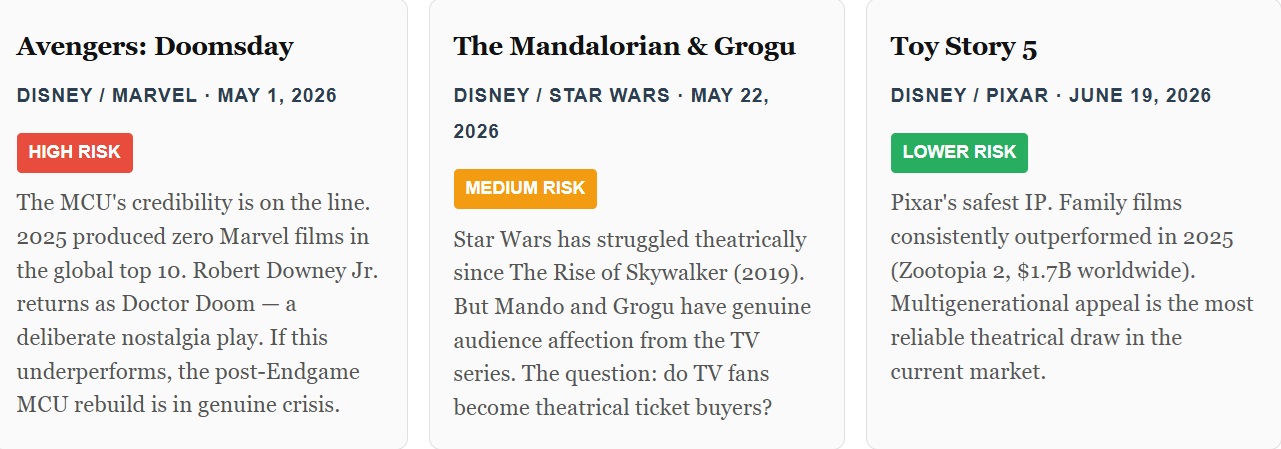
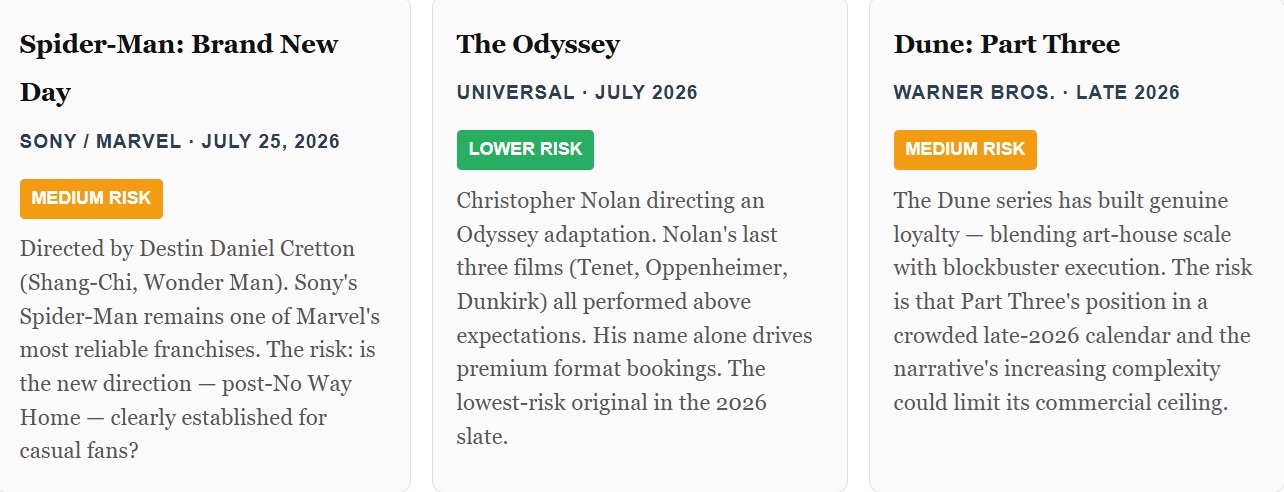
Against this backdrop, the 2026 theatrical slate is almost entirely franchise-driven. Deadline projects $9 billion domestic for 2026 — but cautions the entire projection rests on the franchise films performing. Here is how the major releases stack up in terms of risk:
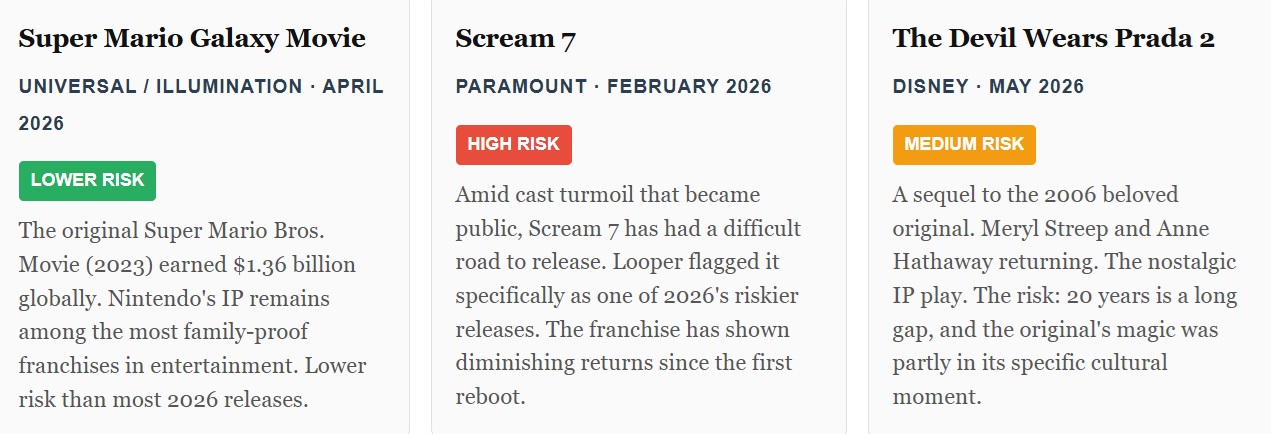
Reasons for Hope: What Could Actually Save 2026
The picture is not entirely bleak. Deadline projects $9 billion domestic for 2026 on the strength of the franchise slate — and a few genuine reasons for optimism exist alongside the structural concerns.
First: premium formats are growing. IMAX hit a record $1.28 billion globally in 2025. Premium large-format screens continue to provide the kind of event-cinema experience that streaming cannot replicate. Nolan’s The Odyssey, Avengers: Doomsday, and Dune: Part Three are all natural IMAX draws — and premium formats are where the theatrical business’s resilience is most visible.
Second: family animation remains reliable. Zootopia 2 earned $1.7 billion worldwide in 2025 — one of the year’s strongest performances. Toy Story 5 and Super Mario Galaxy Movie have the same built-in multigenerational appeal. PG-rated films with minimal content restrictions have become the safest theatrical bet in the current market.
Third: Christopher Nolan. His return with The Odyssey represents the single most compelling argument that original, director-driven blockbusters can still work at scale. Nolan’s track record — Dunkirk, Tenet (which performed in a pandemic), Oppenheimer ($950M globally) — is the strongest individual director argument for theatrical cinema’s continued relevance.

The Bollywood Parallel: India’s Own Box Office Anxiety
The Hollywood crisis has a direct Indian parallel that is less frequently discussed but equally real. The Indian theatrical market in 2025 produced its own version of franchise fatigue and star-power disappointment. The films that succeeded — Sarvam Maya (₹150 crore worldwide), South Indian blockbusters with strong word-of-mouth — did so on the strength of story and audience connection rather than star power or marketing scale alone.
The films that failed often shared a common characteristic: they asked audiences to show up based on star value rather than story value. When that bargain stopped working — when audiences decided that a familiar face was not sufficient reason to buy a ticket — the losses were significant. The biggest Indian theatrical successes of 2025 carried the same lesson as Hollywood’s: audiences will pay for an experience that feels worth their money and their time. They will not pay simply because the industry expects them to.
The OTT question is also identical in structure to the Hollywood one. When Sarvam Maya moved to JioHotstar 36 days after theatrical release, it demonstrated both the strength of the theatrical window (36 days of sustained revenue generation) and the pressure on that window (audiences who know the streaming date may defer attendance). The Indian industry is navigating the same calculation as Hollywood, with the same absence of a clean answer.
FAQs
How much did the Hollywood box office make in 2025?
Approximately $8.7 billion in North America — missing the $9 billion target for the second consecutive year. Pre-pandemic, the domestic market generated $10–11 billion annually. 2025 was described by some metrics as a 27-year low when adjusted for inflation. The revenue held up partly due to higher ticket prices and premium formats, not meaningful growth in actual cinema attendance.
What is the Netflix–Warner Bros. deal and why does it worry cinemas?
Netflix announced an $82.7 billion acquisition of Warner Bros. in late 2025. Netflix co-CEO Ted Sarandos has signalled that theatrical windows will “evolve” in a “more consumer-friendly direction” — widely understood to mean shorter exclusive cinema periods before films stream. For cinemas, a shortened window is an existential threat: it removes the audience’s primary incentive to buy a ticket rather than wait. The deal is pending regulatory approval as of March 2026.
Which Hollywood films lost the most money in 2025?
Disney’s Snow White remake lost over $200 million. Warner Bros.’ Joker: Folie à Deux, Furiosa: A Mad Max Saga, and Black Adam each lost over $100 million. Wicked: For Good earned under $350 million domestically — a sharp drop from the original. Multiple Marvel titles including Captain America: Brave New World, Elio, and Thunderbolts significantly underperformed. 2025 was the first year since 2020 with no Marvel film in the global top 10.
What are the biggest films releasing in 2026?
Key 2026 theatrical releases include: Avengers: Doomsday (May 1), The Mandalorian & Grogu (May 22), Toy Story 5 (June 19), Spider-Man: Brand New Day (July 25), The Odyssey by Christopher Nolan (July), Dune: Part Three (late 2026), Super Mario Galaxy Movie (April), Scream 7 (February), and The Devil Wears Prada 2 (May). Deadline projects $9 billion domestic for 2026 if franchise films perform.
Is franchise fatigue real, or just media hype?
It is real and now confirmed by data. Variety’s year-end analysis noted most major franchises show “signs of oversaturation or fatigue.” Even Avatar: Fire and Ash tracked below Avatar: The Way of Water’s comparable pace despite strong IMAX performance. Paul Dergarabedian of Comscore confirmed studios continue betting on familiar IP for audience comfortability — but that bet is increasingly not paying off at the scale needed to justify costs.
Will 2026 be better or worse than 2025 for Hollywood?
Mixed picture. Early Q1 2026 data (through February 24) showed the combined January–February 2026 total at approximately $991.9 million — holding a narrow lead over 2025 when unadjusted, but trailing when adjusted for inflation. Analysts at That Park Place noted: “Adjusted for inflation, 2026 is coming short on an apples-to-apples transactional level.” The full-year result will depend almost entirely on whether Avengers: Doomsday, Toy Story 5, and The Odyssey perform at the top of their ranges.
Sources: CNBC — Franchise Fatigue & 2026 Risks (Jan 30, 2026) · Variety — Box Office Struggled in 2025 (Dec 29, 2025) · The Wrap — Hollywood Had a Bad 2025. How Much Worse in 2026? (Jan 5, 2026) · Deadline — Global Box Office 2025 Report (Jan 2, 2026) · That Park Place — 2025 Box Office Analysis (Jan 2, 2026) · That Park Place — 2026 Q1 Box Office Analysis · WebProNews — Franchise Fatigue Analysis (Jan 30, 2026)

Content writer at Popcorn Review, specializing in movie reviews, box office insights, and film analysis. Passionate about bringing cinema stories to life.

