
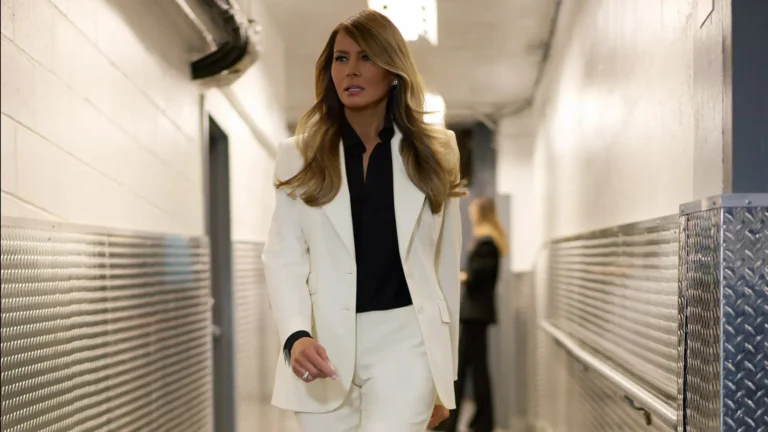
The Melania documentary opened to $8.1 million in its debut weekend at the US and Canadian box office. That number needs context — because the Melania documentary release strategy was unlike anything the genre has seen in years. — and why it surprised almost everyone paying attention to the film ahead of release.
Documentary films rarely get wide theatrical releases at all. Most go straight to streaming. The ones that do get a theatrical run typically open in limited venues, build slowly through word of mouth, and eventually land on a platform where they find their actual audience. For a documentary to open on over 1,700 screens, spend aggressively on marketing, and land in the top three at the box office in its opening weekend is genuinely unusual. For one to do it in January — historically one of the weakest months for theatrical attendance — makes the number more significant still.
Early tracking had projected somewhere between $3 million and $5 million for the opening weekend. The $8.1 million result was nearly double the high end of those estimates. Whatever you think about the film’s subject, that gap between projection and performance is the most interesting story here from a film industry perspective.
What the Melania Documentary Is Actually About
Melania, directed by Brett Ratner and distributed by Amazon MGM Studios, covers the 20 days leading up to Donald Trump’s second inauguration in January 2025. It’s structured around Melania Trump narrating her own story — her upbringing in Slovenia, her immigration to the United States, her modeling career, her marriage, and her two stints as First Lady separated by four years of what the film describes as deliberate, chosen private life.
The production had full cooperation from its subject. Melania Trump reportedly had significant editorial involvement, which explains both the film’s intimacy and its limitations depending on which reviews you read. The footage includes behind-the-scenes moments from inauguration preparations, interactions with staff, and what the film presents as candid family scenes.
It premiered at the Kennedy Center in Washington D.C. on January 29, 2026. Donald Trump attended, along with cabinet members and several celebrities. The event used a black carpet rather than the traditional red — a deliberate aesthetic choice that became its own minor news story ahead of the theatrical release two days later.
Amazon MGM paid $40 million for distribution rights and spent an additional $35 million on marketing, making the total investment $75 million. That is, by any measure, an extraordinary amount of money to spend on a documentary. For comparison, Michael Moore’s Fahrenheit 9/11 — still the highest-grossing documentary in US box office history — cost around $6 million to make and grossed $119 million domestically. Marketing pushed it, but nothing close to this scale.
The marketing for Melania included advertising during NFL playoff games, extensive billboard campaigns, and a projection on the Las Vegas Sphere. Amazon was clearly positioning this as a cultural event film rather than a traditional documentary release, and the strategy paid off in opening weekend numbers even if recouping $75 million theatrically will be extremely difficult.
The Box Office Numbers in Detail
| Metric | Figure |
| Opening Weekend Gross (US + Canada) | $8.1 million |
| Number of Theaters | 1,778 |
| Opening Day (Friday) | $2.9 million |
| Box Office Rank (Opening Weekend) | 3rd |
| Pre-release Projection | $3–5 million |
| CinemaScore | A |
| Total Investment (Rights + Marketing) | $75 million |
| International Release | 27 countries |
For a Melania documentary built around a politically divisive figure, landing third at the box office in January is a result that demands honest analysis. The third-place finish — behind horror film Send Help and sci-fi thriller Iron Lung — is solid by documentary standards. The CinemaScore of A is particularly notable. CinemaScore surveys audiences on opening night and grades their reaction; an A rating means the people who showed up genuinely liked what they saw. For a politically loaded documentary, that’s harder to achieve than it sounds because the audience self-selects toward supporters who are predisposed to approve, but it still reflects real audience satisfaction rather than just brand loyalty.
The demographic breakdown skewed heavily toward viewers 55 and older, which aligns with what you’d expect for a film appealing primarily to conservative audiences and people with existing interest in the Trump family’s public life. Younger audiences were significantly underrepresented compared to typical wide-release films.
What Critics Said — and Why the Gap With Audiences Matters
Critical response to the Melania documentary was sharply and almost uniformly negative. Rotten Tomatoes showed critic scores in the 20–30% range at the time of opening weekend, while audience scores sat around 80% positive. That gap — roughly 50 percentage points between critics and paying audiences — is one of the largest seen for any recent wide-release film.
The Guardian described the film as slow-paced and short on genuine revelation. Deadline acknowledged some candid moments but called it “not particularly revealing” for a documentary about someone so carefully guarded. Forbes raised the question of political motivation, noting the irony of Amazon’s Jeff Bezos having donated to Trump’s inaugural fund around the same period the studio acquired distribution rights for $40 million.
The New York Times called it a “vanity film.” USA Today was harsher still.
Supporters of the film pushed back on the critical consensus on social media, pointing to the box office performance as evidence that critics were applying political bias rather than genuine film criticism. This argument has some validity — there’s a legitimate question about whether a documentary covering the same ground about a Democratic First Lady would receive similarly uniform critical dismissal — but it also doesn’t fully address the substantive criticisms about the film’s lack of depth or its one-sided perspective.
The honest answer is probably that both things are true simultaneously: the critical coverage has a political dimension that affects the framing of reviews, and the film is also genuinely not particularly revealing or cinematically ambitious. A well-made promotional documentary is still a promotional documentary.
The Editorial Control Question
The most substantive criticism the film faces — and the one that’s hardest to dismiss — is the question of Melania Trump’s editorial involvement.
Multiple reports indicated she had significant control over what appeared in the final cut. That’s not unusual for authorised documentaries; subjects routinely negotiate approval rights as part of cooperation agreements. But it does fundamentally shape what kind of film is possible. A documentary where the subject controls the edit cannot be a documentary that challenges or interrogates the subject. It can only be a documentary that presents the subject as the subject wishes to be presented.
This doesn’t make the film worthless. There is genuine value in extended, unfiltered access to a public figure who has historically been one of the least interviewed, least accessible First Ladies of modern times. If Melania Trump is willing to speak about her immigration story, her childhood in Slovenia, her experience of being caricatured by media, and her deliberate retreat from public life between 2021 and 2025, that is interesting material regardless of the framing.
But viewers should watch it with clear eyes about what they’re actually watching. This is an authorised portrait, not an independent investigation. The candid moments are candid moments she approved. The revelations are revelations she chose to make.
Brett Ratner as Director
Brett Ratner directing this film is itself a story worth noting. Ratner was one of the most commercially successful directors in Hollywood in the 2000s — the Rush Hour franchise, X-Men: The Last Stand, Tower Heist — before multiple women accused him of sexual misconduct during the #MeToo movement. He stepped back from the industry at that point, settled several lawsuits, and has operated at significantly lower visibility since.
Melania is his highest-profile work in nearly a decade. Several entertainment journalists noted the somewhat unusual nature of this comeback being attached to a Trump family production. Ratner has denied the allegations made against him and has not been criminally charged.
His technical background in glossy, commercial filmmaking is evident in the documentary’s production quality — it looks expensive and moves professionally. Whether that aesthetic sensibility is the right fit for documentary filmmaking is a separate question; some critics felt the polished surface worked against the intimacy the film was trying to achieve.
The Amazon-Trump Dynamic
The $40 million Amazon MGM paid for distribution rights, combined with Jeff Bezos’s reported $1 million donation to Trump’s inaugural fund and his attendance at the inauguration, created a media narrative about corporate accommodation of political power that ran alongside the film’s release.
Amazon has disputed characterisations of the deal as politically motivated, describing it as a straightforward commercial acquisition. The film’s opening weekend performance gives them a reasonable argument — $8.1 million is a genuine result that suggests commercial logic rather than pure political calculation.
Whether the streaming numbers justify the total investment will depend on how Melania performs on Prime Video once it arrives there, which was expected within three to four weeks of the theatrical release. The theatrical gross alone cannot recoup $75 million — at roughly 50% splits with exhibitors, Amazon’s take from opening weekend was around $4 million. But streaming rights, international licensing, and the broader publicity value of the theatrical release feeding into streaming numbers could make the economics work over time.
What This Means for Documentary Film
The Melania release is worth thinking about beyond the specific film because it represents a deliberate attempt to apply blockbuster release strategy to a documentary.
Wide release on 1,778 screens. $35 million marketing spend. NFL advertising. The Las Vegas Sphere. These are tools that have been used for franchise superhero films and major animated features. Using them for a documentary about a First Lady is genuinely new territory.
The opening weekend result — $8.1 million against $3–5 million projections — suggests the strategy can work to drive opening weekend numbers. Whether it’s commercially sustainable at the scale Amazon invested is less clear. The film would need to perform like a mid-budget narrative feature at the box office to justify the $75 million outlay through theatrical alone, which is unlikely.
But if streaming adds significantly to the returns, and if the theatrical release created enough cultural conversation to drive streaming subscribers toward the film, then the model becomes more defensible. We likely won’t know the full picture for several months.
What’s certain is that other studios and streaming platforms will study this release closely. The appetite for political documentary content in a polarised media environment is clearly real. Whether that appetite can be consistently monetised at this scale, or whether the Melania opening was a one-time event driven by a uniquely famous and divisive subject, is the question the industry will be watching.
What’s Actually Worth Watching in the Film
Setting aside the politics — if you’re deciding whether to stream the Melania documentary on Prime Video — here’s the honest take: — if you’re trying to decide whether to stream it when it arrives on Prime Video — the honest assessment based on critical and audience reports is this:
The most interesting parts of the film are Melania Trump speaking about her own life before she became a public figure. Her account of growing up in Yugoslavia under communism, her early modelling career, and her immigration to the United States contains material that hasn’t been covered extensively elsewhere. For viewers genuinely curious about who she is beyond the headlines, those sections are worth the time.
The inauguration preparation footage has a certain historical document value regardless of politics — access to that period and those events is real and won’t exist anywhere else.
The film becomes less interesting when it moves into territory where Melania is responding to media criticism or addressing specific controversies, because the one-sided framing becomes most visible there. The “Be Best” section, in particular, drew criticism for addressing the initiative without engaging seriously with the context in which it existed.
At roughly 90 minutes, it’s a manageable watch. Go in knowing what it is — an authorised portrait by its subject, beautifully produced, limited by its own terms of access — and you’ll get something out of it. Expect an independent investigation and you’ll be frustrated.
Related Articles
- 2026 Grammy Awards: Every Historic Win, Shocking Moment, and Controversy You Need to Know
- Catherine O’Hara Dies at 71: Remembering a Comedy Legend
- February 2026 Streaming Releases: Who Won, Who Disappointed
- Pan-India Films 2026: The Movies That Could Dominate the Box Office
The Melania documentary is a film that will be remembered less for its cinematic qualities and more for what its release revealed about the entertainment industry in 2026 — how streaming platforms navigate political relationships, how documentary film is being repositioned as mainstream theatrical entertainment, and how polarised audiences will pay very different prices for the same footage depending on what they already believe.
The $8.1 million opening weekend is real. The CinemaScore is real. The critical pile-on is real. The $75 million investment that still needs to be justified is real. All of those things are simultaneously true, which makes Melania — whatever you think of its subject — a genuinely interesting case study in modern entertainment.
Follow all our documentary, streaming, and box office coverage on Instagram and Pinterest.

Popcorn in hand and a opinion ready — Emily covers movie reviews, box office buzz, and all things cinema at Popcorn Review.

