
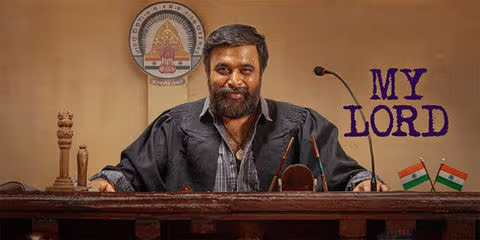
My Lord is the kind of Tamil film that arrives with all the right ingredients — a fearless director, a premise torn from genuine social horror, a lead actor who has never chased glamour over truth, and a musical composer who understands silence as well as sound. For a significant portion of its 2 hours 27 minutes, it is exactly the film it promises to be: a biting, darkly funny, quietly devastating portrait of bureaucratic violence against ordinary people. Then the second half happens, and the film has to decide whether it wants to remain a satire or become a sermon. It cannot fully commit to either — and that hesitation is the difference between a great film and a very good one.
Director Raju Murugan has earned the right to tackle material this uncomfortable. Cuckoo (2014) was tender and unusual. Joker (2016) was one of the most genuinely subversive Tamil political films in years. Japan (2023) was widely considered a misstep. My Lord sits somewhere between those peaks and valleys — a film with unmistakable intelligence, genuine moments of cinematic originality, and a final act that retreats from the difficult work it had been doing so effectively in the first half.
Quick Reference: My Lord at a Glance
| Detail | Information |
|---|---|
| Title | My Lord |
| Language | Tamil |
| Genre | Political Satire / Social Drama / Legal Drama |
| Director & Writer | Raju Murugan (Cuckoo, Joker) |
| Producer | Jayanthi Ambethkumar — Olympia Films |
| Lead Cast | M. Sasikumar, Chaithra J Achar |
| Supporting Cast | Asha Sharath, Guru Somasundaram, V. Jayaprakash, Gopi Nainar, Vasumithra |
| Cinematography | Nirav Shah |
| Music | Sean Roldan |
| Editing | Sathyaraj Natarajan |
| Costume Design | D.R. Poornima |
| Distributor | Sri Kumaran Films (Tamil Nadu & Kerala); 2D Entertainment (Tamil Nadu) |
| Filming Locations | Kovilpatti (Southern Tamil Nadu) & Chennai |
| Shoot Duration | 60 days |
| Release Date | February 13, 2026 (Valentine’s Day weekend) |
| Runtime | 2 hours 27 minutes |
| IMDB Rating | 6.5 / 10 |
| Day 1 Box Office | ~₹0.35 crore net India |
| Day 1 Occupancy | 11.47% (Tamil Nadu); peak night shows 15.27% |
| Popcorn Review Rating | ★★★ 3 / 5 |
Section-by-Section Breakdown
1. The Story: What My Lord Is Actually About
Muthusirpi (Sasikumar) and his wife Suseela (Chaithra J Achar) are a modest couple living in Kovilpatti — a mill town in Southern Tamil Nadu that Nirav Shah’s camera renders in appropriately unglamorous, sun-bleached tones. Their nightmare begins through the malice of a local money lender, who uses his political connections to have them officially declared dead in government records. They wake up, in effect, to discover the state has decided they no longer exist.
What initially reads as a Kafkaesque absurdist comedy — the couple walking from government office to government office, being sent from desk to desk by officials who look through them as though they are ghosts — gradually reveals its darker architecture. In Chennai, Central Minister Sujatha Mohan (Asha Sharath) urgently requires a kidney transplant. Muthusirpi’s blood type makes him a compatible donor match. His official death on paper makes him, effectively, untraceable and legally unprotected. The two narratives converge: his fight to prove he is alive intersects with a criminal organ trafficking network connected to the highest levels of political power.
The real-world basis of this premise is not subtle — Tamil Nadu has been home to kidney trafficking scandals for decades, and Raju Murugan is clearly aware that his audience will recognise the institutional landscape he is mapping. The Kovilpatti setting itself carries weight: it is not a generic rural backdrop but a specific place with a specific working-class identity, and the film treats its geography with the same seriousness it treats its characters.
2. Direction: Raju Murugan at His Best — and His Most Cautious
Raju Murugan has a specific, identifiable cinematic signature that is immediately apparent in My Lord: an eye for the grotesque absurdity embedded in ordinary institutional life. His best images are not dramatic confrontations but observed moments — a group of senior doctors performing an elaborate religious ritual outside a gleaming private hospital while its fleet of branded ambulances looks on; a government official stamping a form without once looking up at the human being standing in front of him; a courtroom where the procedures of justice unfold with precise formality while the substance of justice dissolves entirely.
These moments are where My Lord is completely, unmistakably itself. In the first half, Murugan operates at a level of controlled, darkly comic tension that recalls the best passages of Joker — a film that remained resolutely, provocatively uncomfortable from beginning to end. The camera lingers on faces rather than events. The satire is embedded in staging rather than stated in dialogue.
The second half is where the film loses its nerve. As the organ trafficking plot escalates toward its climax, Murugan’s instinct for tonal complexity appears to give way to the commercial grammar of Tamil social drama — louder, more expository, more invested in delivering the message directly than trusting audiences to carry it themselves. The Hollywood Reporter India described this as the film going from “biting satire to generic drama about helping thy enemy, watering your plants, eating healthy and sundry.” That characterisation is sharper than it is fair, but it contains real truth. The final act simply does not live up to the architecture that precedes it.
3. Performances: Sasikumar and Chaithra Carry the Film
M. Sasikumar is one of Tamil cinema’s most reliably honest actors — a performer who has never been interested in constructing a star persona around himself, and who consistently delivers work that prioritises the specific weight of a character over generic heroism. His Muthusirpi is the fullest expression of the acting philosophy he has been developing since Subramaniapuram: restrained, grounded, and in command of the character’s interior life without ever announcing it. The scenes where Muthusirpi experiences the growing realisation that the system does not simply fail him but actively, deliberately refuses to acknowledge his existence — these scenes work because Sasikumar plays them without a single note of theatrical self-pity.
Chaithra J Achar is the film’s revelation. She was announced as making her Tamil debut with this project, though 3BHK technically preceded it in release, making My Lord her sophomore Tamil film rather than her debut. Regardless, this is the performance that will define her Tamil introduction. Her Suseela has a quiet dignity and emotional precision that anchors the film’s domestic scenes — she is not playing “the wife” as a supporting function but as a character with her own specific relationship to the nightmare the couple is experiencing. Several reviewers, including Tenvow, specifically cited her as the revelation of the film.
Asha Sharath as Minister Sujatha Mohan is exactly the right kind of antagonist for this material — not a cartoonish villain but a pragmatic, self-preserving political figure who does terrible things through institutional procedure rather than personal cruelty. Guru Somasundaram, one of Tamil cinema‘s most distinctive character actors, brings his characteristic intensity to what amounts to a limited but memorable role. V. Jayaprakash — whose work as the journalist character functions as the film’s conscience — has been singled out by audiences for a performance that lands best when the film has not yet begun to overstate its case.
4. Cinematography, Music and Technical Craft
Nirav Shah’s cinematography is one of the film’s most consistent strengths from frame to frame. He shoots Kovilpatti as a place of specific, lived-in texture — not a romanticised rural landscape and not a grim poverty spectacle, but a particular kind of southern Tamil mill town with its own visual logic. The contrast between these dusty, human-scaled Kovilpatti scenes and the sterile, gleaming, inhuman corridors of Chennai’s private hospitals and government corridors is not just aesthetically satisfying — it is doing thematic work. The film’s visual grammar communicates its argument about the distance between where power lives and where it reaches.
Sean Roldan has been one of Tamil cinema’s most interesting composers since Irudhi Suttru and Vikram Vedha, and his score for My Lord is a reminder of what makes him distinctive: he understands that the most emotionally precise response to tragedy is not a swelling orchestral statement but the right kind of silence, occasionally interrupted by something small and specific. The two singles released before the film — “Esa Kaaththa” (November 19, 2025) and “Raasathi Raasa” (December 11, 2025) — are of a piece with the film’s overall tone. The complete album was released on February 10, three days before release. Multiple reviewers singled out the score specifically as elevating the quieter scenes beyond what the writing alone achieves.
Editor Sathyaraj Natarajan has been the subject of some of the film’s more measured criticism. The consensus is that a firmer editorial hand in the second half — excising some of the more expository dialogue sequences and reducing the escalating courtroom climax — would have resulted in a tighter, more consistently effective film. The 2-hour 27-minute runtime is not excessive by Tamil cinema standards, but several sequences in the final act feel longer than their dramatic weight justifies.
5. The Vallalar Philosophy: What the Film Is Really Saying
Raju Murugan is not the kind of filmmaker who uses philosophical references as decoration. The invocation of Vallalar — the 19th-century Tamil mystic and social reformer Ramalinga Swamigal, whose philosophy centred on compassion for all living beings, the abolition of caste distinctions, and the radical idea that feeding the hungry is the highest spiritual act — is structural to the film’s moral architecture, not ornamental to it.
Vallalar’s specific contribution to Tamil thought is the concept of jeeva karunyam — compassion for all life. His philosophy explicitly opposed the commodification of the human body and the institutionalisation of cruelty through systemic indifference. In a film about organ trafficking, identity erasure by the state, and the reduction of a human being to his biological usefulness, invoking Vallalar is not a cultural reference — it is the film’s thesis. The system that declares Muthusirpi dead and routes him toward involuntary organ donation is, from a Vallalar perspective, the precise opposite of a compassionate society. It treats the human body as a resource, existence as a bureaucratic condition, and life as something that can be revoked by those with power over paper.
Where the film occasionally overreaches is in making this argument explicitly, through dialogue, rather than allowing it to remain implicit in the imagery. Murugan’s best work trusts audiences to arrive at the philosophy themselves. When the film states its own argument, the effect is flattening rather than clarifying.
6. Box Office and Reception
My Lord opened on February 13 — Valentine’s Day weekend — which is not ideal positioning for a socio-political drama about organ trafficking and bureaucratic death certificates. The Day 1 occupancy was 11.47% across Tamil Nadu, with night shows reaching a higher 15.27%, suggesting the audience that did arrive was responsive enough to spread word of mouth into later screenings. Day 1 net box office in India was approximately ₹0.35 crore — modest, but broadly in line with expectations for a mid-budget social drama without a marquee action or romance hook.
Urban centers including Chennai showed relatively stronger engagement, consistent with the pattern of Murugan’s previous films performing better with audiences who come specifically for the director’s voice. The film’s true commercial trajectory — as with most Murugan films — is likely to be determined by word of mouth over subsequent weeks and, ultimately, by its OTT release, where socially conscious Tamil cinema has historically found its most sustained audience.
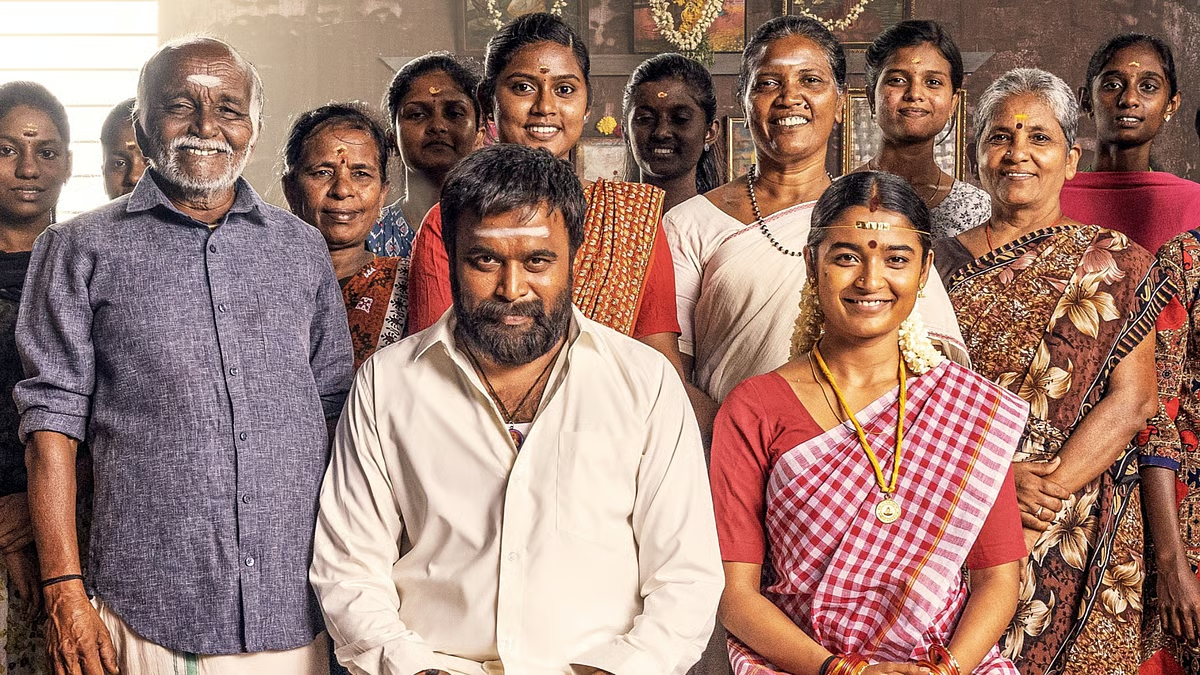
What works: Sasikumar’s career-best restraint. Chaithra J Achar’s revelation of a performance. Nirav Shah’s visually intelligent cinematography. Sean Roldan’s score, which consistently outperforms the scenes it accompanies. Raju Murugan’s first half — dark, funny, specific, uncomfortable in all the right ways. The Kovilpatti setting, rendered with rare fidelity.
What doesn’t: The second half gradually replaces the film’s biting satirical intelligence with a more conventional melodramatic grammar. The courtroom climax, in particular, is where the film is at its most heavy-handed. The editing in the final act needed a firmer hand. Murugan tells his audience what to think when he should trust them more.
Bottom line: A flawed but genuinely significant film. The first half alone justifies watching it. For audiences who appreciate cinema that chooses discomfort over safety, My Lord is worth your time and thought — even where it falters.
What the Critics Said — Full Review Summary
— Vishal Menon, Hollywood Reporter India
The critical consensus clusters around a recognisable pattern: the film’s first half is appreciated by almost all reviewers as sharp, inventive, and thematically confident; the second half is the point of divergence, with some finding the tonal shift forgivable given the film’s sincerity, and others finding it a betrayal of the satire’s earlier promise. The IMDB score of 6.5 reflects a general audience that found the film engaging without finding it exceptional — which is, in fact, a reasonably accurate description of the experience.
How My Lord Compares to Raju Murugan’s Earlier Films
My Lord is the fourth feature from Raju Murugan, and its position in his filmography is instructive. Cuckoo (2014) was a quiet, unconventional love story that established his eye for marginalised characters and unsentimentalised emotion. Joker (2016) was the breakthrough — a political satire that committed to its discomfort all the way through, never blinking, never reaching for comfort, and arriving at a conclusion that felt genuinely earned rather than politically convenient. Japan (2023) was widely considered a significant stumble — a film that lost the discipline of Joker without replacing it with anything coherent.
My Lord reads, in that context, as a partial recovery. It has the first-half discipline, the visual intelligence, the commitment to authentic characterisation over hero worship. What it does not fully recapture is Joker‘s willingness to sustain its discomfort to the very end without softening the conclusion for audience comfort. The final act of Joker was genuinely unsettling. The final act of My Lord resolves more tidily than the material warrants. For a film whose entire premise is that the systems meant to protect ordinary people are structurally designed to erase them, a tidy resolution is a form of dishonesty — and audiences who feel the film’s satire working on them in the first half may register that dishonesty as a disappointment rather than a relief.
Final Thoughts: Should You Watch My Lord?
Yes — with calibrated expectations. My Lord is a film that matters more than it fully succeeds. Its premise is genuinely dangerous, its performances are among the year’s best Tamil acting work, and Raju Murugan’s distinctive voice is present throughout, even where it speaks less clearly than it should. Nirav Shah’s cinematography and Sean Roldan’s score are each worth experiencing on their own terms.
It is not the film that Joker was. But it is considerably more than the film Japan was. For Tamil cinema audiences who follow either Raju Murugan or Sasikumar, it is an essential watch. For audiences unfamiliar with either, it is an accessible entry point into a kind of Tamil social drama that prioritises intelligence over spectacle — a rarer commodity than it should be.
Rating: ★★★ 3 out of 5 — A flawed, significant Tamil film. The first half alone is worth your evening.
Have you seen My Lord? Tell us what you thought in the comments — and which Raju Murugan film remains your favourite.
Frequently Asked Questions — My Lord Tamil Movie
What is My Lord Tamil movie about?
My Lord is a 2026 Tamil political satire film directed by Raju Murugan. It follows Muthusirpi and his wife Suseela, a couple living in Kovilpatti, Southern Tamil Nadu, who are wrongly declared dead in government records by the influence of a local money lender. As they struggle to reclaim their legal existence, they become entangled in a larger criminal network involving illegal kidney trafficking connected to a Central Minister who urgently needs a transplant. The film explores identity erasure, institutional corruption, organ trafficking, and political impunity through a blend of dark satire and social drama.
Who is in the cast of My Lord?
The lead roles are played by M. Sasikumar as Muthusirpi and Chaithra J Achar as his wife Suseela. Supporting roles are played by Asha Sharath (as Central Minister Sujatha Mohan), Guru Somasundaram, V. Jayaprakash, Gopi Nainar, and Vasumithra. The film is directed and written by Raju Murugan, with cinematography by Nirav Shah, music by Sean Roldan, and editing by Sathyaraj Natarajan.
When was My Lord released and what is its runtime?
My Lord was released in theatres across Tamil Nadu and Kerala on February 13, 2026 — Valentine’s Day weekend. Its runtime is 2 hours and 27 minutes. The film was distributed by Sri Kumaran Films in Tamil Nadu and Kerala, and by 2D Entertainment in Tamil Nadu. It was produced by Jayanthi Ambethkumar under the Olympia Films banner.
Is My Lord based on a true story?
The film is not based on a specific documented incident, but it draws directly from real institutional failures in India — including cases of people being wrongly declared dead in government records (a documented bureaucratic problem), Tamil Nadu’s history of kidney trafficking scandals, and the well-documented nexus between private healthcare, organ donation list manipulation, and political corruption. Raju Murugan has consistently described the film as grounded in systemic realities rather than individual events.
How did My Lord perform at the box office?
My Lord opened modestly, with a Day 1 box office collection of approximately ₹0.35 crore net in India. Tamil Nadu occupancy on opening day was 11.47%, with peak night show occupancy reaching 15.27%. The Valentine’s Day weekend positioning was not ideal for a socio-political drama. Urban centres including Chennai showed stronger engagement. The film’s long-term commercial performance is expected to be determined primarily by word-of-mouth and its eventual OTT release.
What are the critics saying about My Lord?
Critical reception has been cautiously appreciative. The Times of India gave 3/5, praising the film’s jabs but noting character limitations. Cinema Express gave 3/5, comparing its levity favourably to Joker. OTTPlay gave 2.5/5, noting earnest intent but insufficient emotional depth. Hollywood Reporter India gave 2.5/5 in the most critical assessment, describing the film as beginning with promise but ending without cinematic subtlety, concluding that it “degenerated from biting satire to generic drama.” IMDB score: 6.5/10. The consistent pattern is strong first half, uneven second half.
Is My Lord a sequel or part of a franchise?
No. My Lord is a standalone original film with no connection to any previous franchise or film. The title refers to the film’s legal drama context — the way individuals must appeal to the system that has wronged them, addressing it as “my lord” in the language of Indian courtroom procedure — and carries satirical weight given that the “lord” in question is a system that refuses to acknowledge the existence of ordinary people.
Where was My Lord filmed?
The film was shot over 60 days across two primary locations: Kovilpatti, a mill town in Southern Tamil Nadu, and Chennai. The Kovilpatti sequences establish the film’s grounded, working-class environment, while the Chennai sequences — covering government offices, hospitals, and courtrooms — provide the institutional backdrop for the central conflict. Cinematographer Nirav Shah uses the visual contrast between the two settings to reflect the film’s thematic argument about the distance between ordinary lives and institutional power.
What is Chaithra J Achar’s background and is this her Tamil debut?
Chaithra J Achar is a Kannada actress. My Lord was announced as her Tamil film debut when the project was revealed in January 2025. However, the film 3BHK was released before My Lord reached theatres in 2026, making My Lord technically her sophomore Tamil release rather than her debut. Her performance as Suseela in My Lord has been widely praised by critics and audiences as the film’s standout turn — described by multiple reviewers as a revelation.
How does My Lord compare to Raju Murugan’s previous films?
Raju Murugan directed Cuckoo (2014), Joker (2016), and Japan (2023) before My Lord. The consensus among critics is that My Lord represents a return to form after Japan — recovering the satirical intelligence and visual distinctiveness of Joker, while falling short of Joker’s willingness to sustain discomfort all the way to its conclusion. The first half of My Lord is frequently compared favourably to Joker’s sharp political comedy; the second half is considered less consistently disciplined.

Popcorn in hand and a opinion ready — Emily covers movie reviews, box office buzz, and all things cinema at Popcorn Review.

