
📋 In This Article
- Her Full Statement to Variety — Every Word, In Context
- The Four Films She Named — What Each Is and Why Each Was Snubbed
- The 2026 Oscar Nominations Reality: Only One Woman, Again
- What Portman Was Actually There to Promote — The Gallerist
- The Other Statement She Made That Day: ICE, Renee Good, and the Pins
- Natalie Portman Calls Out Oscars — 2018, 2020, and Now
- The Rose McGowan Counterattack — And How The Gallerist Answers It
- The Full History: Women and the Best Director Oscar
- FAQs
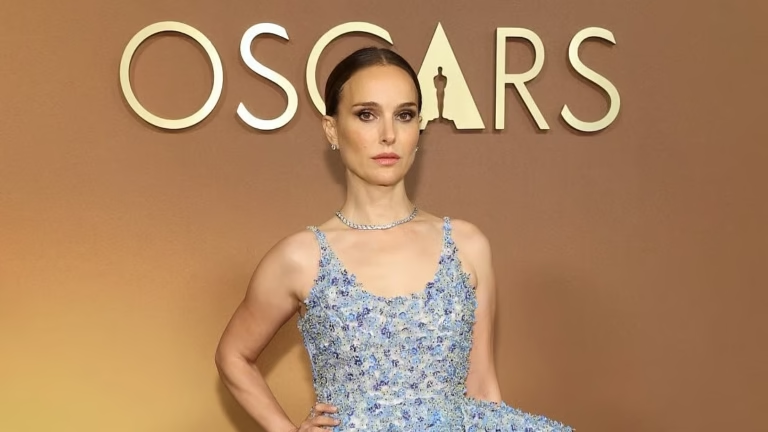
On January 24, 2026, Natalie Portman called out the Oscars for the third significant time in her public career — and this time she came with names. Standing at the premiere of her new film The Gallerist at the Sundance Film Festival in Utah, she told Variety directly: “So many of the best films I saw this year were made by women. You just see the barriers at every level because so many were not recognized at awards time.” She then listed four specific films — Eva Victor’s Sorry, Baby, Shih-Ching Tsou’s Left-Handed Girl, Nia DaCosta’s Hedda, and Mona Fastvold’s The Testament of Ann Lee — concluding: “We have a lot of work to do still.”
The timing was exquisite. The Oscar nominations had been announced just days earlier, on January 19. Of the five Best Director nominees, four were men, and one was a woman: Chloé Zhao, for Hamnet. Of the ten Best Picture nominees, only one — Hamnet — was directed by a woman. The pattern that Portman has been naming, in various forms, since 2018 had repeated itself exactly.
This is not a paraphrase of what Portman said. This article contains her full quotes, the full details of every film she named, a complete breakdown of the 2026 nominations, the history of her Oscars commentary, and what happened when someone pushed back — publicly and hard — on whether she has the standing to say these things.
★ January 24, 2026 — Sundance Film Festival, Utah
Her Full Statement to Variety — Every Word, In Context
Natalie Portman made the statements on the red carpet of The Gallerist’s world premiere at the Eccles Theater at the 2026 Sundance Film Festival on January 24 — five days after the Oscar nominations were announced on January 19. She was speaking directly with Variety. The full sequence of what she said, in the order she said it:
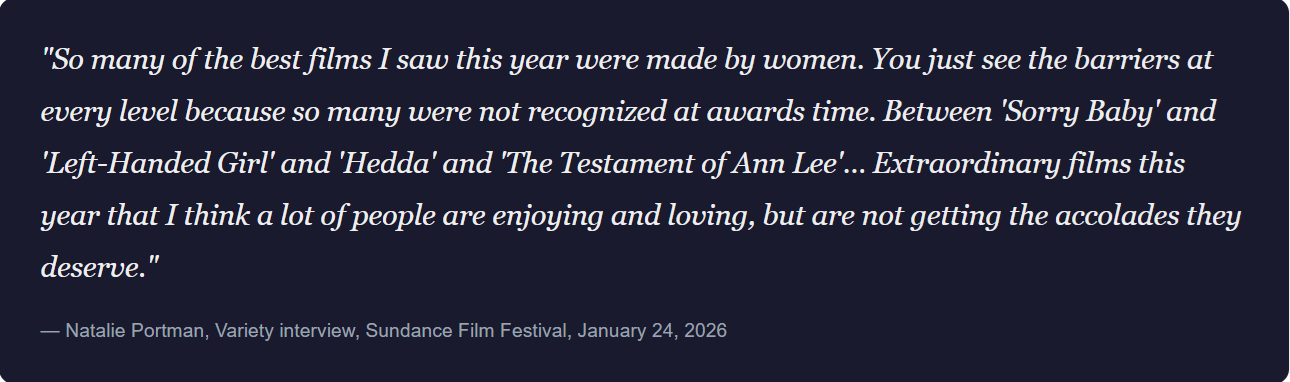
She then addressed the structural barriers that extend far beyond awards recognition alone:

She ended on a note that was neither combative nor resigned:

The critical detail in the statement is the word “still.” Portman has been making variations of this same argument publicly since 2018. The word “still” acknowledges that the conversation has been going on for eight years — and arrives at the same destination every awards cycle.
★ The Four Films She Named — Every One Worth Knowing
The Four Films Portman Named — What Each Is and Why Each Was Snubbed
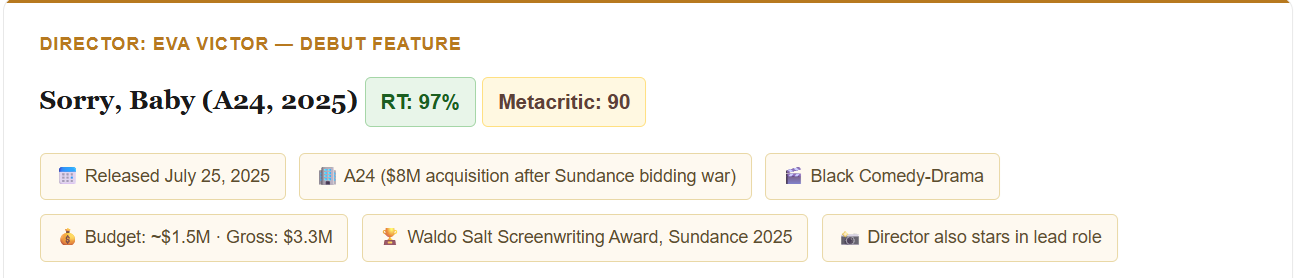
Sorry, Baby is the debut feature of Eva Victor, who wrote, directed, and stars in the film as Agnes Ward — a New England literature professor processing the lasting aftermath of sexual assault. The story unfolds in four non-linear chapters titled by year, including one called “The Year With the Bad Thing” — a structural choice that reviewers consistently described as deliberate and sophisticated rather than as an indie affectation.
The film premiered at Sundance Film Festival 2025 in January, where it won the Waldo Salt Screenwriting Award and triggered a bidding war between A24, Searchlight Pictures, Neon, and Mubi. A24 won for $8 million. Its Rotten Tomatoes score of 97% reflects the kind of sustained critical consensus that Oscar campaigns are built on. The site’s consensus reads: “Carrying off difficult subject matter with a light touch and wry sense of humor, Sorry, Baby triumphantly announces writer-director and star Eva Victor as a formidable talent.” Victor was produced by Barry Jenkins and Adele Romanski. Victor received a Golden Globe nomination for Best Actress. The National Board of Review gave Victor Best Directorial Debut. Not one Oscar nomination followed.
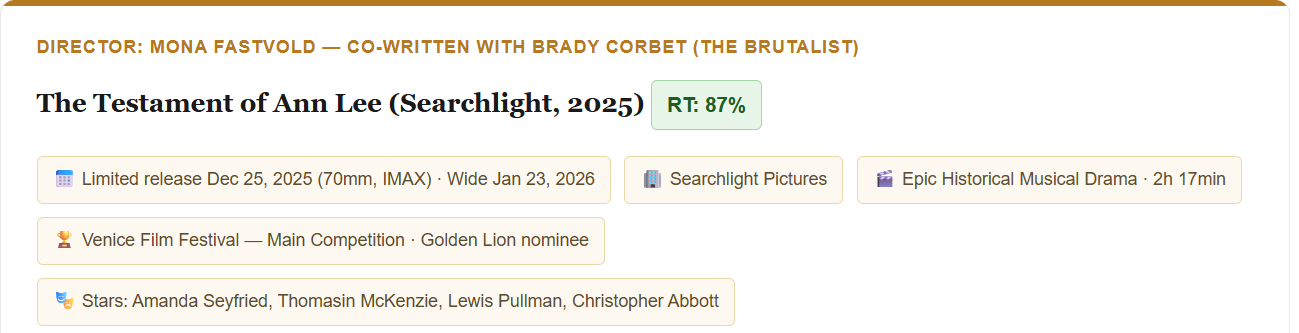
The Testament of Ann Lee is the most formally ambitious film on Portman’s list — a sweeping period musical drama co-written by Mona Fastvold and Brady Corbet (who won Best Director at Venice two years earlier for The Brutalist) about Ann Lee, the Mancunian preacher who founded the Shakers and proclaimed herself the female incarnation of Christ, who emigrated to America in the 1780s to build a utopian religious community.
Amanda Seyfried, in what multiple critics described as the performance of her career, plays Ann Lee through the full arc of her physical and spiritual deterioration. Seyfried received Golden Globe and Critics’ Choice Award nominations for Best Actress. The film’s score — drawn from original Shaker hymns by composer Daniel Blumberg — was described by Fastvold as “one of the most experimental, extreme projects” Blumberg had ever undertaken. The Irish Times gave the film five stars, with Donald Clarke describing it as “the stuff of masterpieces.”
Released on 70mm and IMAX for Christmas Day 2025, then expanded wide on January 23, 2026 — the week of Portman’s Sundance statement — the film received zero Oscar nominations in any category, including Best Actress for Seyfried, Best Adapted Screenplay, Best Cinematography, and Best Director for Fastvold.

Nia DaCosta’s Hedda is a modern-set adaptation of Henrik Ibsen’s 1891 play Hedda Gabler, with Tessa Thompson in the lead role as Hedda Gabler Tesman — described by Looper as “a chaotic, queer gal desperate to hold on to her societal power and money during a fancy house party” — and Nina Hoss as her ex-lover Eileen Lovborg. DaCosta, who directed Little Woods and Captain Marvel and who Looper noted also directed 28 Years Later: The Bone Temple, brings what multiple reviews described as “dark and sensual fun” to Ibsen’s text, with Tessa Thompson’s performance described as particularly layered and show-stealing.

Shih-Ching Tsou’s Left-Handed Girl received festival acclaim and is positioned by Portman among the year’s most deserving films overlooked by the Academy. Tsou is a Taiwanese-American filmmaker known for her work as a producer alongside co-director Sean Baker on Tangerine and The Florida Project. Left-Handed Girl represents her solo directorial feature debut. Portman’s inclusion of this film in her list — alongside the higher-profile entries — reflects the breadth of her original argument: that the Academy’s failures aren’t limited to overlooking marquee art films, but extend to the full landscape of female-directed work.
★ The 2026 Oscar Nominations — By the Numbers
The 2026 Nominations Reality: One Woman, Ten Best Picture Nominees, One Female-Directed
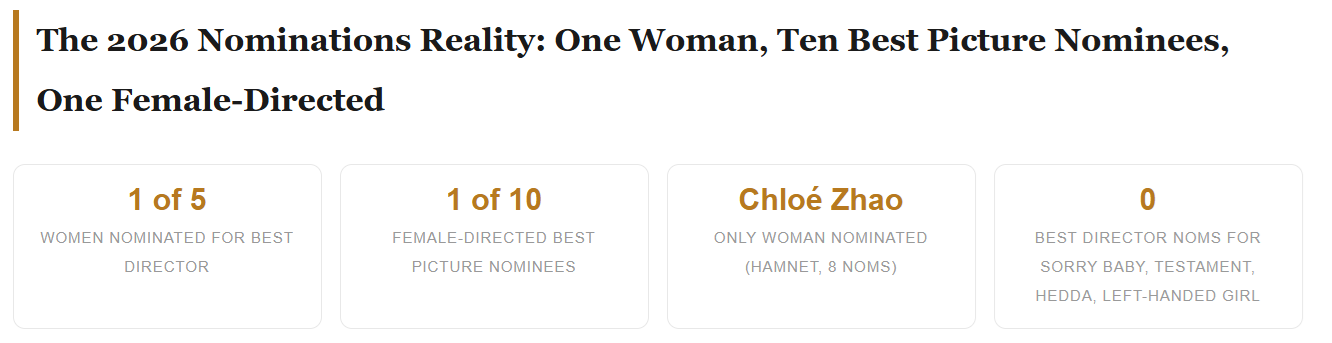
The 98th Academy Awards nominations, announced January 19, 2026, confirmed the pattern. Of five Best Director nominees, four were men. Chloé Zhao was the sole woman, for Hamnet — which received eight nominations total including Best Picture. Of the ten Best Picture nominees, Hamnet was the only film directed by a woman. In the Best International Feature Film category, there was one female-directed entry: Kaouther Ben Hania’s The Voice of Hind Rajab.
Portman’s observation — that the four films she named received zero nominations between them, despite strong critical consensus — is not a matter of subjective opinion. Sorry, Baby holds a 97% on Rotten Tomatoes and a 90 on Metacritic. The Testament of Ann Lee competed for the Golden Lion at Venice and holds an 87%. The argument that these films were overlooked due to systemic bias rather than quality has real evidentiary weight.

★ The Film She Was There to Promote
What Portman Was Actually There for: The Gallerist (Cathy Yan, Sundance 2026)
The Gallerist — Premiered January 24, 2026, Eccles Theater, Sundance
Cast: Natalie Portman (Polina Polinski, gallery owner + producer), Jenna Ortega (Kiki, assistant), Da’Vine Joy Randolph (Stella Burgess, artist), Catherine Zeta-Jones (Marianne Gorman, art dealer), Sterling K. Brown (Polina’s ex-husband), Zach Galifianakis (Dalton Hardberry, art influencer — the corpse), Daniel Brühl (nepo baby collector), Charli XCX (Dalton’s girlfriend, cameo).
Plot: Polina Polinski, an uptight Miami gallery owner facing bankruptcy, bets everything on making unknown artist Stella Burgess a success at Art Basel Miami. Art influencer Dalton Hardberry swings by for an early preview, tears the gallery apart — and then accidentally impales himself on Burgess’s centerpiece sculpture, “The Emasculator” (a cattle castration tool blown up to Jeff Koons scale). With the doors about to open, Polina drapes the body in baroque fashion and calls it art. The hoax goes viral. The complications multiply. The film opens with Andy Warhol’s quote: “Art is what you can get away with.”
Reviews at Sundance were divided but converged on praising the ensemble cast and Yan’s visual style. Deadline called it “a slight but intelligent black comedy” with “a whirlwind performance by Natalie Portman.” The Hollywood Reporter called it “limp satire.” Boardroom called it “wickedly fun.” Variety’s Peter Debruge compared it to “something David Mamet might have written (then shoved in a drawer).” ARTnews called it “an entertaining romp… plucked with panache.” The film awaits distribution as of March 2026.
Cathy Yan described The Gallerist at the post-premiere Q&A as “smart, wicked fun for the clever.” At a post-premiere panel on female collaboration in filmmaking, Portman said: “It’s a very special process to be in community with women on set.”
★ The Other Statement She Made That Same Day
The “ICE OUT” and “BE GOOD” Pins — Portman’s Other Statement at Sundance
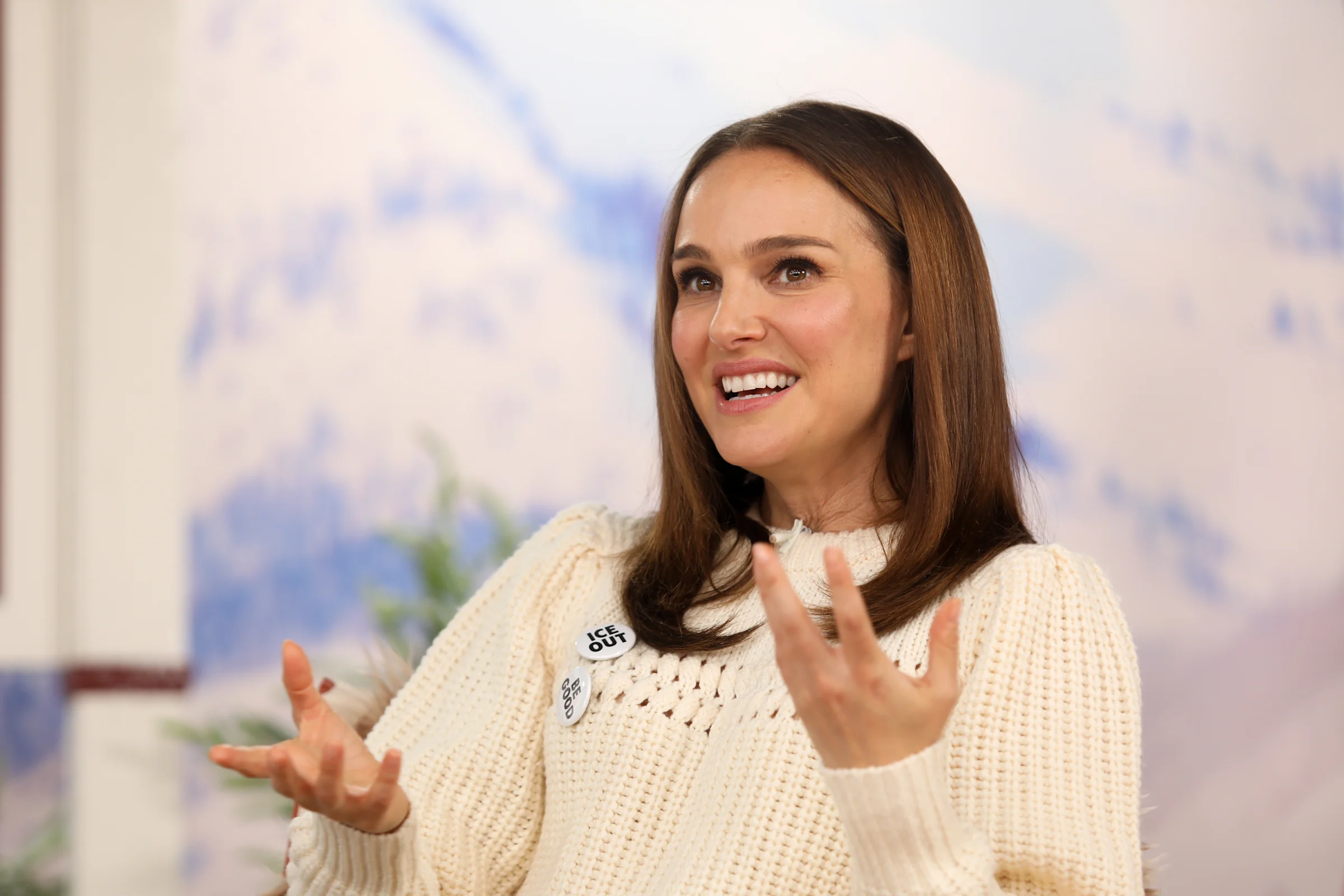
When Natalie Portman called out the Oscars at Sundance on January 24, she was also wearing two pins on her outfit — “ICE OUT” and “BE GOOD” — in the same tribute gesture made by Mark Ruffalo at the Golden Globes two weeks earlier. Both pins referred to Renee Good, a 37-year-old mother killed by an ICE agent in Minneapolis on January 7, 2026, and to the broader ICE enforcement operations that had been generating national protests since the start of the year.
Before she discussed the Oscars nominations, Portman told Variety:
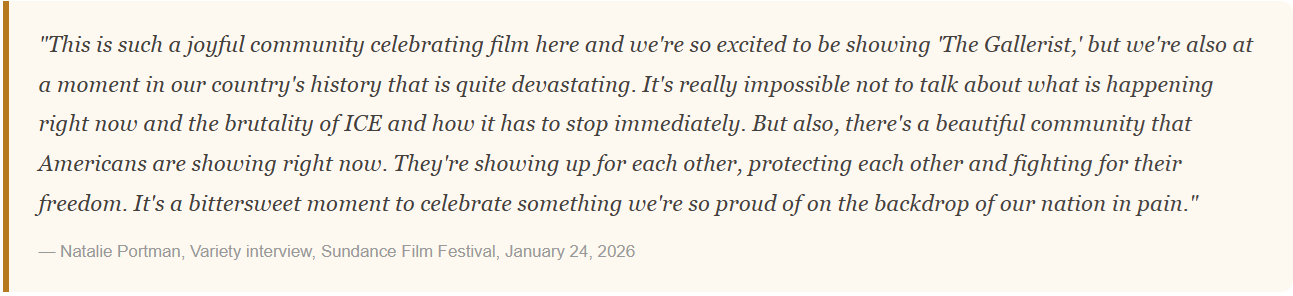
The two elements of her January 24 Sundance appearance — the political statement about ICE and the critique of the Oscars — are connected thematically. Both concern visibility, power, and whose suffering and whose work gets acknowledged by institutions.
★ Eight Years of the Same Conversation
Natalie Portman Calls Out Oscars — 2018, 2020, and Now
★ The Counterargument — And How She Answered It
The Rose McGowan Counterattack — And What Has Changed Since
The criticism, directly stated: In 2020, Rose McGowan argued that Portman wearing a cape embroidered with the names of snubbed female directors was a hollow gesture from someone who had spent nearly three decades choosing to work almost exclusively with male directors. At that point, Portman’s only collaboration with a female director in a feature film was her own: A Tale of Love and Darkness (2015), which she wrote, directed, and starred in. Short films, music videos, and commercials — where she had worked with Mira Nair, Sofia Coppola, Rebecca Zlotowski, and others — were not considered equivalent.
McGowan’s argument was not that Portman was wrong to criticise the Academy. It was that the credibility of the critique was undermined by her own career choices.
Portman’s response at the time — “I will keep trying” — was widely considered honest but insufficient as a full rebuttal. The Gallerist, directed by Cathy Yan, represents a concrete step toward making good on that statement. The fact that she chose to make a film with Cathy Yan — and is here at Sundance promoting it, in the same breath as criticising the Oscars for overlooking female directors — is the most direct answer she has given to McGowan’s 2020 challenge.
★ The Longer Picture
The Full History: Women and the Best Director Oscar
As of the 2026 nominations, three women in the Academy’s 98-year history have won Best Director. Portman’s point — that the pattern “repeats itself” — is statistically accurate. The Academy’s A2020 initiative, launched in 2016 to double the number of women and underrepresented groups among members, produced genuine improvement in certain categories and years. But the Best Director category, where nominations are decided by the Directors Branch (which has historically had a lower percentage of female members than the Academy at large), has proven the most resistant to change.
FAQs
What did Natalie Portman say about the Oscars 2026?
At Sundance on January 24, she told Variety: “So many of the best films I saw this year were made by women. You just see the barriers at every level because so many were not recognized at awards time. Between Sorry Baby and Left-Handed Girl and Hedda and The Testament of Ann Lee… Extraordinary films this year that I think a lot of people are enjoying and loving, but are not getting the accolades they deserve. We have a lot of work to do still.”
Which films did Portman say were snubbed at the 2026 Oscars?
Sorry, Baby (Eva Victor, A24, 97% RT — zero Oscar nominations), Left-Handed Girl (Shih-Ching Tsou), Hedda (Nia DaCosta, starring Tessa Thompson and Nina Hoss), and The Testament of Ann Lee (Mona Fastvold, starring Amanda Seyfried, Venice Film Festival main competition — zero Oscar nominations including Best Actress for Seyfried).
How many women were nominated for Best Director at the 2026 Oscars?
One: Chloé Zhao for Hamnet, which received eight nominations total. Of the ten Best Picture nominees, only Hamnet was directed by a woman. In Best International Feature, only one of the five entries was directed by a woman (Kaouther Ben Hania’s The Voice of Hind Rajab).
What is The Gallerist that Portman was promoting at Sundance?
A dark comedy thriller directed by Cathy Yan (Birds of Prey), starring Portman as a desperate Miami gallery owner who accidentally ends up with a dead art influencer on her hands and decides to sell the body as conceptual art at Art Basel Miami. Cast includes Jenna Ortega, Da’Vine Joy Randolph, Catherine Zeta-Jones, Sterling K. Brown, Zach Galifianakis, Daniel Brühl, and Charli XCX. Reviews were mixed-to-positive. Awaiting distribution. Portman is a producer.
What happened with Natalie Portman and the 2020 Oscars?
She wore a Dior haute couture cape with the names of snubbed female directors — Greta Gerwig, Lorene Scafaria, Marielle Heller, Lulu Wang, Céline Sciamma — embroidered on the lining. Rose McGowan publicly criticised the gesture as hypocritical given Portman’s own record of working almost exclusively with male directors. Portman responded: “I will keep trying.” The Gallerist, directed by Cathy Yan, is a direct answer to that response.
Has Natalie Portman directed a film herself?
Yes. A Tale of Love and Darkness (2015), which she wrote, directed, and starred in — an adaptation of Amos Oz’s memoir, filmed in Hebrew. It premiered at the Cannes Film Festival and was released by Universal Pictures. It is the only feature film she has directed to date.
Sources: People via Yahoo — Portman Calls Out Oscars at Sundance (Jan 26, 2026) · People/AOL — Full Portman Quotes, All Four Films Named (Jan 26, 2026) · Just Jared — Portman on ICE + Oscars at Sundance (Jan 24, 2026) · World of Reel — Full Portman Statement + Context (Jan 26, 2026) · ComingSoon — Portman Slams 2026 Oscar Nominations (Jan 27, 2026) · Wikipedia — Sorry, Baby (2025 film) · Wikipedia — The Testament of Ann Lee · Wikipedia — The Gallerist (film) · Deadline — The Gallerist Review: Sundance 2026 (Jan 27, 2026) · The Hollywood Reporter — The Gallerist Sundance Review (Jan 25, 2026) · Looper — Best 2025 Films With Zero Oscar Nominations (includes Hedda, Testament of Ann Lee) · IMDb — Portman Responds to McGowan Criticism: ‘I Will Keep Trying’ (2020)

Popcorn in hand and a opinion ready — Emily covers movie reviews, box office buzz, and all things cinema at Popcorn Review.

