
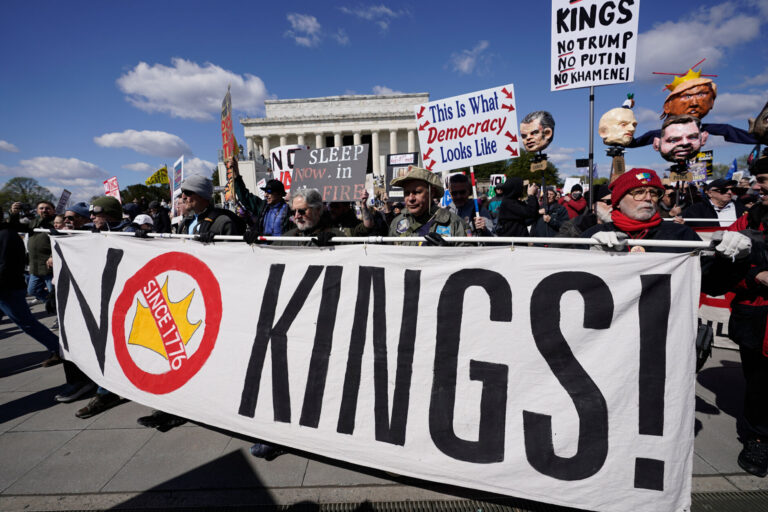
On Saturday, March 28, 2026, something extraordinary happened in the United States. Not in one city. Not in two. In more than 3,000 locations across all 50 states — from Times Square to a tiny town in Alaska called Kotzebue — millions of Americans stepped out of their homes and took to the streets together.
They carried signs. They sang songs. They wore Handmaid’s Tale red robes in Nashville and inflatable frog costumes in Kansas and waved American flags in San Francisco. And in city after city, they were joined by some of the biggest names in Hollywood — actors, musicians, and entertainers who decided that this moment was too important to watch from the sidelines.
The No Kings protest 2026 was not just a political demonstration. It was a cultural earthquake. And for entertainment audiences, the celebrity dimension of this story — who showed up, what they said, and what it means — is one of the most compelling Hollywood narratives of the year.
This is the complete breakdown. Every celebrity. Every quote. Every city. Every moment that mattered.
What Is the No Kings Protest 2026? The Context You Need
Before we get to the celebrities, let’s understand what they were standing up for — because without this context, the celebrity angle is just gossip. With it, it becomes genuinely historic.
The No Kings protest 2026 — officially called “No Kings 3” — was the third nationwide demonstration organized under the No Kings banner. The movement began in June 2025 as a direct response to President Donald Trump’s $100 million military parade held on his 79th birthday, funded by taxpayers. The name “No Kings” is a pointed reference to the protesters’ view of Trump’s approach to executive power.
The October 2025 round brought an estimated 5 to 7 million people into the streets — one of the largest single-day protests in American history. March 28, 2026 was organized to be even bigger.
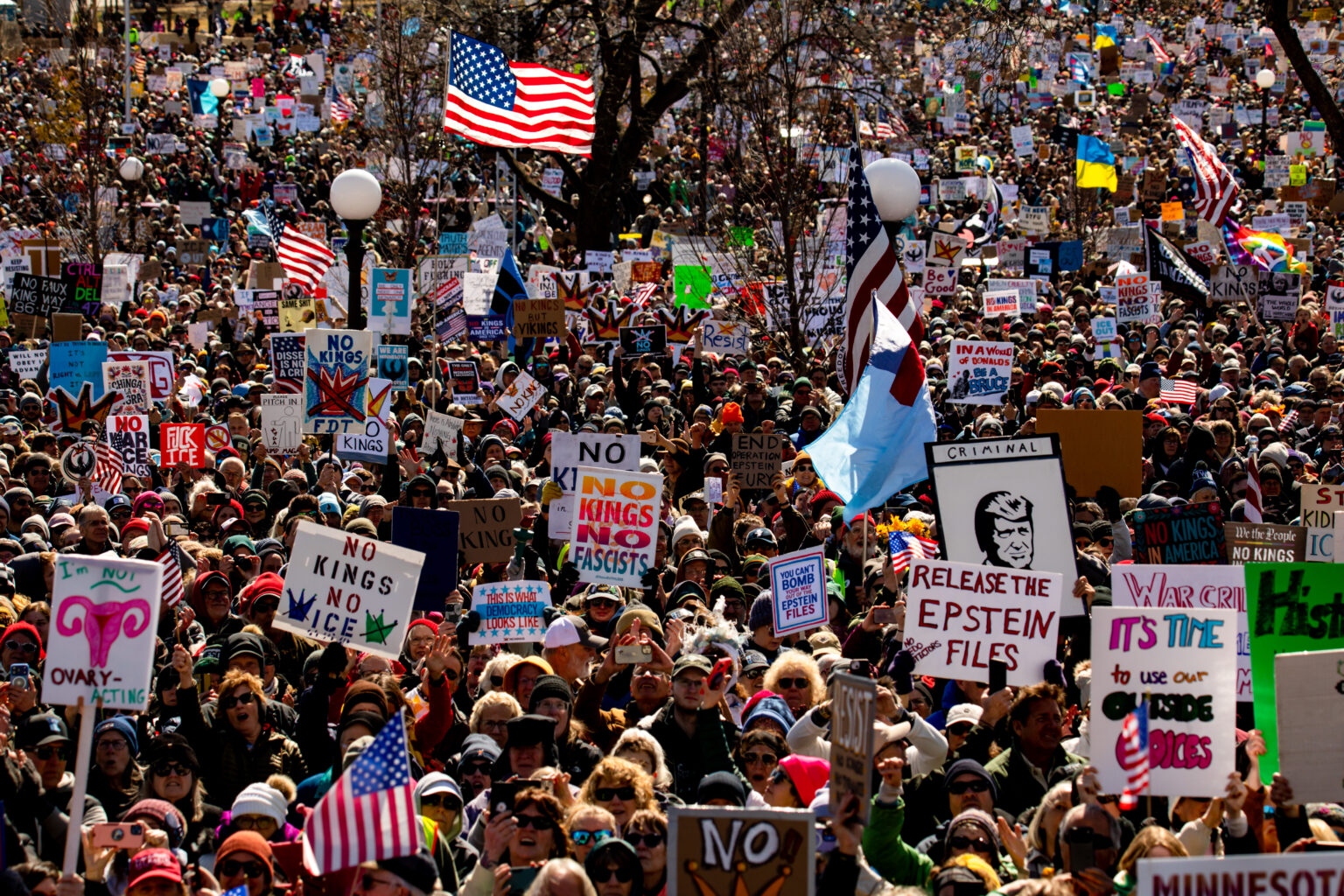
What made this third round uniquely charged was its location: Minneapolis–St. Paul, Minnesota, chosen as the flagship city because of what had happened there just weeks earlier. In January 2026, federal ICE agents fatally shot two American citizens — Renée Good, a mother of three, on January 7, and Alex Pretti, a VA nurse, on January 24 — during an aggressive immigration enforcement campaign called Operation Metro Surge. The killings ignited a national firestorm. Organizers raised over $1 million in relief funds for the victims’ families.
On March 28, the Minnesota State Capitol became the stage for the most powerful moment of the entire day.
The Numbers: How Big Was No Kings Protest 2026?
| City / Location | Estimated Crowd | Notable Detail |
|---|---|---|
| St. Paul, Minnesota (Flagship) | 200,000+ | Bruce Springsteen headlined; Bernie Sanders, Jane Fonda, Joan Baez spoke |
| New York City (Manhattan) | 100,000+ across 5 boroughs | Robert De Niro led march from Central Park South; held banner with AG Letitia James |
| Los Angeles | Tens of thousands | Giant Trump baby blimp; arrests at Metropolitan Detention Center standoff |
| San Francisco | 220,000+ (Bay Area total) | Embarcadero Plaza march; previous No Kings drew similar numbers |
| Chicago | 250,000+ (per organizers) | Grant Park rally; previous No Kings drew same figure |
| San Diego | 40,000 | Police confirmed figure |
| Providence, Rhode Island | 20,000 | March from State House to downtown |
| Washington D.C. | Tens of thousands | Memorial Bridge march; Jane Fonda spoke at Kennedy Center |
| Nashville | Large crowds | Handmaid’s Tale red robes; crossed Seigenthaler Pedestrian Bridge |
| International | Thousands across 12+ countries | Rome, Europe, Latin America, Australia — called “No Tyrants” in monarchies |
| Total events nationwide | 3,000+ | All 50 states; almost half in GOP-leaning areas |
Organizers noted that two-thirds of RSVPs came from outside major urban centers — red-leaning communities in Idaho, Wyoming, Montana, Utah, South Dakota, and Louisiana, as well as suburban swing areas in Pennsylvania, Georgia, and Arizona. This was not a coastal liberal protest. It reached into the American heartland.
Bruce Springsteen: The Moment That Stopped America
If there was one image that defined the No Kings protest 2026, it was Bruce Springsteen — 76 years old, in a black jacket, standing at a microphone on the steps of the Minnesota State Capitol in front of an estimated 200,000 people — and performing a song he had written, recorded, and released in a single weekend.
The song is called “Streets of Minneapolis.”
Springsteen wrote it on a Saturday in January, recorded it the following day, and released it within 48 hours of the ICE killings of Renée Good and Alex Pretti. He described it as a direct response to what he called “the state terror being visited on the city of Minneapolis.”
“This past winter, federal troops brought death and terror to the streets of Minneapolis. But they picked the wrong city. The power and the solidarity of the people of Minneapolis and Minnesota was an inspiration to the entire country. Your strength and your commitment told us that this is still America, and this reactionary nightmare — and these invasions of American cities — will not stand.”
He then spoke directly about the victims:
“For those who gave their lives: Renée Good, mother of three, brutally murdered. Alex Pretti, VA nurse, executed by ICE. Shot in the back and left to die in the street without even the decency of our lawless government investigating their deaths. Their bravery, their sacrifice, and their names will not be forgotten.”
Then he launched into the song. The crowd of 200,000 chanted “ICE out now” as Springsteen played. It was his third performance of the song — he had debuted it at a benefit concert at Minneapolis’ First Avenue in January, performed it again at Democracy Now!’s 30th anniversary event in New York, and now brought it to the largest audience yet.
The timing was no accident. On Tuesday, April 1 — just four days after the protest — Springsteen’s “Land of Hope and Dreams” tour kicks off at Minneapolis’ Target Center. He told the Minnesota Star Tribune: “The tour is going to be political and very topical about what’s going on in the country. Minneapolis and St. Paul — that was the place I wanted to begin it, and I wanted to end it in Washington.”
For a man who has spent 50 years channeling the anxieties of working-class America into music, this was not a departure from his art. It was the fullest expression of it.
Robert De Niro: The Godfather Takes Manhattan
In New York City, the most iconic image of the day was Robert De Niro — 82 years old, one of the most decorated actors in cinema history — marching on Seventh Avenue in Manhattan, holding a hand-painted banner alongside New York Attorney General Letitia James and Reverend Al Sharpton.
The march departed from Central Park South at 2:00 PM ET, moving south through Midtown. Television host Padma Lakshmi and Public Advocate Jumaane Williams were also among those leading the procession.
When De Niro addressed the crowd, he was not subtle:
“It’s time to say no to kings. It’s time to say no to Donald Trump. We’ve had enough. No King Trump, no unnecessary wars that rob our resources, sacrifice our brave servicemen and women and slaughter innocents. No corrupt leader enriching himself and the Epstein class buddies.”
In a separate interview before the march, he gave a more personal account of what was driving him into the streets:
“Every morning when I get up, I reach for my phone to look at the headlines of the day, and for some time now, I start every morning depressed about the latest outrage from our would-be king. Every f***ing day there’s something new and crazy.”
And speaking directly to the chant of the crowd, he offered the line that went viral across social media within minutes:
“When the crowds are chanting ‘No Kings,’ what I’m really hearing is ‘No Trump.'”
He described the turnout as “a great rallying cry, and hugely successful as millions of us have answered the call.”
For De Niro, this was not his first No Kings appearance — he has been one of the most vocal celebrity critics of the Trump administration throughout its second term. But the scale of Saturday’s march gave his words a different resonance. This was not an interview or a social media post. This was the streets of New York, alive with hundreds of thousands of voices, and De Niro in the middle of it all.
Jane Fonda: The Speech She Didn’t Give (And Why It Was More Powerful)
Jane Fonda made a deliberate choice at the Minneapolis rally that set her apart from every other celebrity on stage.
She did not give her own speech.
Instead, the 88-year-old actress and lifelong activist — a woman who has been arrested at climate protests, who has spent decades at the front lines of social movements — stepped to the microphone and read a statement from Becca Good, the wife of Renée Good, the American citizen killed by an ICE officer on January 7.
“The world now knows that my wife sparkled with sunshine and shone with kindness that is unmatched.”
It was a quiet, devastating choice. In a day full of powerful celebrity speeches, Fonda used her platform not to amplify herself — but to amplify a grieving widow who might never otherwise have had 200,000 people hear her words.
Fonda also appeared separately at the Kennedy Center in Washington, D.C., where she spoke to a different crowd earlier in the day.
That decision — to cede the microphone — is the kind of celebrity activism that rarely gets the attention it deserves. And it’s the kind of thing that only a woman of Fonda’s experience and moral seriousness would think to do.
Joan Baez & Maggie Rogers: Music as Protest
The Minneapolis stage was not just a political rally. It was a concert. And beyond Springsteen, two remarkable musical performances defined the day’s cultural dimension.
Joan Baez — the 85-year-old folk legend who sang at the 1963 March on Washington alongside Martin Luther King Jr., who has spent six decades using her voice as a political instrument — performed at the flagship St. Paul rally. Her presence alone was a statement. This was a woman who has witnessed every major American protest movement of the past 60 years, and she still showed up.
Maggie Rogers also performed, representing the next generation of artist-activists. Rogers, whose music blends indie pop with genuine emotional depth, has become increasingly vocal about political issues in recent years. Her appearance alongside Baez was a visual representation of the movement’s generational breadth — from an 85-year-old civil rights era legend to a 31-year-old artist who grew up in a completely different America.
Tom Morello — guitarist of Rage Against the Machine, a band whose entire identity is built on political protest — also performed at the St. Paul event, adding a harder-edged musical dimension to the day.
The Full Hollywood Rollcall: Every Celebrity Who Showed Up
Beyond the headliners, an extraordinary list of actors, entertainers, and cultural figures participated in the No Kings protest 2026 across the country.
The Psychology of Celebrity Activism: Why Hollywood Showed Up This Time
Here’s a question most entertainment sites skip over entirely: Why do celebrities show up to protests at all? And more importantly — does it actually help?
The cynical answer is that celebrity activism is performative — about brand-building, not genuine conviction. And that cynicism is not entirely wrong. There are celebrities who tweet support for causes from yachts, who pose for protest photos and leave in private cars, whose activism is indistinguishable from PR management.
But the No Kings protest 2026 Hollywood contingent tells a different story when you look at it carefully.
Robert De Niro did not post a tweet. He marched in Manhattan with a banner in his hands, in front of cameras that have photographed him for five decades, saying things that will be used against him in every conservative media outlet for years. There’s no upside to that kind of exposure for a man of his age and legacy. He showed up because he felt compelled to show up.
Jane Fonda chose to give someone else’s words instead of her own. That is the opposite of ego-driven activism. That is a woman who understands that her presence amplifies what she points at — and she chose to point at grief rather than at herself.
Bruce Springsteen wrote a song in a weekend and performed it at a state capitol. He’s 76. He’s about to launch a major tour. He did not need to make this political. He chose to.
Whether you agree with their politics or not, there is something different in the quality of engagement from these figures compared to the typical celebrity social media post. This was not curated. It was committed.
The Research Behind Celebrity Protest Effectiveness
Political scientists have studied celebrity activism extensively. The findings are nuanced:
Celebrities do not change the minds of people who strongly disagree with them — and can sometimes harden opposition. But they are enormously effective at one specific thing: mobilizing people who already agree but haven’t yet acted. Lea Thompson’s “3.5% theory” post — referencing political scientist Erica Chenoweth’s research showing that sustained nonviolent protest by 3.5% of a population has historically been sufficient to bring about political change — is a perfect example of using celebrity reach to translate research into action.
On March 28, the people who needed to be mobilized were already sympathetic to the cause. The celebrities’ role was not to persuade — it was to normalize showing up. And by every measure, it worked.
The White House Response: “Trump Derangement Therapy Sessions”
The Trump administration did not send out officials to meet with organizers or acknowledge the scale of the protests. Instead, White House spokesperson Abigail Jackson issued a statement that has already become one of the most-quoted lines of the day:
“The only people who care about these Trump Derangement Therapy Sessions are the reporters who are paid to cover them.”
The previous two No Kings rounds were met with similar dismissal. Trump himself called the October 2025 protests “a joke” and participants “whacked out.” Both he and Vice President JD Vance posted AI-generated memes depicting Trump wearing a crown in response to the October marches — a response the internet found more revealing than intended.
As of Saturday evening, neither Trump nor Vance had publicly commented on the March 28 demonstrations.
Myth vs. Fact: What the Internet Got Wrong About the No Kings Protest 2026
❌ MYTH: The No Kings protests are just a big-city, coastal liberal thing
✅ FACT: Organizers reported two-thirds of RSVPs came from outside major urban centers. Texas, Florida, and Ohio each had over 100 events. Idaho, Wyoming, and Utah had events in double digits. One of the most far-flung demonstrations took place in Kotzebue, Alaska.
❌ MYTH: Celebrities only show up for the photo opportunity
✅ FACT: De Niro marched with a banner in hand. Fonda gave up her speaking slot to read a widow’s words. Springsteen performed a song he wrote specifically about ICE killings. The depth of engagement from the top-line celebrities goes well beyond a photo-op.
❌ MYTH: These protests are violent and dangerous
✅ FACT: Organizers explicitly committed to nonviolent action and trained leaders in de-escalation. The vast majority of the 3,000+ events were peaceful. In Los Angeles, arrests were made at a specific standoff at a detention center — a small fraction of what was otherwise a peaceful day nationwide.
❌ MYTH: Bruce Springsteen “went political” for the first time
✅ FACT: Springsteen has been one of the most consistently political artists in American rock history. Born in the USA (1984), The Ghost of Tom Joad (1995), his Obama campaign appearances — he has never been apolitical. “Streets of Minneapolis” is the continuation of a 50-year artistic tradition.
❌ MYTH: Nobody outside liberal circles was watching
✅ FACT: The protests made international news across 12+ countries, with solidarity demonstrations in Rome, Europe, Latin America, and Australia. In countries with constitutional monarchies, the movement is called “No Tyrants” — a semantic adaptation that shows how globally resonant the message has become.
What Does This Mean for Hollywood? The Industry Angle
There is a business dimension to celebrity political activism that entertainment media rarely addresses honestly. Let’s go there.
Hollywood has always had a complicated relationship with political engagement. The blacklist era of the 1950s destroyed careers on the basis of suspected communist sympathies. The lesson that generation learned — that politics could be professionally fatal — cast a long shadow over the industry for decades.
But something has shifted in the past ten years. The social media era means that silence is now also a political statement. A celebrity who says nothing during a period of national political upheaval is making a choice — and audiences notice. The cultural expectation, particularly among younger demographics, is that artists who have platforms will use them.
This creates a genuine commercial tension. Conservatives make up a significant portion of the movie-going public. Films with cast members who become strongly associated with one political side risk alienating audiences on the other.
But the No Kings protest 2026 Hollywood participants have, for the most part, made a calculation: the short-term commercial risk of political engagement is outweighed by the long-term reputational value of being on the right side of history. De Niro has not had a blockbuster in years. Springsteen’s music has transcended commercial calculation. Fonda’s legacy is cemented. These are not people who are making commercial decisions — they are people who have reached a stage where the only currency that matters to them is authenticity.
Whether younger Hollywood stars — who have much more at stake commercially — will follow their lead is the more interesting question going forward.
The International Dimension: When America’s Protest Goes Global
One aspect of the No Kings protest 2026 that received surprisingly little coverage in American media was its international dimension.
Demonstrations were organized in more than a dozen countries — from Europe to Latin America to Australia. In Rome, thousands marched with chants aimed at Premier Giorgia Meloni’s government. In countries with constitutional monarchies, organizers renamed the movement “No Tyrants” to avoid confusion — an adaptation that shows remarkable political sensitivity.
This is not a small thing. When an American domestic protest movement generates solidarity marches in 12+ countries simultaneously, it signals that the political anxieties driving the demonstrations are not uniquely American. They are being watched, and recognized, internationally.
For Hollywood celebrities — whose films and careers have always been global in reach — that international dimension adds a layer of context to their participation. They are not just speaking to American audiences. They are speaking to a world that is paying attention.
Deadline — De Niro, Fonda, Springsteen at No Kings 3.0 Protests
TIME — No Kings Protest Organizers Expecting Record Turnout
CNN — No Kings Protests Live Updates March 28, 2026
Variety — Bruce Springsteen Performs ‘Streets of Minneapolis’ at No Kings Rally
Rolling Stone — Springsteen Performs at St. Paul No Kings Rally
Hollywood Life — What Does No Kings Protest Mean?
IBTimes UK — Celebs Who Stood Up at US No Kings Protests
PBS NewsHour — No Kings Rallies Draw Crowds Across U.S. and Europe
Minnesota Star Tribune — No Kings MN Live Updates
Wikipedia — March 2026 No Kings Protests
Axios — No Kings Day Draws 3,000 Rallies; Springsteen, Baez Performances
Frequently Asked Questions (FAQ)
Final Word: The Day Hollywood Put Down the Script and Stepped Into the Story
The No Kings protest 2026 was many things. It was a political demonstration. It was a concert. It was a funeral march for two Americans killed by their own government. It was a geography lesson — showing that dissent in America is not just coastal, not just urban, not just liberal.
And it was a Hollywood story.
Not because celebrities make protests more important. But because their participation tells you something about the temperature of an industry that has always been a cultural barometer. When 82-year-old Robert De Niro is marching in Manhattan. When Bruce Springsteen is writing songs in a weekend and performing them at state capitols. When Jane Fonda is choosing a widow’s words over her own — something is happening that is bigger than politics.
These are people who have spent their lives telling other people’s stories. On March 28, 2026, they stepped out of the theater and into the street to tell their own.
Whether that changes anything politically is a question for historians. But whether it matters as a cultural moment — as a snapshot of where Hollywood stands in one of America’s most turbulent periods — the answer is undeniable.
It matters enormously.
Which celebrity’s participation in the No Kings protest 2026 surprised you the most — and which one do you think made the biggest impact? Drop your thoughts in the comments. 👇

Popcorn in hand and a opinion ready — Emily covers movie reviews, box office buzz, and all things cinema at Popcorn Review.

