
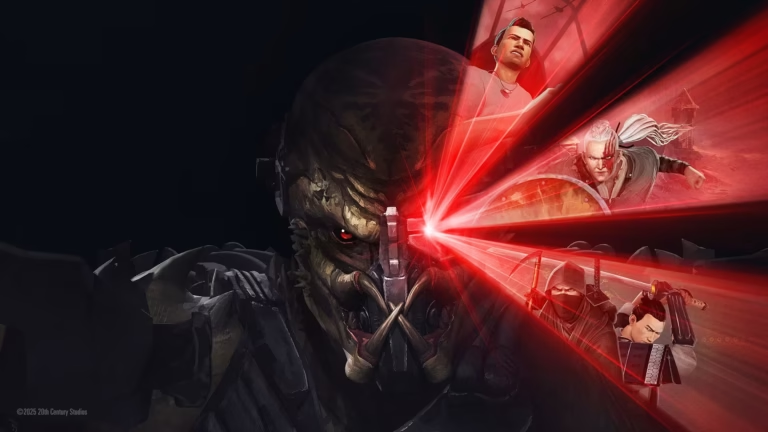
Predator: Killer of Killers stands as one of 2025’s most audacious and surprising cinematic achievements—an animated anthology film that successfully proves the Predator franchise has extraordinary potential beyond live-action spectacle. Released on June 6, 2025, exclusively on Hulu and Disney+, this film demonstrates that the franchise is thriving under director Dan Trachtenberg’s creative vision.
This comprehensive Predator: Killer of Killers review explores every dimension of this groundbreaking animated film—from its innovative anthology structure and exceptional voice cast to its technical animation mastery, thematic depth, and why this boldly original approach reinvigorates the legendary sci-fi action franchise. Whether you’re a devoted Predator fan, animated film enthusiast, or simply seeking quality streaming content, this complete guide explains why Predator: Killer of Killers deserves immediate watching.
Predator: Killer of Killers: Essential Film Information
Director, Writers & Production Team
Predator: Killer of Killers comes from the creative vision of director Dan Trachtenberg, the filmmaker behind the acclaimed 2022 Predator prequel Prey. Trachtenberg developed this animated feature secretly while simultaneously working on pre-visualization and development for the upcoming live-action film Predator: Badlands. This dual creative workload demonstrates Trachtenberg’s remarkable commitment to expanding the Predator franchise’s creative possibilities.
Co-directing with Trachtenberg is Josh Wassung, co-founder of The Third Floor, the animation company providing the film’s visuals. Screenwriter Micho Robert Rutare crafted the screenplay based on a story concept by Trachtenberg and Rutare, working from characters created originally by Jim Thomas and John Thomas.
Streaming Platform: Hulu (exclusive in United States), Disney+ (international release)
Format: Animated science fiction action anthology film
Runtime: 90 minutes (notably concise for its ambitious scope)
Release Date: June 6, 2025
Animation Studio: The Third Floor
Music Composer: Benjamin Wallfisch (known for Alien: Romulus; his first animated film score)
Studio/Distributor: 20th Century Studios
Producers: John Davis, Dan Trachtenberg (PGA), Marc Toberoff, Ben Rosenblatt (PGA)
Executive Producers: Lawrence Gordon, James E. Thomas, John C. Thomas, Stefan Grube
Film Classification: Sixth installment in the Predator franchise; First animated entry
Complete Voice Cast & Character Descriptions
The exceptional voice cast brings authenticity and emotional depth to the three interconnected warrior stories:
Lindsay LaVanchy as Ursa (Viking Raider – 841 A.D. Scandinavia): LaVanchy voices the fierce Viking warrior mother leading her son Anders on a revenge mission against the Krivich tribe. Her character anchors the film’s opening segment, portraying a mother balancing maternal protection with warrior determination. Ursa’s story emphasizes how personal vengeance transcends time, as she demonstrates extraordinary combat prowess while suffering the emotional weight of her son’s death during the Predator encounter.
Louis Ozawa as Kenji and Kiyoshi (Samurai Brothers – 1609 Japan): Ozawa previously appeared in Predators (2010) as Hanzo Kamakami. Here, he voices dual roles as feuding samurai brothers separated by ambition, shame, and family politics. His dual performance captures the complexity of sibling rivalry transformed into reluctant alliance when confronted by alien threat.
Rick Gonzalez as Torres (WWII Pilot – 1942 North Africa): Gonzalez brings dynamic energy to Torres, a grounded U.S. Navy mechanic suddenly drafted into extraordinary circumstances. His character arc explores how ordinary people display extraordinary courage when confronted with impossible odds and extraterrestrial threat.
Michael Biehn as Vandy (WWII Commander): Biehn, best known for Aliens (1986) as Corporal Hicks, brings gravitas to Captain Vandenburg. His performance provides emotional weight to the WWII segment, demonstrating how leadership demands ultimate sacrifice.
Doug Cockle as Einar (Viking Elder): Cockle voices Ursa’s father, whose death initiates her revenge quest. Though brief, his performance establishes the emotional catalyst driving the entire opening narrative.
Cherami Leigh as Young Ursa: Leigh voices young Ursa in flashback sequences, capturing the vulnerability that paradoxically strengthens the adult Ursa’s determination.
Supporting Voice Cast: Jeff Leach, Damien Haas, Lauren Holt, Piotr Michael, Andrew Morgado, Felix Solis, Britton Watkins provide additional voices creating the rich world populated by Viking warriors, Japanese nobility, WWII soldiers, and ultimately, alien hunters.
Plot Overview & Anthology Structure
Central Premise: Warriors Across Time Face Ultimate Predator
Predator: Killer of Killers employs an innovative anthology structure spanning three distinct historical periods. The film presents three separate warrior stories—each featuring devastating encounters with Predators—that gradually interconnect toward an ambitious final act revealing deeper conspiracy.
The film’s structure itself represents a thematic statement: that certain archetypes of human warriors—the furious mother defending her lineage, the conflicted warrior seeking redemption, the pilot protecting his squadron—emerge repeatedly across history, each facing identical extraterrestrial threat.
Segment 1: Viking Vengeance (841 A.D. Scandinavia)
The film opens in ancient Scandinavia with Ursa, a Viking warrior mother leading her son Anders and their clan against the Krivich tribe. Their target is Zoran, responsible for forcing Ursa to kill her own father when she was younger. This deeply personal vendetta propels the opening segment—a brutal meditation on how trauma perpetuates across generations.
The Vikings slaughter the Krivich clan, and Ursa personally confronts Zoran. Before she can claim complete revenge, Anders beheads Zoran, denying Ursa the final kill. This moment proves significant—Ursa’s need for personal vengeance remains unsatisfied, setting emotional stakes for the segment.
Immediately following the human victory, a Predator ambushes the Viking group. The creature systematically hunts Ursa’s warriors, killing them brutally. Anders suffers severe injuries protecting his mother. Ursa, demonstrating extraordinary skill and determination, engages the Predator in intense underwater combat, ultimately defeating and killing the creature—though her victory comes at catastrophic cost. Anders, mortally wounded, dies in Ursa’s arms, transforming her triumph into tragedy.
This opening segment establishes the film’s thematic foundation: human victory is simultaneously defeat. Warriors who triumph over human enemies discover that triumph means nothing against extraterrestrial threat. Personal survival becomes impossible without emotional devastation.
Segment 2: Samurai Redemption (1609 Feudal Japan)
The narrative shifts to feudal Japan, where brothers Kenji and Kiyoshi occupy conflicting positions in their clan. Kiyoshi, the favored son, defeats Kenji in a mandatory duel meant to determine their father’s successor. Kiyoshi’s victory comes with violent scarring—he deliberately scars Kenji’s face, marking his defeated brother as shame incarnate.
Kenji flees into exile, becoming a shinobi (ninja) in the shadows of Japanese society. Twenty years pass. Their father dies. Kiyoshi becomes lord of the region, secure in power. Kenji, driven by two decades of humiliation and rage, returns secretly to confront his brother.
Kenji infiltrates Kiyoshi’s castle with shinobi stealth, confronting his brother in sword combat. Kenji defeats Kiyoshi decisively, returning the scar—literally marking Kiyoshi’s face with identical wound. This moment represents perfect revenge symmetry: Kenji restores equilibrium through matched violence.
However, as Kiyoshi falls wounded into the castle moat, a Predator attacks. The creature kills Kiyoshi’s remaining guards with systematic brutality. Kenji, despite his shinobi skills and combat prowess, barely escapes. Recognizing the futility of individual warrior power against extraterrestrial threat, Kenji performs extraordinary action: he saves his dying brother.
This segment’s emotional core emerges in its climax: the feuding brothers, driven by decades of mutual hatred, unite against shared threat. Their combined effort kills the Predator, but Kiyoshi dies from injuries sustained—both from Kenji’s blade and the Predator’s weapons. Kenji achieves revenge and resurrection of family bonds simultaneously, only to suffer loss again.
Segment 3: Pilot’s Sacrifice (1942 WWII North Africa)
The timeline shifts forward to 1942 North Africa, where Torres, a U.S. Navy mechanic, serves under Captain Vandenburg. During the North African campaign, the squadron encounters a mysterious aircraft that destroys allied units with impossible precision. Torres, grounded from flight duty due to mechanical malfunction, suspects the aircraft is anomalous—not human-constructed.
Torres attempts warning the squadron that the aircraft is an extraterrestrial Predator starship, but arrives too late. The Predator pilot systematically eliminates the allied squadron, killing Torres’ fellow soldiers with technological precision. Only Torres and Vandy survive.
Vandy, demonstrating extraordinary courage, sacrifices himself—allowing Torres time to escape and counterattack. Torres, piloting a damaged Grumman F4F Wildcat fighter, outmaneuvers the vastly superior Predator technology through creative thinking and intimate knowledge of his aircraft’s capabilities.
In the film’s most spectacular aerial sequence, Torres tricks the Predator starship into destroying itself, achieving victory against impossible odds. He survives the crash, is rescued, and decorated for valor. He returns home to his garage, seemingly achieving safe refuge from conflict.
The segment’s conclusion shatters this apparent peace: another Predator ship arrives, abducting Torres from his civilian sanctuary. This moment proves crucial—victory doesn’t grant safety. Predators recognize skilled warriors and continue hunting them across decades and geographical distance.
Final Segment: Alien Gladiatorial Arena
The film’s final act reveals that Ursa, Kenji, and Torres—three warriors separated by centuries and continents—have been preserved through Predator technology. All three warriors awaken in cells aboard an alien vessel, placed in suspended animation after killing their respective Predators.
They’re transported to an arid desert alien world—a gladiatorial arena presided over by a Predator warlord Ursa dubs the “Grendel King.” This Predator demands the three warriors fight to the death, with the survivor fighting the Grendel King himself.
Initially, Ursa attacks Kenji and Torres, assuming betrayal. Eventually, the three recognize shared circumstance and unite. They coordinate tactical approach against a colossal alien beast unleashed by the Grendel King. Torres is apparently consumed by the creature but escapes internally, stealing a hoverbike and deactivating explosive collars.
The three warriors flee together toward the Grendel King’s starship. The Grendel King pursues, wielding devastating Predator weaponry. In climactic confrontation, the three warriors—representing different eras, cultures, and warrior traditions—combine their unique skills against superior extraterrestrial technology.
The film’s conclusion remains ambiguous and powerful, suggesting that human determination, tactical cooperation, and warrior spirit transcend technology, time period, and cultural origin. The final scenes leave viewers questioning the Predators’ ultimate fate and the warriors’ ultimate destination.
Technical Execution: Animation Excellence & Visual Mastery
Animation Style & Visual Design
Predator: Killer of Killers employs distinctive animation approach sometimes compared to video game aesthetics—a description that captures the film’s stylized but visceral quality. The Third Floor’s animation team created visuals emphasizing clarity, dynamic movement, and visceral impact over photorealism.
Each historical segment receives distinct visual treatment reflecting its era. Viking sequences employ cool tones, harsh lighting, and textures evoking Scandinavian environments. Japanese segments utilize sophisticated color grading reflecting feudal aesthetics—muted teals, golds, and shadow play emphasizing samurai honor traditions. WWII sequences employ period-accurate aircraft design with meticulous attention to military detail.
The Predator designs evolve across segments while maintaining franchise consistency. Rather than identical creatures, slight design variations suggest different Predators or evolutionary development. The final Grendel King represents apex Predator design—visually distinct, exponentially more dangerous, combining recognizable Predator elements with unsettling innovation.
Action Choreography & Combat Visualization
Animation allows action sequences impossible in live-action filmmaking. The underwater combat between Ursa and the Predator showcases swimming choreography, three-dimensional spatial awareness, and visceral brutality with unprecedented clarity. The samurai sword duel between Kenji and the Predator displays intricate blade work, environmental utilization, and tactical sophistication.
The WWII aerial combat represents the film’s technical pinnacle—three-dimensional aerial dogfighting sequences displaying both aircraft handling and alien technology with dynamic precision. These sequences would require extraordinary budget and months of filming in live-action; animation renders them with perfect clarity.
Direction & Pacing
Dan Trachtenberg directs with remarkable efficiency. Despite 90-minute runtime, the film presents three distinct stories with meaningful character development, establishing shots creating environmental atmosphere, and climactic action sequences without feeling rushed.
The pacing deliberately slows during character moments. Ursa’s grief holding her dying son; Kenji’s hesitation before saving Kiyoshi; Torres’ quiet moment in his garage before abduction—these pauses provide emotional weight preventing the film from devolving into pure action spectacle.
Sound Design & Original Score
Benjamin Wallfisch’s original score serves the film with remarkable subtlety. Rather than providing constant musical accompaniment, Wallfisch employs minimalist approach—letting silence and environmental sound dominate, reserving music for emotional peaks. This restraint makes musical moments exponentially more impactful.
Sound design throughout emphasizes visceral reality. Sword impacts, gunfire, Predator weapon discharge, creature vocalizations—all contribute to immersive sensory experience. The sound design team captured authentic period military sounds, creating WWII segment with surprising historical accuracy in audio dimension.
Major Themes: Why Predator: Killer of Killers Resonates
Human Determination vs. Technological Superiority
The film’s central theme explores whether human ingenuity, courage, and determination can overcome technological advantage. Each warrior—despite lacking advanced technology—defeats a Predator through tactical thinking, environmental awareness, and sheer determination. Yet victory never grants complete safety or permanent peace.
Generational Trauma & Cyclical Violence
Ursa’s quest for revenge stems from trauma inflicted upon her father. Kenji’s exile and return reflect decades of shame perpetuation. Torres represents innocence destroyed by conflict. The film suggests human violence follows patterns—trauma generates revenge, revenge generates more trauma, creating cycles breaking only through death or forced cooperation.
Universal Warrior Archetype Across Time & Culture
By presenting Vikings, samurai, and WWII pilots facing identical Predator threat, the film proposes that certain warrior archetypes—the protective mother, the disgraced fighter seeking redemption, the reluctant hero sacrificing for others—transcend historical period and cultural origin. These archetypes represent fundamental human responses to threat, honor, and survival.
Cooperation vs. Individual Achievement
The final segment’s crucial moment emerges when three warriors raised in completely different cultures, separated by centuries, recognize the necessity of cooperation. Individual warrior excellence proves insufficient—only unified effort achieves victory. The film celebrates individual skill while acknowledging that lone warriors, however exceptional, cannot defeat exponentially superior force.
Predator Mythology Expansion
The film’s revelation that Predators deliberately hunt and preserve exceptional human warriors expands franchise mythology. Predators aren’t mindless killing machines but sophisticated hunters with strategic hunting philosophy. The Grendel King represents apex hunter—not just physically superior but strategically brilliant.
Comparison to Previous Predator Films
Relationship to Prey (2022)
Predator: Killer of Killers directly follows the creative template established by Prey, Trachtenberg’s previous Predator entry. Both films place the Predator into different historical settings, emphasizing human warrior skill against alien threat. Both films feature protagonists using environmental knowledge and tactical thinking rather than advanced technology to achieve victory.
However, Killer of Killers expands the concept significantly. Where Prey focused on singular Comanche warrior Naru, Killer of Killers presents three interconnected warriors across wildly different eras and cultures. The anthology structure and final reveal suggest larger narrative implications for the entire franchise.
Relationship to Original 1987 Predator
John McTiernan’s original Predator (1987) emphasized squad dynamics, military hierarchy, and how elite soldiers recognize themselves outmatched by superior intelligence and technology. Killer of Killers echoes these themes while expanding them. Where the original film trapped soldiers on Earth, Killer of Killers expands the hunting grounds to alien worlds and across historical time.
Distinction from Previous Sequels
Unlike Predators (2010) or The Predator (2018), which faced critical reception challenges, Killer of Killers demonstrates how strategic creative choices revitalize franchises. The film’s animation medium, anthology structure, and refusal to explain away the Predator through scientific exposition create fresh approach while respecting franchise foundations.
Where to Watch: Streaming Information
Predator: Killer of Killers premiered exclusively on Hulu (June 6, 2025, United States) and Disney+ (international markets). The film is available for streaming on both platforms with active subscription.
Current Availability: Full film available for streaming on Hulu and Disney+ as of March 2026. The film represents direct-to-streaming release model, similar to Prey, suggesting this may become preferred distribution method for Predator franchise entries between theatrical releases.
Viewing Recommendations: The film benefits from large-screen viewing given its emphasis on spatial animation, aircraft design, and environmental detail. Sound system quality significantly enhances experience—the aggressive audio design and Benjamin Wallfisch’s score deserve quality playback.
Critical Reception & Audience Response
Predator: Killer of Killers achieved remarkable critical success. The film received positive reviews from many outlets, currently sitting on a 97% Fresh rating on Rotten Tomatoes after 68 reviews, with many reviews praising the three stories, action sequences, violence, the shocking conclusion and Predator easter eggs.
Critics particularly praised:
- Animation excellence — The technical execution and stylistic approach
- Trachtenberg’s direction — Efficient storytelling within 90-minute runtime
- Action sequences — Combat choreography and spectacle
- Voice performances — Emotional authenticity from cast
- Benjamin Wallfisch’s score — Original music enhancing emotional impact
Some critics noted the film’s narrative simplicity and character development constraints inherent to anthology structure. However, overwhelming consensus positioned Killer of Killers as significant franchise entry exceeding expectations for animated spinoff.
Frequently Asked Questions: Predator: Killer of Killers Explained
Q1: Is Predator: Killer of Killers canon to the main Predator franchise timeline?
A: Yes, Predator: Killer of Killers is officially recognized as the sixth installment in the Predator franchise. The film’s events—three warriors being collected by Predators—have direct narrative implications for the franchise’s expanding mythology. Director Dan Trachtenberg confirmed the film establishes lore relevant to future live-action entries, particularly Predator: Badlands.
Q2: Do I need to watch Prey before watching Killer of Killers?
A: Not required, but highly recommended. PreyKiller of Killers. The two films share thematic DNA—historical humans defeating Predators through tactical thinking. Watching Prey first enhances appreciation of how Killer of Killers expands these concepts across multiple eras and cultures.
Q3: Why is this film animated instead of live-action?
A: Animation allowed Trachtenberg to accomplish scope impossible within live-action budgets and production timelines. The underwater combat, three-dimensional aerial combat, exotic environments, and multiple distinct historical periods required animation to achieve visual clarity and narrative efficiency. Animation also enabled the film’s rapid development—Trachtenberg developed Killer of Killers while simultaneously preparing Predator: Badlands for theatrical release.
Q4: How does this film connect to Predator: Badlands?
A: Predator: Killer of Killers provides world-building context for Predator: Badlands (releasing November 7, 2025, theatrically starring Elle Fanning). The Grendel King and the gladiatorial arena revelation establish larger Predator civilization and hunting philosophy. Badlands will expand on mythology established in Killer of Killers, though each film functions independently.
Q5: Do the three warriors survive the final segment?
A: The film’s ending remains deliberately ambiguous. The three warriors flee toward the Grendel King’s starship with the Grendel King in pursuit. The final scenes suggest they may escape, but ultimate fates remain uncertain. This ambiguity invites interpretation and suggests potential for future franchise entries exploring these characters’ fates.
Q6: How does this film compare to other Predator sequels?
A: Killer of Killers achieved significantly stronger critical reception (97% Rotten Tomatoes) than previous sequels. Unlike Predators (2010) or The Predator (2018), this film receives universal praise for its execution. The animation medium, anthology structure, and creative storytelling distinguish it from previous entries while respecting franchise foundations.
Q7: Is this film appropriate for all viewers?
A: Predator: Killer of Killers is rated for mature audiences. The film contains intense violence, bloody action sequences, and death of characters including children (Anders). The WWII segment depicts aircraft attacking and killing soldiers. Parental discretion is strongly advised for younger viewers.
Q8: Where can I watch Predator: Killer of Killers?
A: The film is exclusive to Hulu (United States) and Disney+ (international markets). Both platforms require active subscription. The film is not available for theatrical viewing or digital rental/purchase separately.
Final Predator: Killer of Killers Review: Why This Film Deserves Your Attention
Predator: Killer of Killers represents creative achievement often missing from franchise filmmaking. Rather than repeating formulas, the film experiments boldly—employing animation, anthology structure, and historical variation to expand franchise mythology.
The film succeeds because it respects its source material while refusing to be constrained by franchise conventions. Dan Trachtenberg demonstrates why he’s become the franchise’s creative visionary—understanding what made the original Predator work while evolving the concept for contemporary audiences.
For Predator franchise enthusiasts, this film is essential viewing. For animated film appreciators, the technical execution and storytelling craft deserve recognition. For anyone seeking quality streaming content combining action, science fiction, and thematic depth, Predator: Killer of Killers rewards investment.
The film proves that franchise fatigue results from creative repetition, not the franchises themselves. Original creative vision—whether applying animation to established properties, employing anthology structure, or expanding mythologies—can revitalize even well-established intellectual properties.
Share Your Predator: Killer of Killers Thoughts
Have you watched Predator: Killer of Killers? Which warrior’s story resonated most powerfully—Ursa’s tragic revenge, Kenji’s redemption arc, or Torres’ unexpected survival? What did you think of the animation style and action choreography? Do you believe the three warriors escaped the Grendel King, or did you interpret the ending differently? How does this film compare to other Predator entries you’ve watched?
Drop your thoughts in the comments below. For more comprehensive film reviews and entertainment analysis, explore Popcorn Review’s coverage of streaming content, Hollywood productions, and animated films. Share this review on Instagram and Pinterest with fellow Predator fans and science fiction enthusiasts. 🎬👽

Popcorn in hand and a opinion ready — Emily covers movie reviews, box office buzz, and all things cinema at Popcorn Review.

