
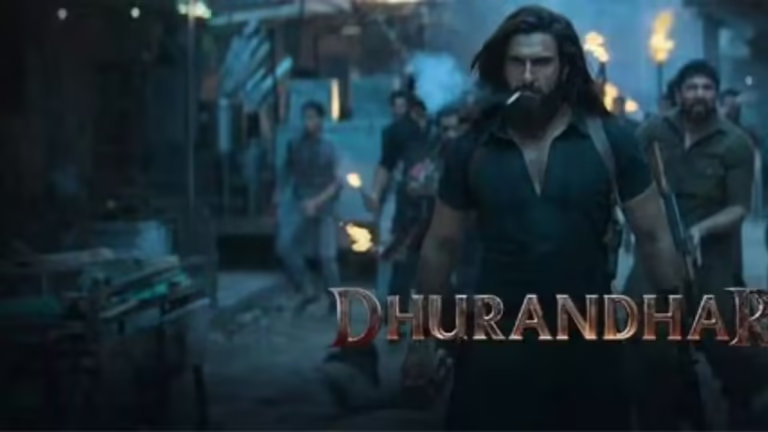
Dhurandhar stands as a watershed moment in Hindi cinema—a 214-minute (3 hours, 34 minutes) ambitious spy thriller that challenges every convention of mainstream Bollywood filmmaking. Released on December 5, 2025, director Aditya Dhar’s follow-up to the critically acclaimed Uri: The Surgical Strike represents a bold artistic statement: comprehensive, uncompromising, and politically provocative storytelling that refuses to simplify complex geopolitical realities into digestible entertainment.
This comprehensive Dhurandhar review explores every dimension of this monumental film—from its massive ₹1,350+ crore worldwide box office dominance and exceptional ensemble cast, through detailed narrative architecture and character development, to nuanced examination of its controversial political messaging and technical execution. Whether you view Dhurandhar as a patriotic masterstroke or propaganda tool, this complete analysis explains why the film dominated 2025 Hindi cinema and sparked passionate debate across social media, film criticism, and political commentary spheres.
Dhurandhar: Complete Production & Essential Information
Director, Writers, Producers & Creative Team
Dhurandhar emerges entirely from the creative vision of director Aditya Dhar, who wrote, co-produced, and directed the film. Dhar previously gained recognition for Uri: The Surgical Strike (2019), a military thriller exploring the 2019 Balakot airstrike’s tactical dimensions. Following Uri’s critical and commercial success, Dhar received creative freedom to develop his most ambitious project—a film he initially conceived as single feature but expanded into a two-part saga.
Director/Writer/Co-Producer: Aditya Dhar (Uri: The Surgical Strike, Boond—his National Award-winning short film)
Producers: Jyoti Deshpande, Aditya Dhar, Lokesh Dhar
Production Companies: Jio Studios, B62 Studios
Cinematography: Vikash Nowlakha (first collaboration with Dhar)
Music Composer: Shashwat Sachdev (second collaboration with Dhar after Uri: The Surgical Strike)
Lyrics: Irshad Kamil
Film Editing: Shivkumar V. Panicker
Production Design: Saini S. Johray
Art Director: Yogesh Bansode
Casting Director: Mukesh Chhabra (renowned for discovering new talent in Indian cinema)
Re-recording Mixer: Justin Jose
Runtime: 214 minutes (3 hours, 34 minutes)—one of the longest mainstream Hindi films in decades
Release Date: December 5, 2025
Filming Duration: July 2024 – October 2025 (approximately 15 months of principal photography)
Filming Locations: Punjab (India), Maharashtra (India), Himachal Pradesh (India), Ladakh (India), Thailand, Karachi (Pakistan sequences)
Estimated Production Budget: ₹150-200 crore (approximately $18-24 million)
Music Rights: Saregama
Complete Ensemble Cast & Character Descriptions
Ranveer Singh as Hamza Ali Mazari/Jaskirat Singh Rangi: The protagonist operates as a covert intelligence operative whose real identity remains concealed throughout the narrative. Singh delivers his most restrained, introspective performance—a departure from his signature high-energy charisma. As Hamza, Singh portrays a man consumed by his mission, haunted by his choices, and increasingly conflicted about the moral implications of his undercover existence. Critics and audiences universally praised Singh’s “subdued yet scorching” portrayal as a career-defining performance demonstrating his range beyond conventional hero roles.
Akshaye Khanna as Rehman Dakait: The antagonist emerges as the film’s most compelling character—a sophisticated Karachi underworld don whose intelligence and philosophical perspective elevate him beyond standard villain archetypes. Khanna’s riveting performance portrays Rehman as intelligent, cultured, and operating under coherent principles distinct from pure evil. The actor’s psychological warfare sequences with Singh represent masterclasses in tension and subtext. Industry observers unanimously acclaimed Khanna’s work as career-best performance that deserves major award recognition.
R. Madhavan as Ajay Sanyal/Ajit Doval: The IB chief who recruits Hamza for the undercover mission. Madhavan portrays Sanyal as strategically brilliant yet emotionally detached—a bureaucrat willing to sacrifice individual agents for national security objectives. His character embodies institutional Cold War mentality and geopolitical pragmatism.
Sanjay Dutt as SP Chaudhary Aslam: The Pakistani law enforcement officer whose sympathies remain ambiguous. Dutt’s nuanced portrayal captures a man caught between national loyalty and moral principle, between Pakistani and international interests.
Arjun Rampal as Major Iqbal: The military liaison navigating complicated intelligence operations. Rampal brings intensity and strategic sophistication to the role of a soldier operating in moral gray zones.
Sara Arjun as Sara/Saira: The female character navigating complex emotional and political dimensions. Arjun’s performance provides emotional counterpoint to the predominantly male-dominated action narrative.
Rakesh Bedi as Vikram Chaudhary: The seasoned intelligence operative providing mentorship and tactical support to Hamza. Bedi’s performance demonstrates that supporting characters receive substantive development rather than becoming mere plot devices.
Gaurav Gera in Supporting Role: The casting choices demonstrate Dhar’s commitment to ensemble depth rather than star-driven narrative.
Danish Pandor, Naveen Kaushik, Saumya Tandon, Manav Gohil: Additional supporting cast members bringing authentic performances to secondary characters.
Notable Cameos: Carl Andrew Harte portrays David Headley (real-life 26/11 Mumbai attacks conspirator); Dalvinder Saini portrays Ajmal Kasab (real-life Mumbai terrorist); additional cameos reference actual historical figures involved in real South Asian geopolitical events.
Detailed Plot Breakdown: Narrative Architecture & Story Progression
Act One: Introduction to the Undercover World (Chapters 1-3)
Dhurandhar opens by establishing Hamza Ali Mazari as an existing operative with established credibility within Karachi’s criminal ecosystem. Rather than following conventional undercover-agent-deployed-to-foreign-location narrative, the film assumes mid-operation reality—Hamza already possesses years of undercover infiltration.
The opening sequences immerse viewers in Karachi’s dangerous underworld, specifically Lyari district’s Rehman Dakait-controlled criminal network. The film employs chapter structure (visible title cards marking narrative divisions) to organize the sprawling three-hour narrative into digestible segments.
Dhar establishes the central dramatic tension: Hamza must infiltrate Rehman’s inner circle while reporting back to Indian intelligence agencies. The stakes involve not merely criminal investigation but counter-terrorism operations spanning nearly a decade of covert activity.
Act Two: Deepening Entanglement (Chapters 4-7)
As Hamza becomes increasingly embedded within Rehman’s criminal organization, his loyalties face unprecedented testing. The film weaves real historical events—the 1999 IC-814 hijacking, the 2001 Indian Parliament attack, the 2008 Mumbai attacks—into the narrative fabric, suggesting connections between criminal underworld and terrorist networks.
This act develops the psychological and emotional dimensions of long-term undercover operations. Hamza experiences genuine emotional connection to people he’s simultaneously betraying. His romantic attachment complicates professional objectives. His sense of identity fragments as he inhabits “Hamza” identity for extended periods, potentially losing touch with his authentic “Jaskirat” self.
The narrative explores moral ambiguity with sophistication. Rehman Dakait, despite being a criminal, articulates coherent philosophical perspectives about Pakistan, India, colonial legacy, and geopolitical power dynamics. Rather than portraying him as simplistically evil, Dhar presents him as intelligent antagonist with legitimate grievances and articulate worldview.
Act Three: Escalating Conflict (Chapters 8-10)
The final act escalates toward confrontation as Hamza’s undercover identity faces exposure. Multiple factions converge: Pakistani intelligence services, criminal elements, Indian agencies—all possessing conflicting objectives and incomplete information.
Dhar structures the climax to emphasize psychological warfare, tactical maneuvering, and intelligence-gathering rather than spectacular action sequences. While the film contains action, it prioritizes espionage elements—information, deception, strategic positioning—over kinetic spectacle.
The narrative concludes ambiguously, suggesting that Hamza’s mission remains incomplete and that personal and professional conflicts require further resolution. This directly sets up Part 2 (Dhurandhar: The Revenge, releasing March 19, 2026), positioning the first installment as the opening chapter of extended saga rather than standalone feature.
Structural Innovation: Chapter-Based Narrative
Dhar’s choice to organize the narrative into visible chapters (reminiscent of episodic streaming television) serves multiple purposes: the chapter structure breaks the 214-minute runtime into digestible segments, provides narrative breathing room for complex espionage plotting, and creates structural similarity to episodic storytelling audiences increasingly expect from long-form entertainment.
Comprehensive Character Analysis: Psychological Depth & Performance Excellence
Hamza Ali Mazari: The Fractured Identity
Ranveer Singh’s central performance explores identity fragmentation resulting from extended undercover operations. Hamza represents the ultimate cost of espionage: the operative loses himself within the constructed identity. Singh portrays this psychological deterioration through subtle physical performance choices—the gradual erosion of Jaskirat Singh Rangi’s identity as Hamza Ali Mazari becomes more “real” than his authentic self.
The performance demonstrates Singh’s capability for restraint and psychological complexity absent from his previous mainstream roles. Rather than grand dramatic gestures, Singh communicates internal conflict through quiet moments—a nearly imperceptible shift in body language, a micro-expression revealing doubt, momentary vulnerability in scenes of solitude.
Singh’s face-off sequences with Akshaye Khanna represent the film’s greatest performances—two actors communicating volumes through minimal dialogue, understanding each other’s intentions through psychological precision. These scenes exemplify acting at its finest.
Rehman Dakait: The Intelligent Antagonist
Akshaye Khanna’s portrayal transcends conventional villainy by presenting Rehman as intelligent, cultured, and philosophically coherent. Khanna communicates Rehman’s danger through intellectual authority and psychological sophistication rather than physical menace. His scenes articulate geopolitical perspectives about Indian-Pakistan history, colonial legacy, and power dynamics.
The performance sophistication emerges in Khanna’s ability to convey multiple layers—surface charisma and menace masking deeper insecurity and philosophical doubt. Rehman questions his own choices and ideology, creating surprisingly human antagonist rather than cardboard villain.
Khanna’s work deserves serious award recognition. His performance represents Indian cinema’s best acting in this cinematic cycle, demonstrating range and depth rarely seen in mainstream films.
Ajay Sanyal: Institutional Cold War Mentality
R. Madhavan portrays the intelligence chief as strategically brilliant but emotionally detached—representing institutional apparatus prioritizing national security over individual welfare. Madhavan communicates this through deliberate coldness, minimalist dialogue, and philosophical distance from personal consequences.
Sanjay Dutt: The Ambiguous Pakistani Officer
Dutt’s portrayal refuses simplistic national allegiance, instead presenting a professional law enforcement officer navigating conflicting loyalties. His character represents the human possibility of friendship and professional respect transcending national boundaries.
Technical Execution: Cinematography, Direction & Production Mastery
Cinematography: Capturing Urban Authenticity
Vikash Nowlakha’s cinematography grounds the film in gritty realism rather than stylized artifice. The visual language emphasizes authenticity of location and environment—Karachi’s streets, criminal underworld spaces, and operational settings receive documentary-like treatment within narrative film structure.
Nowlakha employs relatively naturalistic lighting avoiding melodramatic chiaroscuro, instead utilizing practical light sources and environmental illumination. This approach reinforces verisimilitude, making undercover operations feel authentically dangerous and immediate rather than cinematic spectacle.
The cinematography distinguishes between spaces: IB headquarters communicate institutional coldness through sleek, minimalist design; criminal underworld locations display dense, chaotic atmosphere reflecting moral and social disorder. This visual contrast supports thematic distinctions between institutional intelligence and criminal networks.
Direction: Managing Ambitious Scope
Aditya Dhar’s directorial achievement emerges in managing 214-minute runtime without excessive indulgence. The chapter structure creates structural rhythm preventing narrative fatigue. Dhar balances action sequences, dialogue-heavy scenes, and psychological moments—creating varied pacing within extended runtime.
Dhar’s direction prioritizes psychological tension over action spectacle. Extended face-off sequences between Singh and Khanna generate suspense through performance and subtext rather than editing dynamics or visual effects. This approach respects audience intelligence, trusting viewers to find tension in professional confrontation and psychological warfare.
The director’s commitment to geopolitical authenticity influences his visual choices—refusing exaggeration, maintaining emotional authenticity even during action sequences, and grounding espionage within realistic operational parameters.
Music Composition: Shashwat Sachdev’s Evocative Score
Shashwat Sachdev’s second collaboration with Dhar creates music serving narrative function rather than commercial calculation. The background score operates as character—pounding rhythms during tense sequences, haunting melodic passages during emotional beats, and sparse instrumentation during psychological confrontation scenes.
The title track (featuring Hanumankind and Jasmine Sandlas) represents a remake of 1995 Punjabi song “Na Dil De Pardesi Nu,” aesthetically grounding the narrative in South Asian cultural context while maintaining contemporary production values. The lyrical content addresses themes of displacement and identity—thematically relevant to Hamza’s undercover existence.
Rather than overwhelming narrative with manipulative emotional cues, Sachdev’s score respects scene content, supporting without dominating. This restraint elevates the score’s effectiveness—music becomes more impactful through selective deployment.
Editing & Pacing: Narrative Rhythm Management
Shivkumar V. Panicker’s editing demonstrates sophisticated rhythm management across 214 minutes. Rather than conventional scene-by-scene cutting, Panicker employs extended takes during psychological confrontations, emphasizing performance and subtext over rapid visual cuts.
The chapter structure (Panicker’s editing responsibility) creates natural pause points—viewers recognize narrative segments and can anticipate pacing shifts. This structure prevents the extended runtime from becoming burdensome.
Production Design: Authentic Environmental Storytelling
Saini S. Johray’s production design avoids Hollywood exaggeration, instead emphasizing authentic architectural and environmental choices. Karachi locations receive treatment respecting geographic reality—not exotic spectacle but functional urban spaces serving narrative function.
The design philosophy extends to intelligence headquarters, criminal safe houses, and operational staging areas—each space communicates thematic content through environmental detail.
Box Office & Commercial Performance: Record-Breaking Achievement
Opening Weekend & Initial Performance
Dhurandhar shattered box office records with phenomenal opening—the film earned substantial collections across all territories, immediately becoming the highest-grossing Indian film of 2025.
Global Box Office Totals
Domestic (India) Collection: ₹1,056.62 crore (approximately $120 million)
International Collection: ₹293.03 crore (approximately $35 million)
Worldwide Total: ₹1,349.65 crore (approximately $160 million USD)
Ranking Achievement: – Highest-grossing Indian film of 2025 – Second highest-grossing Hindi film of all-time (after highest-grossing Bollywood films) – Fourth highest-grossing Indian film of all-time – Highest-grossing first installment of a franchise opening
Financial Success Factors
The exceptional box office performance reflects multiple factors: Ranveer Singh’s star power combined with ensemble cast appeal, Aditya Dhar’s proven track record (Uri’s commercial success), geopolitical timing coinciding with heightened India-Pakistan tensions, and word-of-mouth regarding the film’s ambitious scope and performances.
The 214-minute runtime—typically considered box office liability—failed to deter audiences, suggesting viewers recognized the investment’s worthiness.
International Performance
International collections (approximately 20% of global total) demonstrate the film’s global appeal beyond South Asian diaspora markets. North American collections particularly exceeded typical Bollywood expectations, suggesting the film’s spy thriller format transcended regional appeal.
Critical Reception: Scores, Consensus & Interpretation
Rotten Tomatoes & Aggregator Scores
IMDb Rating: 8.3/10 (based on 50,000+ user reviews)
Letterboxd Critical Reception: Mixed to positive, with particular praise for performances and criticism regarding propaganda elements
Major Critical Reviews
The Hindu (Anuj Kumar): “Moored by a charismatic Akshaye Khanna and a brooding Ranveer Singh, Aditya Dhar’s ambitious but overstretched and chest-thumping espionage saga serves political interests, tests endurance.”
The Hollywood Reporter India (Rahul Desai): “Aditya Dhar’s second film after Uri: The Surgical Strike stars Ranveer Singh as a patriotic spy trapped in an inert and distracted action thriller.”
Mint (Uday Bhatia): “Dhurandhar offers sadism and expert bad vibes and it shares something else fundamental with Dhar’s previous work—it’s propaganda in service of a hawkish India, designed to flatter the ruling BJP leadership.”
The Times of India (Renuka Vyavahare): “3.5/5 stars — Power-packed Karachi mafia thriller where lead actor Ranveer Singh delivers a subdued yet scorching performance that largely anchors the film’s impact. The film’s immersive world-building, gritty, violent underworld narrative…rarely feels overbearing, owing to stylish, tight storytelling.”
Filmfare (Devesh Sharma): “3.5/5 stars — Aditya Dhar’s Dhurandhar is a film that refuses to be contained by the grammar of a conventional spy thriller.”
IGN (Siddhant Adlakha): “8/10 stars — Bollywood gangster saga Dhurandhar walks a fine line between raucous entertainment and hateful propaganda.”
Critical Consensus
Critics nearly universally praised:
- Akshaye Khanna’s career-best performance as Rehman Dakait
- Ranveer Singh’s mature, restrained portrayal of Hamza
- Technical excellence (cinematography, editing, sound design)
- Psychological sophistication over action spectacle
- Ambitious scope and extended runtime justified by narrative depth
- Face-off sequences between Singh and Khanna representing acting mastery
Critics nearly universally criticized:
- Political propagandistic messaging serving “hawkish India” ideology
- Historical revisionism regarding real geopolitical events
- Simplistic portrayal of Pakistan and Pakistani character
- Jingoistic patriotism potentially glorifying violence
- Narrative unevenness within extended 214-minute runtime
- Third act feeling rushed despite extended duration
Controversy & Political Messaging: Propaganda Accusations Explained
The Central Controversy
Dhurandhar sparked heated debate regarding its political messaging and potential propaganda function. Critics argue the film deliberately employs real geopolitical events—the IC-814 hijacking, 2001 Parliament attack, 2008 Mumbai attacks—to suggest connections between criminal underworld and terrorist networks, creating implicit accusations against Pakistan’s government and intelligence apparatus.
Specific Accusations
Historical Revisionism: Critics argue the film oversimplifies complex historical events, employing cinematic narrative to suggest causality and responsibility where historical reality remains contested and ambiguous.
Stereotyping Pakistan: The portrayal of Pakistan as exclusively characterized by corruption, terrorism, and criminal networks receives criticism as reductive and dehumanizing. Even sympathetic Pakistani characters (like Chaudhary Aslam) ultimately serve Indian intelligence interests.
Jingoistic Patriotism: Critics argue the film employs patriotic language and emotional appeals to justify violence and dehumanization. The film’s implicit message—that extreme measures become justified when protecting national interests—raises ethical concerns.
Supporting Ruling Government Ideology: Multiple critics explicitly note the film aligns with current BJP government’s hawkish India-Pakistan positioning. The film’s geopolitical perspective reflects and reinforces government ideological positioning.
Defensive Arguments
Supporters counter that:
- The film accurately reflects real counterterrorism operations’ brutality and moral complexity
- Depicting realistic geopolitical tensions doesn’t constitute propaganda—it represents authentic storytelling
- Pakistan’s government has engaged in genuinely problematic activities that cinema can legitimately explore
- Portraying Pakistani characters with agency and intelligence (Khanna’s Rehman) suggests respect for Pakistani sophistication
- Art inevitably reflects creators’ political perspectives; attributing all political content to propaganda oversimplifies artistic expression
The Ranveer Singh Controversy
During film promotion at the International Film Festival of India in Goa, Ranveer Singh mimicked a sacred Bhoota Kola ritual (Tulu indigenous tradition), which audience members found disrespectful. Singh subsequently issued formal apology, and in January 2026, an FIR (First Information Report) was filed alleging he hurt religious sentiments.
This separate incident highlighted broader tensions around cultural respect and appropriation in entertainment.
Detailed Comparison to Other Spy Thrillers & Ranveer Films
Comparison to Pathaan (Shah Rukh Khan, 2023)
Pathaan represented Bollywood’s then-recent spy thriller success. Comparison reveals fundamental differences: Pathaan prioritized action spectacle and romance subplots; Dhurandhar emphasizes psychological complexity and espionage realism. Pathaan’s protagonist remained morally clear; Dhurandhar’s Hamza exists in moral ambiguity. Pathaan provided conventional entertainment conclusion; Dhurandhar ends ambiguously, setting up continuation.
Comparison to War 2 (Hrithik Roshan, 2025)
War 2 represented contemporary action thriller featuring superstar. Dhurandhar employs different philosophical approach—less spectacle-oriented, more character-driven narrative.
Comparison to Ranveer Singh’s Previous Spy Thriller Work
Singh’s previous roles (Band Baaja Baaraat, Padmaavat, 83) emphasized different acting registers. Dhurandhar presents his most restrained, psychologically complex character—demonstrating range exceeding his typical roles.
Comparison to International Spy Franchises
Dhurandhar’s scope and ambition approximate Hollywood spy franchises (Mission: Impossible, James Bond), suggesting Bollywood’s capability for franchise-level production values and narrative sophistication.
Frequently Asked Questions: Dhurandhar Explained
Q1: Is Dhurandhar worth watching despite its 214-minute runtime?
A: Absolutely. The extended runtime justifies itself through narrative depth, character development, and psychological sophistication. Unlike conventional lengthy films that feel padded, Dhurandhar’s length serves storytelling function. The chapter structure prevents runtime fatigue. For viewers appreciating intelligent spy thrillers with substantive character development, the investment proves worthwhile.
Q2: Is Dhurandhar propaganda?
A: This remains contested. The film definitely employs real geopolitical events to advance its narrative and reflects director Aditya Dhar’s political perspective. Critics argue it serves hawkish India ideology; supporters contend it authentically portrays counterterrorism complexity. Cinema inevitably reflects creators’ perspectives—whether this constitutes “propaganda” depends on evaluative framework. Viewers should watch with awareness of the film’s political messaging and form independent judgments.
Q3: Do I need to watch Part 1 before Part 2?
A: Yes, absolutely. Part 1 (Dhurandhar, December 2025) and Part 2 (Dhurandhar: The Revenge, March 2026) comprise single narrative split into two installments. Part 1 ends ambiguously, directly setting up Part 2. Watching Part 2 without Part 1 context would prove confusing.
Q4: Which performance deserves more recognition—Singh or Khanna?
A: Both performances rank among Hindi cinema’s finest. Singh’s restrained, psychologically complex portrayal demonstrates range. Khanna’s antagonist transcends villainy through intelligence and philosophical sophistication. Khanna’s performance perhaps receives less mainstream recognition despite excellence—his work deserves serious award consideration.
Q5: How does this compare to Uri: The Surgical Strike?
A: Uri represented military action thriller celebrating specific tactical operation. Dhurandhar expands into extended undercover operation with greater psychological complexity and moral ambiguity. Uri was more straightforward patriotic entertainment; Dhurandhar engages more complicated geopolitical questions. Both films reflect Aditya Dhar’s sensibility but Dhurandhar represents significant creative expansion.
Q6: Is the film appropriate for all audiences?
A: No. Dhurandhar carries an A rating (Unrestricted Public Exhibition) due to violence, sexual content, and adult themes. The film contains intense action violence, blood, and morally complex scenarios. Viewers should respect content warnings—the film targets mature audiences comfortable with gritty, violent storytelling.
Q7: Will there be a third Dhurandhar installment?
A: Director Aditya Dhar has not confirmed plans beyond Part 2. The initial conception involved two-part saga—Part 1 opens the operation, Part 2 presumably concludes it. Extended franchise possibilities remain unconfirmed but the two-part structure suggests intended conclusion within two films.
Q8: What’s the best viewing format for Dhurandhar?
A: Theatrical exhibition on large screens with quality sound systems optimizes the cinematic experience. The extended runtime and immersive storytelling benefit from theatrical presentation. However, streaming availability (expected post-theatrical window) will accommodate viewers unable to experience theatrical exhibition. IMAX or premium format screens further enhance the experience, though standard theatrical presentation satisfies the film’s technical requirements.
Final Dhurandhar Review: Assessment & Overall Evaluation
Dhurandhar represents one of Hindi cinema’s most ambitious, controversial, and technically accomplished films. Aditya Dhar’s unflinching examination of undercover operations, geopolitical complexity, and moral ambiguity transcends conventional spy thriller conventions.
The film’s greatest achievement emerges in its performances—Ranveer Singh’s mature restraint, Akshaye Khanna’s intelligent antagonism, and ensemble casting elevate psychological dimensions over action spectacle. These performances rank among Hindi cinema’s finest achievements.
The film’s controversial political messaging demands engagement rather than dismissal. Whether viewers perceive propaganda or authentic storytelling reflects evaluative perspectives. The film provokes genuine debate regarding geopolitical representation, national interest justifications for violence, and cinema’s political responsibility.
The extended runtime challenges conventional commercial filmmaking. Yet Dhurandhar justifies its 214 minutes through narrative depth, character development, and psychological sophistication. The chapter structure prevents fatigue while supporting thematic progression.
Technical excellence—cinematography, editing, sound design, music composition—demonstrates Bollywood’s capacity for production-value parity with international cinema. Vikash Nowlakha’s cinematography, Shashwat Sachdev’s score, and Shivkumar V. Panicker’s editing elevate material through professional execution.
Final Rating: 8.5/10 — Exceptional performances, technical mastery, and psychological sophistication distinguish Dhurandhar as significant Hindi cinema achievement. Political messaging invites critical engagement. Extended runtime serves narrative function. A must-watch for serious cinema enthusiasts.
Recommendation: Watch Dhurandhar if you appreciate intelligent spy thrillers, exceptional acting performances, and willingness to engage politically complicated cinema. Expect moral ambiguity, intense action violence, and 214-minute commitment. Avoid if you prefer conventional patriotic entertainment or dismiss any film with political perspective as propaganda. Dhurandhar rewards engaged viewing and critical thinking.
Share Your Dhurandhar Reactions & Perspectives
Have you watched Dhurandhar? What did you think of Ranveer Singh’s restrained performance? Did Akshaye Khanna’s portrayal exceed expectations? How do you interpret the film’s political messaging—is it propaganda or authentic storytelling? Did the 214-minute runtime feel justified? Will you watch Part 2? How would you rate the film?
Drop your thoughts in the comments below. For more comprehensive film reviews and entertainment analysis, explore Popcorn Review’s coverage of Bollywood blockbusters, box office trends, and upcoming releases. Share this review on Instagram @pop_cornreview and Pinterest @PopcornReview with fellow cinema enthusiasts! 🎬🍿

Popcorn in hand and a opinion ready — Emily covers movie reviews, box office buzz, and all things cinema at Popcorn Review.

