
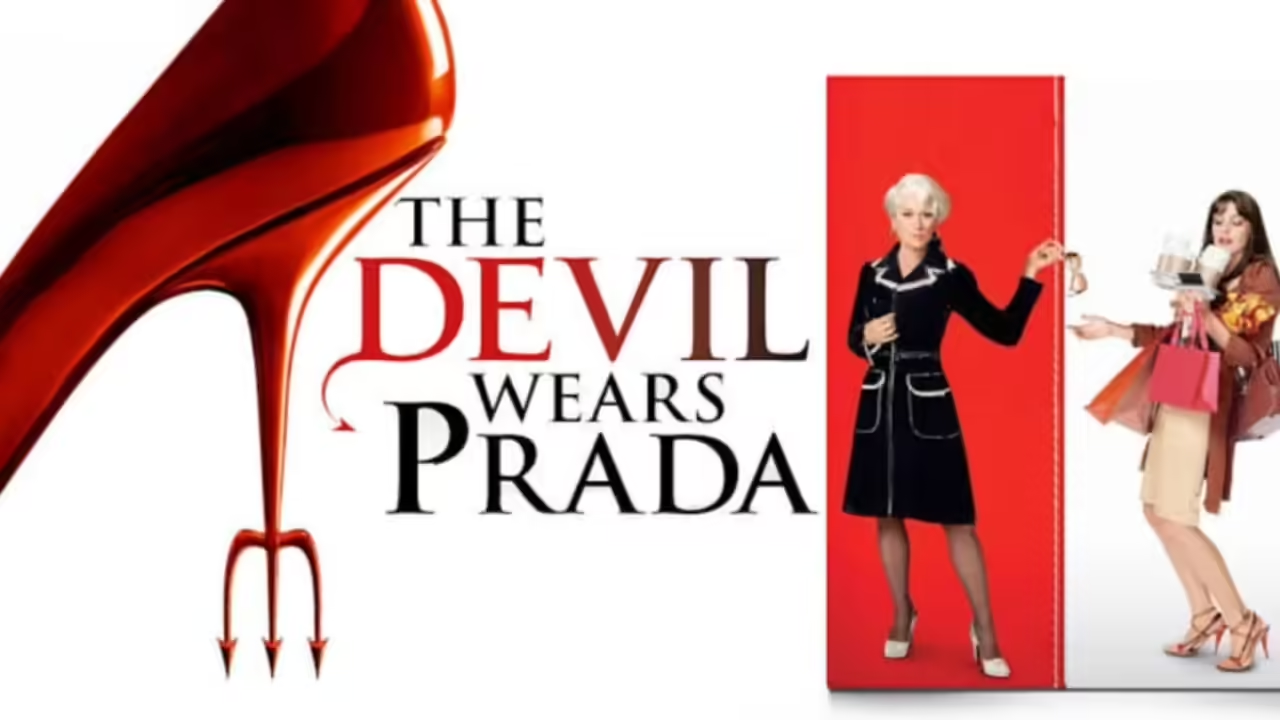
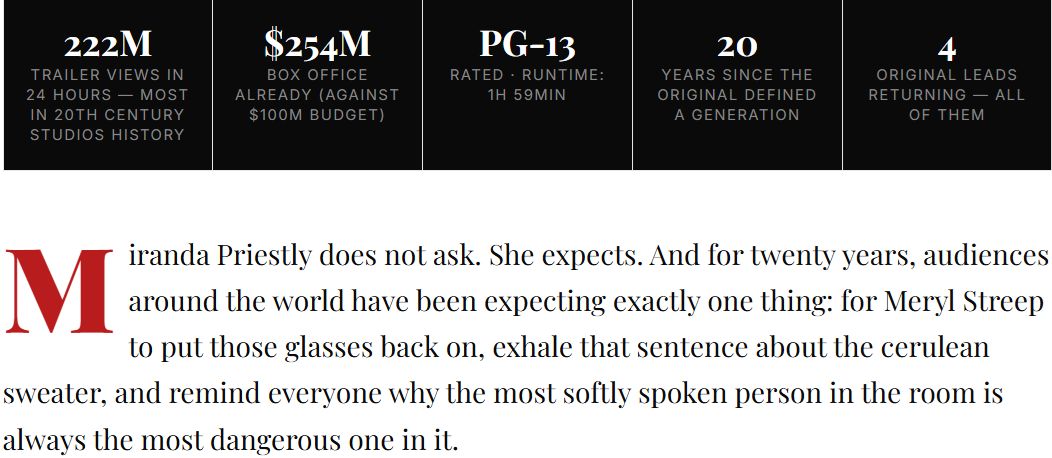
They are about to get what they asked for — on May 1, 2026, in theatres everywhere. And the answer to the question the internet has been asking since July 2024, when the sequel was first announced, is: yes. It was worth it. The original miracle didn’t repeat — it rarely does. But what arrived instead is something richer, stranger, and more honest about power and ageing and legacy than the cheerful comedy of the original had any obligation to be.
Here is everything you need to know, starting with the basics and building to the things the trailers don’t tell you.
The Story
📖 The Plot — What Actually Happens
Two Decades Later, Everyone Has Become Someone Else’s Miranda.
Andy Sachs (Anne Hathaway) is no longer a junior assistant. She has become a respected journalist — the kind of career she always wanted. But the world she works in has been hollowed out by technology and money. Her entire newsroom is laid off by text message during a awards gala — abruptly, without ceremony. The cruelty of it is the point.
Meanwhile, Miranda Priestly (Meryl Streep) is navigating the most humiliating challenge of her career: she allowed a laudatory piece about a luxury brand to run in Runway without proper vetting, and it turned out the brand used sweatshop labour. Her authority is damaged. Her judgment is publicly questioned. Irv Ravitz — Runway’s owner and Miranda’s boss — decides the magazine needs credibility it currently lacks.
His solution: hire Andy as Runway’s new Features Editor. Without asking Miranda. Andy reports to work. Miranda’s displeasure is immeasurable but, for once, she cannot simply dismiss it. Because Irv has given Andy the job specifically to limit Miranda’s power.
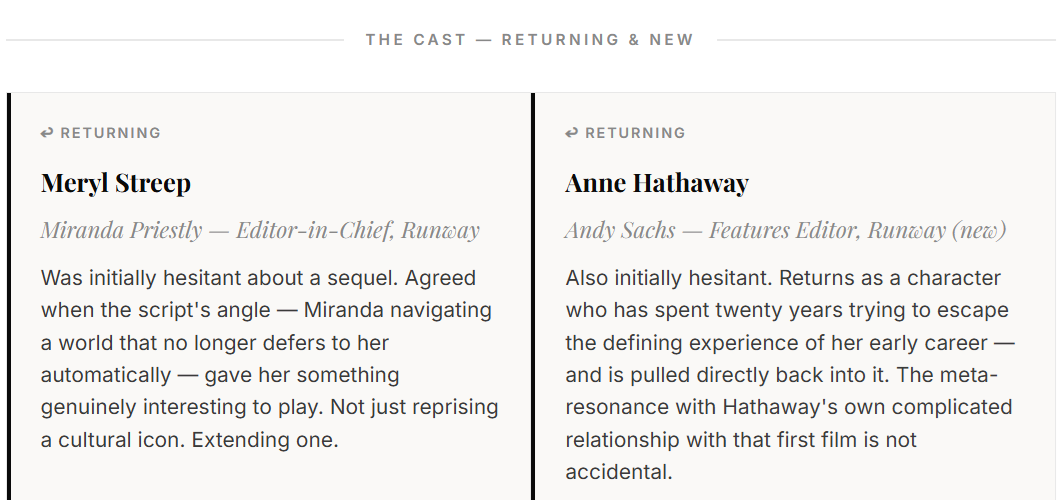
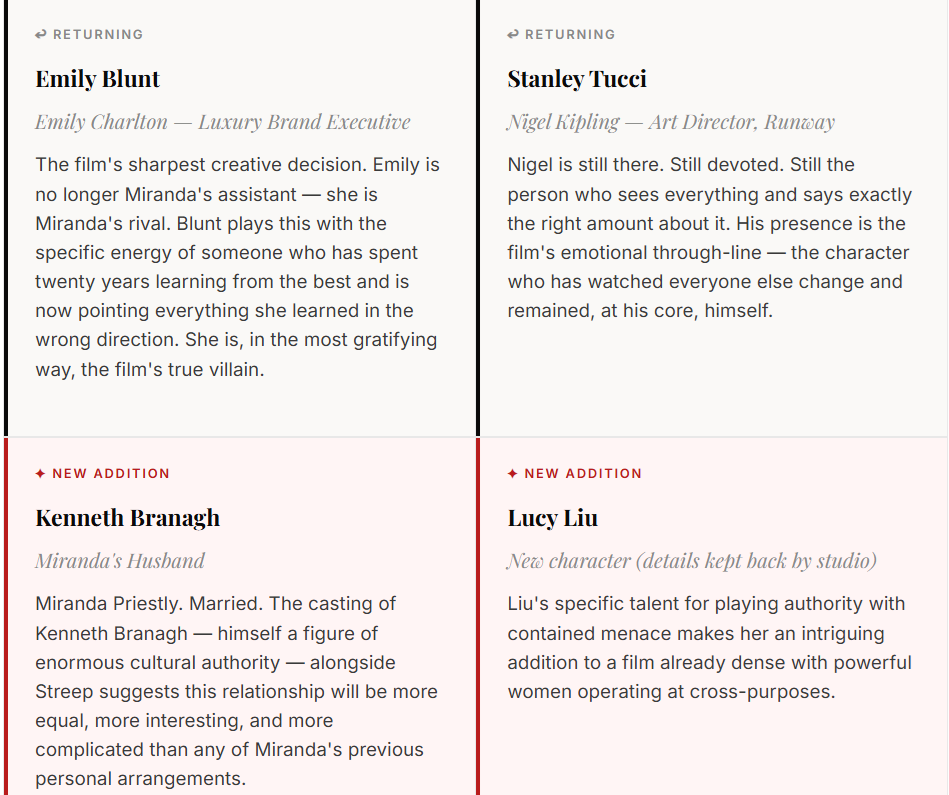
And then there is Emily Charlton (Emily Blunt) — Miranda’s former first assistant, now a high-powered luxury brand executive whose advertising budget Miranda desperately needs. Emily has all the power. She has become, in every meaningful sense, the person she spent years assisting. She knows exactly how Miranda operates. She knows exactly where the weaknesses are. And she is not above using that knowledge.
The film is about three women, two decades of accumulated ambition and grievance, a failing industry, and the question of what happens to power when the systems that sustained it start to crack.
The observation was pointed because Devil Wears Prada 2 is a theatrical release, not a streaming one. The debate — about whether the homogenisation of streaming visual aesthetics is now infecting theatrical filmmaking — ran for weeks online and generated a level of cinematography discourse unusual for a fashion comedy sequel. Production designer Jess Gonchor and director David Frankel have both addressed the criticism; the final film will confirm whether it was a trailer-grade issue or a deeper aesthetic choice.
- Box office:$326.7M globally
- RT score:75% critics, 82% audience
- The world:Fashion magazines as cultural force
- Andy:Ambitious outsider, learning to survive
- Emily:Insider, Miranda’s weapon
- Miranda:Untouchable, all-powerful
- Theme:What are you willing to become?
- Tone:Comedy with a fashionable sting
- Anna Wintour:Subject of satirical inspiration
- Box office:$254M+ and climbing
- RT score:Generally positive reviews (premiered April 20)
- The world:Fashion magazines in decline; digital disruption
- Andy:Established journalist, career upended, pulled back in
- Emily:Power broker — Miranda’s adversary
- Miranda:Still formidable, but navigating a world that no longer automatically defers
- Theme:What does power look like when the systems change?
- Tone:Comedy with a darker, more honest sting
- Anna Wintour:Appeared on Vogue cover alongside Streep in April 2026
The original The Devil Wears Prada (2006) is, by any cultural measure, one of the most enduring films of the 2000s. It grossed $326.7 million globally against a $35 million budget. Meryl Streep was nominated for an Academy Award for Best Actress — her fifteenth nomination. Emily Blunt made her American breakthrough. The cerulean sweater monologue entered the cultural vocabulary of a generation that was not in the workforce when the film released but grew up quoting it.
https://www.youtube.com/watch?v=PMd1at7OwiE&pp=ygUXVGhlIERldmlsIFdlYXJzIFByYWRhIDI%3D
Its themes — ambition vs. authenticity, the cost of success, the way institutions extract labour from people who are desperate to be inside them — only became more relevant with time. A film about a young woman discovering that succeeding at a prestigious job requires her to become someone she doesn’t fully recognise landed differently in 2014 than it did in 2006, and differently again in 2021, and differently yet again in 2026. It is the kind of film that people return to when something in their working life needs naming.
“The reason The Devil Wears Prada has lasted is that it’s a film about the gap between what you think success will feel like and what it actually is. That’s a gap that doesn’t close.”
The sequel has an unusual advantage and an unusual burden. The advantage: audiences already love these characters with the specific warmth reserved for films that accompanied them through formative experiences. The burden: the original is not just remembered fondly — it is practically memorised. Every line Miranda delivers in the sequel will be held against every line she delivered in the original. Every moment of silence will be compared to those specific, devastating pauses.
David Frankel and Aline Brosh McKenna’s answer to this pressure was smart: don’t try to reproduce the original’s emotional register. Set the sequel in a world that has changed so fundamentally — the collapse of print media, the transfer of fashion authority from editors to algorithms and influencers, the specific vulnerability of women who built their power in industries that no longer work the way they used to — that the characters are forced to become something genuinely new.
Development on The Devil Wears Prada 2 was announced in July 2024. All four leading actors — Streep, Hathaway, Blunt, and Tucci — signed on to reprise their roles, with Frankel and McKenna returning to direct and write, respectively. Given that both Streep and Hathaway had been publicly hesitant about a sequel for years, their simultaneous agreement was the signal that the script had found the right angle.
Principal photography took place from June to October 2025 in Manhattan and Milan, with additional filming in Newark, New Jersey. Filming officially wrapped on October 20, 2025.
The physical production became, itself, a cultural event. According to production designer Jess Gonchor, who had been in that role for the original, it was “a mob scene” at the American Museum of Natural History, again standing in for the Metropolitan Museum of Art. A large crowd in the Meatpacking District also watched the filming of the scene where Andy boards the Hampton Jitney. Gonchor noted: “The shoot was the middle of summer and it was pretty special to see people embracing the movie like that.”
One notable last-minute development: in April 2026, it was revealed that Sydney Sweeney, who was meant to cameo as herself, was cut from the finished film. No reason was given, but such cuts in the editing process are rarely dramatic — they are almost always structural. The film found a different shape without the cameo than it had with it.
The original was a story about power from the outside looking in — Andy arriving at an institution she didn’t understand, trying to survive, eventually choosing her own identity over the institution’s demands. The sequel is a story about power from the inside — what happens to people who built their careers inside those institutions when the institutions crack? What does Miranda Priestly look like when she is no longer untouchable? What does Emily become when she has the power Miranda trained her to want but never gave her?
These are questions that the original didn’t have to ask because the original was about becoming. The sequel is about having become — and then discovering that having arrived does not mean staying arrived.
It is, in other words, a more grown-up film than the original. Not better — the original is a near-perfect entertainment machine and perfection of that kind is irreproducible. But grown-up in a way that earns its existence rather than merely extending it.
Meryl Streep is, predictably, extraordinary — but the performance that will be talked about is Emily Blunt’s, which does something genuinely unexpected with a character we thought we knew. Anne Hathaway is warmer and more confident than she was at 24 and it shows. The Lady Gaga soundtrack is better than a film this self-aware deserves. The story is sharper than the marketing suggests. It is not the original. It was never going to be. What it is instead is something with its own intelligence and its own reason for existing — and in the landscape of legacy sequels, that alone puts it in rarified company. Book your seats.
In Theatres May 1, 2026

Popcorn in hand and a opinion ready — Emily covers movie reviews, box office buzz, and all things cinema at Popcorn Review.

