
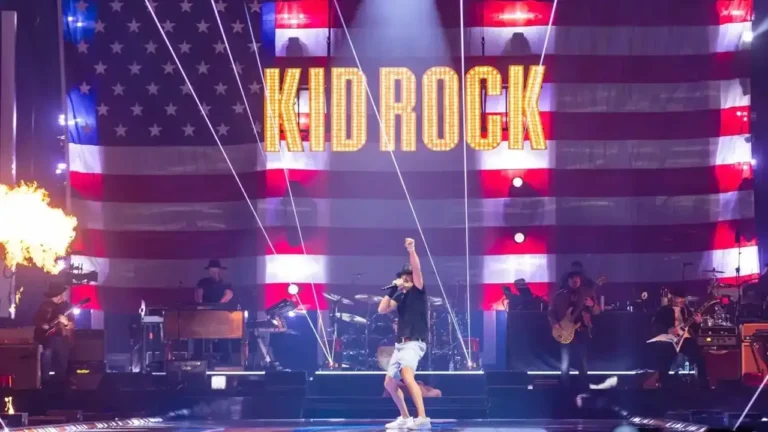
The Simu Liu Kid Rock halftime controversy that exploded across social media on February 8–9, 2026 was not about two entertainers who happened to disagree. It was a single explosive tweet dropped into the middle of the most politically charged Super Bowl in American history — on a night when two competing halftime shows aired simultaneously, when the President of the United States criticised the NFL’s choice of performer, and when the question of who gets to perform at America’s biggest annual event became a flashpoint for some of the deepest cultural divisions in the country.
Simu Liu’s post cut through all of that noise in eleven words.
“am i fucking hallucinating or did they really organize a ‘halftime show’ with kid rock lip syncing to a crowd of seven people in an attempt to prove white dominance?!?!? whatever; bad bunny was absolutely LIT.”
Within hours, those words had been shared millions of times. They triggered furious responses from conservative commentators, warm support from others, and a news cycle that ran for days. To understand why the Simu Liu Kid Rock halftime controversy hit the way it did, you need to understand what happened that night in full — because this story begins long before Simu Liu sent a single tweet.
Super Bowl LX: The Most Politically Loaded Super Bowl in History
Super Bowl LX was played on February 8, 2026 at Levi’s Stadium in Santa Clara, California — a game between the Philadelphia Eagles and the Kansas City Chiefs. The Chiefs won 40–22, with Patrick Mahomes recording a near-perfect performance. But the game itself was secondary to everything happening around it.
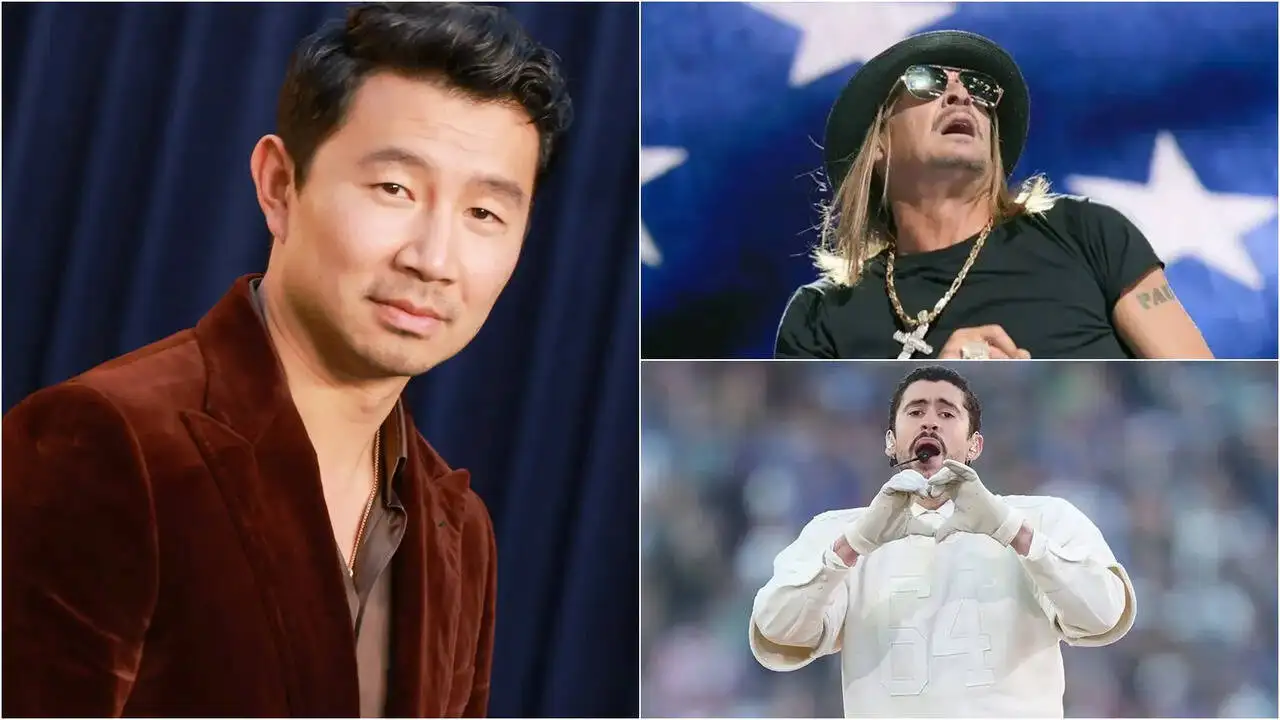
The political temperature surrounding Super Bowl LX had been building since October 2025, when the NFL announced that Bad Bunny — Puerto Rican rapper and three-time Grammy winner Benito Antonio Martínez Ocasio — would headline the Apple Music Super Bowl Halftime Show. The reaction from conservative media and political figures was immediate and intense.
President Donald Trump told Newsmax he had “never heard” of Bad Bunny. House Speaker Mike Johnson called the selection a “terrible decision” and suggested Lee Greenwood as an alternative. Conservative influencers argued that the NFL, as America’s most-watched sporting institution, should feature an “American” performer — a framing that critics immediately pointed out erased the fact that Bad Bunny was born in Puerto Rico, a U.S. territory, making him an American citizen by birth.
Bad Bunny had also become a politically polarising figure beyond his music. At the 68th Annual Grammy Awards — held just days before Super Bowl LX — he won Album of the Year for Debí Tirar Más Fotos and used his acceptance speech to say: “Before I say thanks to God, I’m going to say — ICE OUT. We’re not savages, we’re not animals.” His outspoken opposition to aggressive ICE enforcement had made him a target of right-wing criticism for months.
Into this charged environment, conservative organisation Turning Point USA (TPUSA) announced their response: The All-American Halftime Show — a counter-event streamed on YouTube and social media during the exact same time window as the official NFL halftime performance.
The All-American Halftime Show: What Kid Rock’s Alternative Performance Was and Wasn’t
The Simu Liu Kid Rock halftime controversy centres on the TPUSA All-American Halftime Show — so understanding exactly what that event was is essential.
TPUSA’s spokesman Andrew Kolvet described it as “an opportunity for all Americans to enjoy a halftime show with no agenda other than to celebrate faith, family, and freedom.” It was filmed in advance at a studio outside Atlanta, with an audience of approximately 200 people. It streamed on Turning Point USA’s social media channels, YouTube, Daily Wire+, TBN, Real America’s Voice, and OANN during the Super Bowl halftime break.
The show was dedicated to TPUSA founder Charlie Kirk, who was reportedly slain in September 2025. Host Jack Posobiec opened with: “This one’s for you, Charlie!”
The lineup: – Brantley Gilbert — performed “Real American” and “Dirt Road Anthem” – Lee Brice — performed “Country Nowadays” – Gabby Barrett — performed “The Good Ones” and “I Hope” – Kid Rock — closed the show with “Bawitdaba” (1999) and a cover of Cody Johnson’s “’Til You Can’t”, to which he added a self-written third verse about faith and Jesus
Kid Rock’s framing before the show was explicitly combative. In a statement, he said: “We’re approaching this show like David and Goliath. Competing with the pro football machine and a global pop superstar is almost impossible… or is it? We plan to play great songs for folks who love America.”
In an interview comparing his show to Bad Bunny’s, he said: “He’s said he’s having a dance party, wearing a dress, and singing in Spanish? Cool.”
The religious closing was striking. Under a single spotlight, identified by his given name Robert James Ritchie, Kid Rock sang: “There’s a book that’s sitting in your house somewhere that could use some dusting off… You can give your life to Jesus and he’ll give you a second chance. ’Til you can’t.” The performance ended with photos of Charlie Kirk and his widow Erika, followed by the Bible verse Isaiah 6:8.
There was, however, a significant problem with Kid Rock’s opening song.
The Lip Sync Scandal: What Actually Went Wrong with “Bawitdaba”
The central technical crisis of the Simu Liu Kid Rock halftime controversy was a visible and widely noted lip-sync discrepancy during Kid Rock’s performance of “Bawitdaba.”
Viewers watching the stream almost immediately noticed that Kid Rock’s mouth movements were not matching the audio track. In some shots, his lips were ahead of the words. In others, they weren’t moving while the track kept playing. At one point, he visibly lowered the microphone away from his face while the vocals continued.
The internet responded swiftly. Rolling Stone described the performance as “half-assed.” Yahoo reported he was being “brutally roasted.” Online commenters were relentless: “Kid Rock doesn’t know how to lip sync his own songs.” The show was labelled “Temu Halftime,” “Redneck Halftime,” and mocked as looking like it was “held in a Dollar Tree parking lot.”
Kid Rock responded on February 10, 2026, posting to X: “My halftime performance was pre recorded but performed live. No lipsycing like the haters and fake news are trying to report. When they synced the cameras to my performance on Bawitdaba, it did not line up as I explain in this video.”
He posted a five-minute video with his DJ, Freddie “Paradime” Beauregard, explaining what he claimed happened. His argument: “Bawitdaba” is a chaotic, high-energy song he has performed live every night on tour since 1998. He would have no reason to lip sync it. The problem, he said, occurred in post-production — the production team struggled to sync the video footage with the audio in the fast-paced edit, he spotted the issue in a rough cut and warned the crew, but they went ahead anyway.
His explanation satisfied some and convinced nobody who had already made up their mind. Critics pointed out that admitting the show was pre-recorded fundamentally undercut the “live” and authentic positioning that made it a supposedly genuine alternative to the polished NFL production. If the TPUSA show was filmed in advance in an Atlanta studio and edited together, the distinction between it and any other pre-taped concert broadcast became difficult to articulate.
On Fox News’ The Ingraham Angle the following Monday, Kid Rock gave his review of Bad Bunny’s show: “Like most people, I didn’t understand any of it. I saw there’s a lot of dancers and a lot of big to-do stuff… Not my cup of tea, but I don’t fault that kid for doing the Super Bowl. I fault the NFL for putting him in that position.”
Bad Bunny’s Official Halftime Show: What Actually Happened on the Big Stage
To fully understand the Simu Liu Kid Rock halftime controversy, you need to know what Bad Bunny was doing at the same time Kid Rock was performing in an Atlanta studio to 200 people.
At Levi’s Stadium in Santa Clara, California, Bad Bunny delivered a 13-minute halftime performance that became one of the most culturally significant moments in Super Bowl history. He became the first artist to headline the Super Bowl halftime show performing entirely in Spanish — a historic milestone for Latin representation on America’s biggest entertainment stage.
His guests were extraordinary: – Lady Gaga joined him to perform “Die With a Smile” – Ricky Martin appeared on stage – Pedro Pascal, Karol G, Jessica Alba, and Alix Earle made cameos – The entire performance was a love letter to Puerto Rico and the Latino community
California Governor Gavin Newsom declared February 8, 2026 as Bad Bunny Day in California. Lady Gaga posted on Instagram: “Thank you Benito for inviting me and thank you to the entire cast for welcoming me onto your stage. I wouldn’t miss it for the world.”
The numbers told their own story. Bad Bunny’s official halftime show averaged 128.2 million viewers on NBC. His performance clips on YouTube accumulated 53 million+ views within days. By contrast, the TPUSA stream peaked at approximately 6 million concurrent viewers, with the uploaded replay reaching around 21 million total views across platforms in the days that followed — a figure TPUSA enthusiastically promoted, though independent verification placed it closer to 19 million.
The ratio is stark: Bad Bunny’s halftime show drew more than 20 times the audience of the alternative.
Simu Liu’s Exact Tweet: What He Said and What He Meant
The Simu Liu Kid Rock halftime controversy reached its flashpoint when the Shang-Chi actor posted to X on the night of February 8, 2026:
“am i fucking hallucinating or did they really organize a ‘halftime show’ with kid rock lip syncing to a crowd of seven people in an attempt to prove white dominance?!?!? whatever; bad bunny was absolutely LIT.”
Three things made this tweet extraordinary:
The specificity of the accusation. Simu Liu didn’t just say the alternative show was bad. He named the exact issue — lip syncing — that had already been circulating online, giving it the amplification of a celebrity endorsement. His characterisation of the audience as “a crowd of seven people” was hyperbolic (the actual attendance was around 200), but landed as effective mockery of the gap between the official Super Bowl’s global audience and TPUSA’s stream.
The phrase “to prove white dominance.” This was the line that generated the fiercest debate. Simu Liu, a Chinese-Canadian actor who made history as Marvel’s first Asian-led superhero franchise star, was explicitly framing the TPUSA event not just as conservative entertainment but as a racially motivated response to a Puerto Rican artist performing in Spanish. Supporters said he was stating something plainly true. Critics called him a “racist pig” and accused him of “pushing hatred towards white people.” The phrase ensured the tweet would not be forgotten quickly.
The casual ending. “whatever; bad bunny was absolutely LIT.” After the incendiary first sentence, the shrug — “whatever” — and the three-word verdict on Bad Bunny’s actual show deflated any sense of righteous fury and replaced it with casual, confident dismissal. It was funny. It was confident. And it was infinitely quotable.
In follow-up posts, Liu expanded on his view. When a fan wrote “Bad Bunny was lit!! One of the best halftime shows,” he replied: “a very exciting performance purely visually… and even better knowing the cultural backdrop of which it speaks to. For me it was deeply touching, joyous and celebratory of what truly makes this country great; our diversity.”
The Reactions: Everyone Who Weighed In
The Simu Liu Kid Rock halftime controversy drew responses from across the entertainment and political spectrum.
Kacey Musgraves — the Grammy-winning country singer — also publicly criticised Kid Rock’s performance, adding mainstream Nashville credibility to the mockery.
Andy Cohen trolled Kid Rock’s TPUSA supporters on Threads. One user wrote the alternative show had them “fighting back tears,” to which Cohen replied: “Me too. The idea that I can wear jorts while looking like a prune gives me hope about getting older! Kinda getting misty just typing it.”
President Trump — who had previously been among the loudest critics of Bad Bunny’s selection — watched the official Super Bowl halftime show rather than Kid Rock’s alternative, and then posted on Truth Social that it was “absolutely terrible, one of the worst, EVER!” He notably did not comment on the TPUSA show at all.
The White House press secretary Karoline Leavitt had previously said: “I think the president would much prefer a Kid Rock performance over Bad Bunny.” The irony that Trump apparently watched Bad Bunny anyway was not lost on commentators.
TPUSA declared victory regardless, announcing: “The All-American Halftime Show pulled in OVER 25 MILLION views on just YouTube and Rumble alone” — a figure that ABC News and other outlets noted could not be independently verified, with the YouTube replay sitting at approximately 19 million.
Conservative critics of Simu Liu were vocal and swift. Some called his racial framing of the event “divisive.” Others criticised him for what they saw as dismissing a legitimate cultural expression of conservative values. Fan sites noted his upcoming appearances in Avengers: Doomsday and his Broadway debut in Oh, Mary! — suggesting his public profile made the tweet carry further than it might have from a less prominent figure.
The Deeper Story: Why This Controversy Was Inevitable
The Simu Liu Kid Rock halftime controversy did not come out of nowhere. It was the product of a specific cultural moment in America — and understanding that moment explains why a single tweet from a Marvel actor became international news.
The selection of Bad Bunny as Super Bowl LX halftime headliner was not just a music booking. It was a statement — intentional or otherwise — about the NFL’s positioning on questions of diversity, Latino representation, and the cultural demographics of its growing fanbase. NFL officials explicitly stated that Bad Bunny’s selection was “an important way to be relevant to its growing Latino fanbase” and part of a broader effort to engage the community of over 70 million Latinos in the US.
TPUSA’s decision to organise a counter-event was equally a statement — about what they believed the Super Bowl should represent. The framing of “faith, family, and freedom” as an implicit contrast to Bad Bunny’s show positioned the alternative not just as different entertainment but as a corrective to something they considered wrong.
The lip sync scandal, when it emerged, became both a practical embarrassment and a metaphor that critics couldn’t resist: a counterprogrammed event designed to showcase authentic American values had apparently not even delivered a live performance. The gap between the stated values and the actual execution became the story.
Simu Liu’s tweet landed at the intersection of all of this — performance criticism, cultural politics, racial representation, and the fundamental question of what “America” looks like on its biggest annual entertainment stage.
The Ratings Verdict: What the Numbers Said
Beyond the cultural debate, the Simu Liu Kid Rock halftime controversy has a concrete numerical dimension worth examining clearly:
| Bad Bunny (Official) | Kid Rock (TPUSA) | |
| TV viewers | 128.2 million avg | Not on broadcast TV |
| Peak concurrent stream | ~130M (TV + digital) | ~6 million (YouTube) |
| YouTube views (48 hrs) | 53 million+ | ~19–21 million |
| Venue | Levi’s Stadium, California | Atlanta studio |
| Live audience | ~70,000 (stadium) | ~200 people |
| Guests | Lady Gaga, Ricky Martin, Pedro Pascal | Brantley Gilbert, Lee Brice, Gabby Barrett |
| Performance type | Live | Pre-recorded |
The numbers make a clear statement. TPUSA’s claim of 25+ million views across platforms, while partially unverified, still represents a fraction of Bad Bunny’s reach. More telling is the nature of the gap: Bad Bunny’s show was accessed by people who actively sought it out on YouTube, while his TV audience was more than 20 times larger than TPUSA’s peak concurrent stream.
Simu Liu’s characterisation of the TPUSA show as “a crowd of seven people” was hyperbolic. But his underlying point — that the alternative show was decisively outperformed by the event it sought to rival — was supported by every available data point.
Simu Liu in 2026: Who He Is and Why His Voice Matters
The Simu Liu Kid Rock halftime controversy drew as much attention as it did partly because of who Simu Liu is in February 2026.
Born: April 19, 1989, in Harbin, China. Raised in Mississauga, Ontario, Canada, by his maternal grandparents before his parents arrived from China. His early life in Canada was marked by financial difficulty — he has spoken publicly about being homeless briefly as a young adult.
Career: He made his name in the Canadian TV series Kim’s Convenience (2016–2021) before his career transformed with the lead role in Marvel’s Shang-Chi and the Legend of the Ten Rings (2021) — the first MCU film with an Asian lead and an Asian-majority cast. The film grossed over $432 million worldwide and was a critical and cultural milestone.
He has since appeared in Greta Gerwig’s Barbie (2023) and has been confirmed for Avengers: Doomsday. In February 2026, he was making his Broadway debut in Oh, Mary! — a Tony Award-winning comedy in which he plays Mary’s teacher.
His public persona is defined by outspoken advocacy for Asian representation in Hollywood, careful use of his platform on social and political issues, and a willingness to engage directly with cultural debates that other high-profile actors tend to avoid. The tweet about Kid Rock’s show was entirely consistent with his established public character — it was direct, it was specific, and it was not going to be walked back.
Frequently Asked Questions
What exactly did Simu Liu say about Kid Rock? On February 8, 2026, Simu Liu posted on X: “am i fucking hallucinating or did they really organize a ‘halftime show’ with kid rock lip syncing to a crowd of seven people in an attempt to prove white dominance?!?!? whatever; bad bunny was absolutely LIT.”
What was the Kid Rock halftime show at Super Bowl LX? Kid Rock did not perform at the official NFL halftime show. He headlined The All-American Halftime Show — a counter-event organised by conservative group Turning Point USA, streamed on YouTube and social media during the official Super Bowl halftime break. The show was pre-recorded in an Atlanta studio before the Super Bowl.
Was Kid Rock actually lip syncing? Viewers noticed that Kid Rock’s mouth movements did not match the audio during “Bawitdaba.” Kid Rock explained on X that the show was “pre-recorded but performed live” and that the lip sync discrepancy was a post-production error — the video footage was not correctly synced with the audio during editing.
Who performed at the official Super Bowl LX halftime show? Bad Bunny headlined the Apple Music Super Bowl LX Halftime Show at Levi’s Stadium in California. He was joined by Lady Gaga, Ricky Martin, and cameos from Pedro Pascal, Karol G, Jessica Alba, and Alix Earle. The performance was the first Super Bowl halftime show performed entirely in Spanish.
How many people watched Bad Bunny vs Kid Rock? Bad Bunny averaged 128.2 million viewers on NBC television and accumulated 53 million+ YouTube views within days. The TPUSA show peaked at approximately 6 million concurrent YouTube viewers and reached approximately 19–21 million replay views on YouTube in the days following.
Why was Bad Bunny’s Super Bowl selection controversial? Conservative political figures, including President Trump and House Speaker Mike Johnson, criticised the NFL’s choice of Bad Bunny — a Puerto Rican artist who performs in Spanish and had publicly opposed Trump’s immigration enforcement policies. TPUSA organised the rival show partly in response to this backlash.
What is Simu Liu known for? Simu Liu is a Chinese-Canadian actor best known for playing Shang-Chi in Marvel’s Shang-Chi and the Legend of the Ten Rings (2021) — the first MCU film with an Asian lead. He also appeared in Greta Gerwig’s Barbie (2023) and is making his Broadway debut in Oh, Mary! in early 2026.
Related Posts You’ll Enjoy
- 🎬 Kangana Ranaut Akshaye Khanna Viral Video: The Full Story Explained
- 🎬 Rajpal Yadav Legal Crisis: ₹9 Crore Case, Tihar Jail & Full Story
- 🎬 Ratna Pathak Shah’s Bollywood Remarks: The Brutal Truth Revealed
- 🎬 Netflix Best Movies List 2026: 30 Brilliant Films You Must Watch
- 🎬 Ranveer Singh Pralay Zombie Thriller: Budget, Cast, Director & Full Details
- 🎬 Upcoming Bollywood Movies 2026 — Most Anticipated Films You Can’t Miss
- 🎬 Top South Indian Blockbusters That Conquered the Pan-India Box Office
📱 Follow us on Instagram for the latest Hollywood celebrity news, cultural controversies, and entertainment updates.
📌 Save this article on Pinterest — we cover every major entertainment cultural moment as it happens.
Last updated: March 2026. This article covers the Simu Liu Kid Rock halftime controversy from Super Bowl LX on February 8, 2026.

Popcorn in hand and a opinion ready — Emily covers movie reviews, box office buzz, and all things cinema at Popcorn Review.

