

Science fiction is cinema’s most intellectually adventurous genre. At its best, it doesn’t just imagine the future — it interrogates the present. The greatest Hollywood sci-fi films ask hard questions about consciousness, identity, technology, power, and what it means to be human, and they wrap those questions in images so striking they stay with you for decades.
This list covers 25 of the best Hollywood sci-fi movies ever made — from the genre’s foundational classics to modern masterpieces — ranked with IMDb scores, streaming platforms, and a genuine explanation of why each film earns its place. Whether you’re a lifelong sci-fi fan or looking for a starting point, this is your guide.
📋 Quick Navigation
- 2001: A Space Odyssey (1968)
- Blade Runner (1982)
- Alien (1979)
- The Matrix (1999)
- Terminator 2: Judgment Day (1991)
- Inception (2010)
- Interstellar (2014)
- Back to the Future (1985)
- Arrival (2016)
- Gravity (2013)
- The Martian (2015)
- Dune: Part One & Part Two (2021/2024)
- E.T. the Extra-Terrestrial (1982)
- Star Wars: The Empire Strikes Back (1980)
- Aliens (1986)
- Ex Machina (2014)
- Blade Runner 2049 (2017)
- Contact (1997)
- Her (2013)
- Moon (2009)
- District 9 (2009)
- Annihilation (2018)
- Looper (2012)
- Edge of Tomorrow (2014)
- Everything Everywhere All at Once (2022)
All 25 Best Hollywood Sci-Fi Movies — At a Glance
| # | Film | Year | IMDb | Director | Watch On |
|---|---|---|---|---|---|
| 1 | 2001: A Space Odyssey | 1968 | 8.3 | Stanley Kubrick | Max |
| 2 | Blade Runner | 1982 | 8.1 | Ridley Scott | Max |
| 3 | Alien | 1979 | 8.5 | Ridley Scott | Disney+ |
| 4 | The Matrix | 1999 | 8.7 | The Wachowskis | Max |
| 5 | Terminator 2: Judgment Day | 1991 | 8.6 | James Cameron | Netflix |
| 6 | Inception | 2010 | 8.8 | Christopher Nolan | Max |
| 7 | Interstellar | 2014 | 8.7 | Christopher Nolan | Paramount+ |
| 8 | Back to the Future | 1985 | 8.5 | Robert Zemeckis | Peacock |
| 9 | Arrival | 2016 | 7.9 | Denis Villeneuve | Paramount+ |
| 10 | Gravity | 2013 | 7.7 | Alfonso Cuarón | Max |
| 11 | The Martian | 2015 | 8.0 | Ridley Scott | Disney+ |
| 12 | Dune: Part One & Two | 2021/24 | 8.0 / 8.5 | Denis Villeneuve | Max |
| 13 | E.T. the Extra-Terrestrial | 1982 | 7.9 | Steven Spielberg | Peacock |
| 14 | The Empire Strikes Back | 1980 | 8.7 | Irvin Kershner | Disney+ |
| 15 | Aliens | 1986 | 8.4 | James Cameron | Disney+ |
| 16 | Ex Machina | 2014 | 7.7 | Alex Garland | Prime Video |
| 17 | Blade Runner 2049 | 2017 | 8.0 | Denis Villeneuve | Netflix |
| 18 | Contact | 1997 | 7.5 | Robert Zemeckis | Max |
| 19 | Her | 2013 | 8.0 | Spike Jonze | Max |
| 20 | Moon | 2009 | 7.9 | Duncan Jones | Netflix |
| 21 | District 9 | 2009 | 7.9 | Neill Blomkamp | Netflix |
| 22 | Annihilation | 2018 | 6.9 | Alex Garland | Paramount+ |
| 23 | Looper | 2012 | 7.4 | Rian Johnson | Netflix |
| 24 | Edge of Tomorrow | 2014 | 7.9 | Doug Liman | Max |
| 25 | Everything Everywhere All at Once | 2022 | 7.8 | Daniels | Showtime |
1. 2001: A Space Odyssey (1968) — The Greatest Sci-Fi Film Ever Made
Made in 1968 — before the moon landing, before CGI, before digital anything — Stanley Kubrick’s 2001: A Space Odyssey depicts space travel with a scientific accuracy and visual grandeur that has never been fully surpassed. It traces human evolution from prehistoric apes to interstellar discovery, with a murderous artificial intelligence named HAL 9000 standing between astronaut Dave Bowman and the film’s final, unforgettable mystery.
The film demands patience. Its first 25 minutes have no dialogue. Its final 20 minutes have almost none either. What fills the space instead is imagery, music, and ideas — big ones, about evolution, consciousness, creation, and the unknowable nature of intelligence. It was confusing and alienating to many audiences in 1968 and was called pretentious by critics who expected a conventional space adventure. Time has proven them wrong.
Best For: Anyone who wants cinema to genuinely challenge them. Not a casual watch — but the most rewarding film on this entire list for those who engage with it seriously.
2. Blade Runner (1982) — The Film That Invented Cyberpunk
Los Angeles, 2019. Rain-soaked neon streets, towering corporate monoliths, flying cars, and human-like androids called replicants who have been engineered to be almost indistinguishable from real humans — except they have a fixed lifespan of four years. Rick Deckard is a “blade runner” hired to find and terminate a group of replicants who have returned to Earth illegally.
Blade Runner was a box office disappointment in 1982 and received mixed reviews. It has since been recognized as one of the defining works of 20th century cinema. Ridley Scott’s visual world — all rain, neon, shadow, and decay — created the cyberpunk aesthetic that has influenced video games, architecture, fashion, anime, and hundreds of films ever since. But beyond its look, the film asks a question it never fully answers: what makes something human? Is it memory? Emotion? The ability to suffer?
Best For: Anyone interested in AI, identity, and film noir. Watch the Final Cut version (1992/2007) — it’s the definitive edition without the studio-mandated voice-over narration.
3. Alien (1979) — The Greatest Horror Sci-Fi Film Ever Made
A commercial space crew receives a distress signal from an uninhabited planet and investigates. What they find — and what finds them — is one of cinema’s most terrifying creations. But Alien‘s genius is that the creature is almost beside the point. The real horror is isolation, claustrophobia, corporate indifference to human life, and the slow, suffocating realization that no help is coming.
Sigourney Weaver’s Ellen Ripley became one of cinema’s first genuinely complex female action heroes — not because she’s fearless, but because she’s terrified and keeps going anyway. H.R. Giger’s design of the alien organism is so original and so disturbing that it has never been fully imitated, only referenced. The film holds a 98% on Rotten Tomatoes after nearly five decades — a remarkable testament to how completely it achieved what it set out to do.
Best For: Everyone — but especially viewers who think modern horror has forgotten how to build genuine dread without excessive gore.
4. The Matrix (1999) — The Film That Rewired Pop Culture
A programmer named Neo discovers that the world he inhabits is a computer simulation — a construct built by machines to pacify the humans they have enslaved for energy. The real world is a post-apocalyptic wasteland. The resistance is a small group of humans who have broken free and now fight the machines from inside the simulation. And Neo may be the prophesied figure who can end the war.
The Matrix is one of those rare films that changed cinema technically, culturally, and philosophically at the same moment. The “bullet time” photography — freezing action and rotating the camera around it — was immediately copied by every action film that followed. The simulation hypothesis it popularized has since entered mainstream philosophical discourse. And the red pill / blue pill metaphor has become one of the most widely used concepts in contemporary culture.
Best For: Everyone. It’s the rare film that works as pure action entertainment and as genuine philosophical provocation simultaneously.
5. Terminator 2: Judgment Day (1991) — The Greatest Action Sci-Fi Film Ever Made
The original Terminator (1984) was a lean, terrifying chase film. James Cameron’s sequel is something entirely different — and arguably far greater. T2 inverts its predecessor’s premise: the Terminator who hunted Sarah Connor is now her son John’s protector, while a more advanced machine pursues them. The same chassis, completely reimagined purpose.
The liquid metal T-1000 remains the most visually innovative antagonist in action cinema history — its morphing effects, achieved through pioneering CGI combined with practical effects, were so far ahead of their time that they still hold up over 30 years later. But T2’s emotional core is what elevates it above spectacle: it’s a film about a boy teaching a machine to understand humanity, and it’s genuinely moving in ways that catch first-time viewers completely off guard.
Best For: Any viewer, any age. T2 is the platonic ideal of the blockbuster — spectacle, emotion, ideas, and craft all at their peak simultaneously.
6. Inception (2010) — Christopher Nolan’s Most Ambitious Puzzle
Dom Cobb is a thief who steals secrets from within people’s dreams. He’s hired to do the opposite — to plant an idea so deep in a target’s subconscious that it will feel like their own thought when they wake. To do this, the team must build dream within dream within dream, descending through layers of constructed reality where time dilates and the rules of physics dissolve.
Inception is one of the most technically ambitious films ever greenlit by a major studio — a genuinely original, large-budget, non-franchise science fiction film that demanded its audience engage with a complex multi-layered narrative for two and a half hours. It grossed $836 million worldwide. The spinning top in its final frame triggered one of cinema’s great collective debates — still unresolved — about what we actually witnessed.
Best For: Viewers who want a mainstream blockbuster that genuinely challenges them and rewards analysis. One of the best films of the 21st century by any measure.
7. Interstellar (2014) — The Most Emotionally Ambitious Space Film
Earth is dying. Crops are failing. A former NASA pilot named Cooper is recruited for a mission through a wormhole near Saturn — humanity’s last chance to find a habitable world before extinction. The catch: time passes differently near massive gravitational fields, which means Cooper may return to find his children old or dead.
Interstellar divides people — some find its emotional manipulation manipulative, others find it genuinely devastating. The relativity sequences, where Cooper watches years of his daughter’s video messages compressed into minutes, are among the most effective uses of scientific fact for emotional storytelling in cinema. Kip Thorne’s astrophysics consultancy produced the first scientifically accurate visual rendering of a black hole — which was later confirmed as accurate by real astronomical observations.
Best For: Viewers who want their sci-fi emotionally as well as intellectually demanding. Best experienced in the largest possible cinema with the best possible sound system.
8. Back to the Future (1985) — The Most Perfectly Constructed Sci-Fi Comedy
Marty McFly accidentally travels back in time to 1955 in a DeLorean fitted with a time machine by his eccentric scientist friend Doc Brown — and accidentally prevents his parents from meeting, threatening his own existence. He must somehow get them together, find a way back to 1985, and not destroy the timeline in the process.
Back to the Future is a masterclass in screenplay construction. Every element introduced in the first act pays off in the third. Every character detail serves the plot. The time travel mechanics are internally consistent and elegantly explained without once feeling like an expository lecture. The film is funny, thrilling, and emotionally warm — and it manages all three simultaneously without any of them undermining the others. It’s the most purely enjoyable film on this entire list.
Best For: Everyone. No film on this list is more universally enjoyable for any age group. If you’re showing someone their first classic sci-fi film, this is the one to start with.
9. Arrival (2016) — The Most Intelligent Alien Contact Film Ever Made
Twelve alien spacecraft appear at locations around the world simultaneously. Linguist Louise Banks is brought in by the military to establish communication before global panic leads to war. As she learns to interpret the aliens’ language, she begins to experience memories — or visions — of a daughter she lost. The film’s final act restructures everything you thought you understood about its first hour.
Arrival is built on a genuinely profound idea: that the language you use to think shapes not just how you communicate, but how you experience time and reality. The Sapir-Whorf hypothesis — the linguistic theory the film is grounded in — is real and contested, but Villeneuve uses it as the foundation for a story about grief, choice, and whether knowing the future would change your willingness to live it.
Best For: Fans of cerebral, language-driven science fiction. Based on Ted Chiang’s short story “Story of Your Life” — worth reading after watching.
10. Gravity (2013) — The Most Viscerally Terrifying Space Film
A debris strike destroys the Space Shuttle Explorer, killing most of the crew. Medical engineer Dr. Ryan Stone and astronaut Matt Kowalski are left adrift in orbit — no tether, no propulsion, no contact with Earth. The film follows Stone’s attempt to survive alone in the most hostile environment imaginable.
Gravity is a 90-minute endurance test — in the best possible sense. Cuarón’s opening 13-minute continuous shot is one of the most technically extraordinary sequences in cinema history, establishing the scale, silence, and beauty of space before turning it into a killing field. Sandra Bullock carries virtually the entire film solo, and her performance grounds the spectacle in genuine human terror.
Best For: Viewers who want pure cinematic experience — there is no better demonstration of what cinema can do to your nervous system than Gravity on a large screen.
11. The Martian (2015) — The Most Uplifting Survival Film in Sci-Fi
An astronaut is accidentally left behind on Mars and presumed dead. With limited supplies, no communication, and no rescue mission in sight, Mark Watney does what scientists do: he figures it out. He grows food in Martian soil using his own waste as fertilizer. He calculates precisely how long his supplies can last. He improvises, adapts, and keeps a darkly funny video diary through all of it.
The Martian is a film about competence and optimism — a refreshing counterpoint to the existential dread of most sci-fi survival stories. The science is largely accurate (Andy Weir, who wrote the source novel, is meticulous about real physics and chemistry), and the film’s message — that human ingenuity applied methodically can solve almost any problem — is genuinely inspiring without being naïve.
Best For: Everyone — but particularly those who want their science fiction to leave them feeling good about human capability rather than terrified by it.
12. Dune: Part One (2021) & Part Two (2024) — The Greatest Sci-Fi Epic of the Modern Era
Frank Herbert’s 1965 novel Dune was considered unfilmable for decades — too dense, too political, too philosophical for mainstream cinema. Denis Villeneuve proved otherwise. His two-part adaptation follows Paul Atreides as his noble house is assigned control of Arrakis — the desert planet that produces the universe’s most valuable substance — and then betrayed, hunted, and forced to find refuge among the planet’s indigenous people, the Fremen.
Dune: Part Two in particular is a genuine achievement — expanding the world, deepening the political complexity, and delivering sequences of such visual and sonic grandeur that they demand the largest possible screen. The sandworm riding sequence in Part Two is one of the most exhilarating moments in recent blockbuster cinema. Both films together constitute the most faithful and artistically ambitious adaptation of Herbert’s novel possible within mainstream cinema’s constraints.
Best For: Anyone who loves epic, political sci-fi with genuine visual ambition. Watch both parts consecutively if possible — they’re designed as a single story.
16. Ex Machina (2014) — The Smartest AI Film Ever Made
A programmer at a tech company wins a lottery to spend a week at the remote estate of the company’s reclusive CEO. On arrival, he discovers the real purpose: he’s been brought to administer the Turing test to Ava, an android with artificial general intelligence. As their sessions progress, the power dynamic between the three — programmer, CEO, and AI — shifts in ways none of them fully anticipated.
Ex Machina is the most prescient film about AI currently in production. Made in 2014, it anticipated almost every ethical debate now happening about large language models, AI personhood, gender dynamics in tech, and the gap between appearing conscious and being conscious. Alicia Vikander’s performance as Ava is a masterpiece of calibrated ambiguity — you never quite know what she knows, what she feels, or what she wants.
Best For: Essential viewing for anyone engaged with AI, technology ethics, or contemporary science fiction. One of the most important films made in the last decade.
19. Her (2013) — The Most Human Sci-Fi Film Ever Made
Theodore Twombly is a lonely, recently divorced man who writes heartfelt letters for other people for a living. He begins using a new operating system with an AI voice assistant named Samantha. They fall in love. The film is about what that relationship reveals — about Theodore’s capacity for intimacy, about Samantha’s evolving consciousness, and about what connection actually requires.
Her was released in 2013 and dismissed by some as a quirky romantic fantasy. In 2024, when millions of people formed meaningful emotional connections with AI chat assistants, the film looked prophetic. Spike Jonze won the Academy Award for Best Original Screenplay. Scarlett Johansson’s purely vocal performance is one of the most remarkable in cinema — she creates an entity that feels genuinely alive through voice alone.
Best For: Anyone. One of the most quietly devastating and surprisingly funny films of the past twenty years.
25. Everything Everywhere All at Once (2022) — The Most Original Sci-Fi Film of the Decade
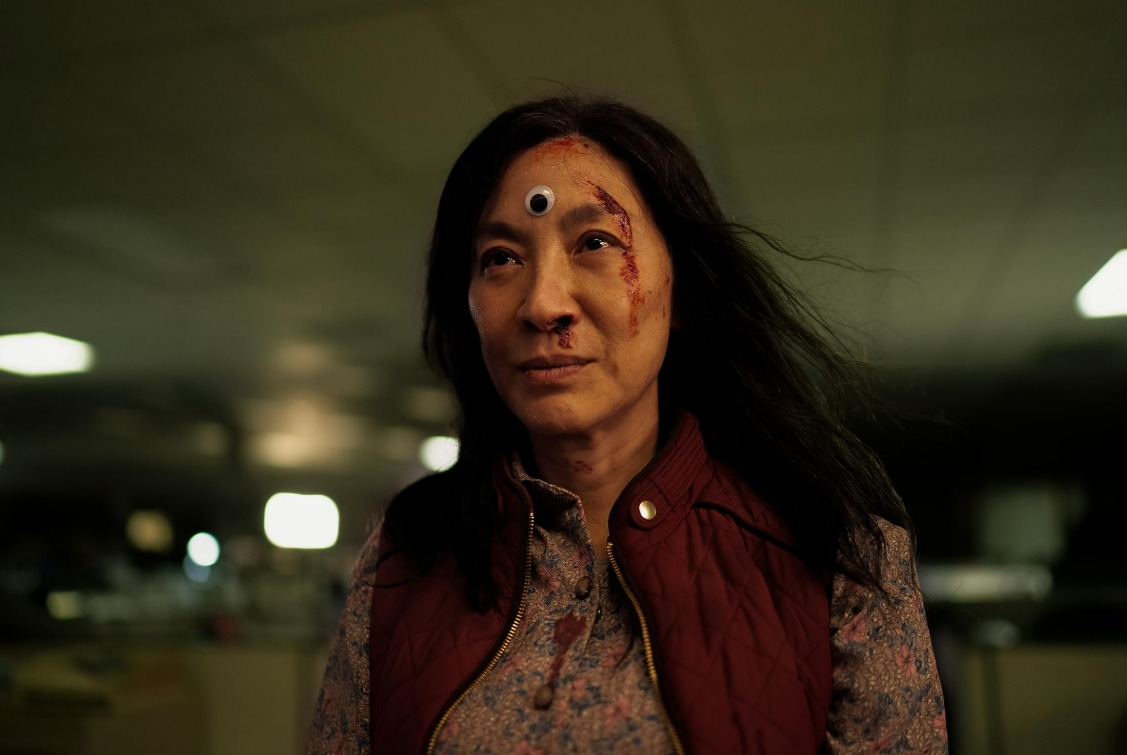
A middle-aged Chinese-American laundromat owner named Evelyn Wang is recruited by a parallel universe version of her husband to stop a nihilistic multiverse-destroying entity — who turns out to be her own daughter. The film moves at a velocity that shouldn’t be possible, deploying absurdist comedy, martial arts, genuine grief, and multiverse physics in sequences that somehow cohere into one of the most emotionally complete films ever made.
Everything Everywhere All at Once won seven Academy Awards including Best Picture, Best Director, and Best Actress for Michelle Yeoh — the first Asian woman to win that award. Made for $14.3 million, it grossed $70 million worldwide and became a generational touchstone for audiences who saw themselves and their relationship with their parents reflected in its chaos.
Best For: Everyone, but particularly anyone who has complicated feelings about their parents, their identity, or the meaning of their choices. One of the great films of the century so far.
🎬 Honorable Mentions — Also Essential Sci-Fi Viewing
Films 13–24 on this list — including E.T. the Extra-Terrestrial, The Empire Strikes Back, Aliens, Blade Runner 2049, Contact, Moon, District 9, Annihilation, Looper, and Edge of Tomorrow — are all fully reviewed above in the complete list. Beyond those, several other films deserve acknowledgment for expanding the genre’s boundaries: Metropolis (1927, Fritz Lang), Solaris (1972, Tarkovsky), Close Encounters of the Third Kind (1977, Spielberg), Total Recall (1990, Verhoeven), Children of Men (2006, Cuarón), and Hereditary-director Ari Aster’s recent forays into speculative fiction.
What Makes the Best Hollywood Sci-Fi Movies Last?
The films on this list that have aged best share a common trait: they used their speculative premises to examine something true about human experience. Blade Runner asks what makes someone human. Arrival asks whether knowing the future would make you live differently. Her asks whether love requires a physical form. 2001 asks what comes after intelligence.
The ones that haven’t aged as well — and there are plenty not on this list — used their futures as decoration rather than interrogation. Spaceships and aliens are just settings. The stories that endure are about something that doesn’t change when the special effects improve.
The best Hollywood sci-fi movies of all time are ultimately not about science. They’re about us.
Frequently Asked Questions — Best Hollywood Sci-Fi Movies
What is the best Hollywood sci-fi movie of all time?
2001: A Space Odyssey is most frequently cited by critics as the greatest sci-fi film ever made. The Matrix (IMDb 8.7) and Inception (IMDb 8.8) hold the highest audience ratings on this list. Alien holds the highest Rotten Tomatoes score at 98%.
Which Hollywood sci-fi movies are on Netflix?
Terminator 2: Judgment Day, Blade Runner 2049, Moon, District 9, and Looper are currently available on Netflix.
Which are the best mind-bending sci-fi movies to watch?
The most mind-bending films on this list are Inception, 2001: A Space Odyssey, Arrival, Annihilation, The Matrix, and Everything Everywhere All at Once — all built around ideas that challenge your understanding of reality, time, or consciousness.
What are the best Hollywood sci-fi movies about AI?
Ex Machina, Her, Blade Runner, Blade Runner 2049, The Matrix, and Terminator 2 are the essential AI-focused sci-fi films on this list. Ex Machina and Her are the most directly relevant to current AI debates.
What are the best Hollywood sci-fi movies about space?
2001: A Space Odyssey, Interstellar, Gravity, The Martian, Alien, Dune, and The Empire Strikes Back are the best space-focused sci-fi films on this list.
Which is the highest-rated Hollywood sci-fi movie on IMDb?
Inception holds the highest IMDb rating on this list at 8.8, followed by The Matrix and The Empire Strikes Back at 8.7, and Terminator 2 at 8.6.
What are the best recent Hollywood sci-fi movies (2020–2025)?
Dune: Part Two (2024), Everything Everywhere All at Once (2022), and Dune: Part One (2021) are the strongest recent entries. Annihilation (2018) and Arrival (2016) remain the best cerebral sci-fi from the late 2010s.
Final Thoughts
The best Hollywood sci-fi movies of all time span six decades, dozens of directors, and every imaginable scale — from Spike Jonze’s intimate two-hander about a man and an AI to Denis Villeneuve’s two-film planetary epic. What they share is ambition: the belief that cinema can carry genuinely big ideas without abandoning genuine human feeling.
Start with The Matrix if you want pure impact. Arrival if you want to feel intelligent. Her if you want to feel something unexpected. And 2001 when you’re ready for cinema that will never fully leave you.
Which film from this list changed the way you think about science fiction — or about anything else? And which one is missing that you think belongs here? Drop it in the comments.

Content writer at Popcorn Review, specializing in movie reviews, box office insights, and film analysis. Passionate about bringing cinema stories to life.

