
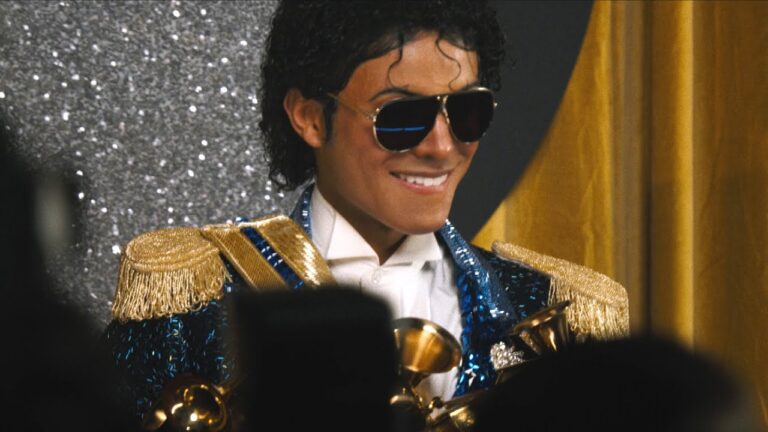
On April 24, 2026, the most controversial, most delayed, most legally entangled biopic in recent Hollywood history finally arrives in cinemas worldwide. Michael — the official biopic of the King of Pop, produced with the blessing (and budget) of the Michael Jackson Estate — has been three years in the making, twice delayed, partially reshot after a legal disaster, publicly condemned by Michael’s own daughter, and is still tracking to open at $55 million+ domestically.
The Michael Jackson biopic 2026 is not a simple film about a beloved entertainer. It is a cultural flashpoint. It will be watched by fans who have defended Michael Jackson through every controversy, critics who believe it is a whitewash, journalists who will debate its omissions for months, and billions of casual viewers across the world who simply grew up knowing every word to Thriller and want to understand the man behind it.
We’ve gone deep — deeper than any other entertainment site — into what this film will actually show, what it has been legally forced to exclude, and the extraordinary behind-the-scenes story of how one of the most anticipated films of the decade became simultaneously a record-breaking cultural event and a flashpoint for one of the music industry’s most unresolved controversies.
Here are 10 shocking things — and the things it’s hiding.
First: The Film in Numbers — Because the Scale Is Jaw-Dropping
| Detail | Fact |
|---|---|
| Release Date | April 24, 2026 (Early Access from April 22) |
| Director | Antoine Fuqua (Training Day, Emancipation) |
| Screenplay | John Logan (Gladiator, The Aviator, Skyfall) |
| Lead Actor | Jaafar Jackson — Michael Jackson’s nephew (film debut) |
| Runtime | 2h 10m (IMDB) — cut from a 3.5-hour original cut |
| CBFC Equivalent Rating | PG-13 (US) — thematic material, language, smoking |
| Trailer views in 24 hours | 116.2 million — most ever for a musical biopic/concert film, beating Taylor Swift: The Eras Tour (96.1M) |
| Projected Opening Weekend | $55M–$60M+ domestic — potential record for a music biopic |
| Times the film was delayed | 3 times (April 2025 → October 2025 → April 2026) |
| Distribution | Lionsgate (US/Canada), Universal (International), Kino Films (Japan) |
| Second film | In development — original cut was 3.5 hours; second part will cover later career |
The 10 Shocking Things the Film Will Actually Show
Michael Jackson’s Nephew Playing Michael Jackson — And He Actually Looks Exactly Like Him
The most talked-about casting decision in Hollywood in years: Jaafar Jackson — son of Jermaine Jackson, nephew of Michael, and a professional musician himself — was cast to play the King of Pop in what is also his feature film debut.
The decision was made after a two-year casting process during which hundreds of actors were reportedly considered. When Jaafar was announced, the internet split instantly between two camps: those who thought it was genius — a real Jackson, carrying the family’s physical resemblance and musical DNA — and those who thought it was nepotistic protection of the legacy, insurance against the film being too harsh.
Then the trailer dropped. And the discourse collapsed into a single reaction: He looks exactly like him.
Director Antoine Fuqua described the moment he watched Jaafar on set for the first time:
“All I could think of was, can he really pull this off? When the music started and he hit those first few moves, I mean, this guy killed it.”
Michael’s mother and Jaafar’s grandmother, Katherine Jackson, approved the casting: “He embodies my son.” That is either the most powerful endorsement a biopic actor has ever received, or the most complicated conflict of interest in film history. Possibly both.
Joe Jackson’s Abuse — And Colman Domingo’s Portrayal of the Most Feared Father in Music History
Joe Jackson — Michael’s father and the architect of the Jackson 5’s success — was by all accounts a controlling, physically abusive figure whose treatment of his children left psychological scars that Michael spoke about publicly throughout his life. Michael famously told Oprah in 1993 that he cried when he saw his father, and described being hit with a belt and rehearsed to the point of exhaustion as a child.
Colman Domingo — one of the finest actors working today, who won the Academy Award for Best Actor for Sing Sing (2024) — plays Joe Jackson. Domingo is not a filmmaker who softens difficult characters. He plays complexity. He plays the monster with the logic that makes it comprehensible.
The film’s focus on Michael’s early life — from Gary, Indiana, through the Jackson 5 years, through the Motown era — means Joe Jackson is central to the first act. How Domingo renders the combination of the man’s theatrical ambition, his undeniable talent management, and his documented cruelty will be one of the most-discussed elements of the film.
The film is confirmed to show Michael’s childhood abuse at Joe’s hands. This is one of the areas where the production has been most explicit: the “human but not sanitized” mandate applies here.
The Iconic Performances — Moonwalk, Thriller, Billie Jean, Beat It — In Full IMAX Glory
Whatever controversy surrounds the film’s treatment of Michael Jackson’s personal life, there is no controversy about what he achieved artistically. And the film is built around recreating those achievements at full cinematic scale.
The official soundtrack spans 13 confirmed tracks: “I’ll Be There”, “Never Can Say Goodbye”, “Wanna Be Startin’ Somethin'”, “Beat It”, “Human Nature”, “Don’t Stop ‘Til You Get Enough”, “Billie Jean”, “Thriller”, and “Bad” are among the confirmed selections — spanning his Jackson 5 roots through Off the Wall (1979) and the entire Thriller (1982) era.
The trailer has already shown extended sequences of Jaafar as Michael performing on stage. The moonwalk. The glove. The fedora. The anti-gravity lean from Smooth Criminal. In IMAX format, with a score from these recordings, this film will be the closest most living audiences ever come to experiencing a Michael Jackson concert live.
This is the dimension of the film that its detractors find most troubling — and its supporters most exciting. A film this visually spectacular about an artist this beloved is going to move people regardless of what it does or doesn’t say about his personal life.
The Child Sexual Abuse Allegations — In Some Form (Exactly What Form Is the $200 Million Question)
The film will address the sexual abuse allegations. That is confirmed. Producer Graham King stated: “I want to humanize but not sanitize, and present the most compelling, unbiased story I can capture in a single feature film and let the audience decide how they feel after.”
The official promotional description calls it a “riveting and honest portrayal of the brilliant yet complicated man” that presents “his triumphs and tragedies on an epic, cinematic scale.”
But the manner in which the allegations are handled — after the legal chaos of the Jordan Chandler 1994 blackout clause (more on that in the “What It’s Hiding” section) — is the central question this film has not yet answered publicly. What we do know is that the original third act was partially or substantially reshot after the legal issue emerged. The final film’s approach to the allegations is not yet known to the public.
What we know: the allegations will appear. Michael Jackson was acquitted in 2005. The film will present the allegations from his perspective — which means it is essentially advocating for his innocence, though producer King insists it will let viewers decide.
Michael’s Isolation, Loneliness, and the Emotional Cost of Being the World’s Biggest Star
One of the most consistent themes in every legitimate account of Michael Jackson’s inner life — from Lisa Marie Presley’s interviews to his own Bashir documentary to the testimonies of people who knew him — is profound, devastating loneliness. The world’s most famous entertainer lived in a gilded isolation that ordinary fame cannot approximate.
Neverland Ranch — the Santa Barbara property that Michael transformed into an elaborately conceived children’s entertainment world — was partly an expression of his desire to recapture the childhood he lost to his father’s ambitions and the industry’s demands. The film is expected to portray this dimension of Michael’s psychology: the child star who never grew up not because he refused to, but because he was never given the space to.
The psychological examination of fame at this scale — the weight of being Michael Jackson — is one of the dimensions where Antoine Fuqua, as a filmmaker, operates most naturally. Training Day, Emancipation, his best work all centres on the psychological cost of surviving extraordinary circumstances. Michael Jackson’s extraordinary circumstances just happened to include being the most famous person on earth.
The Motown Origin Story — Berry Gordy, Diana Ross, and the Industry That Made and Shaped Him
One of the most interesting casting choices in the film is the recreation of the Motown world that discovered and shaped the Jackson 5. Larenz Tate plays Berry Gordy. Kat Graham plays Diana Ross. Laura Harrier plays Suzanne de Passe — the Motown executive who championed the Jacksons early in their career.
The Motown years are formative in ways that go far beyond chart success. They are where Michael Jackson learned — from the greatest assembly of Black music industry talent America had ever produced — exactly how the machine of popular music works, who it rewards, and what it costs to stay inside it.
The complex relationship between Michael and Diana Ross in particular — she was something between a mentor, a protective older figure, and an artistic idol to a boy who needed all three simultaneously — is one of the most genuinely fascinating dimensions of his early biography. How the film handles it will determine whether these Motown sequences feel like corporate origin story or genuine human drama.
Michael Jackson’s Skin — And the Vitiligo Diagnosis That Changed His Appearance Forever
Michael Jackson’s changing skin colour was one of the most discussed and debated physical transformations in entertainment history. During his lifetime, he was accused of deliberately bleaching his skin to appear white — a charge he denied, claiming instead that he suffered from vitiligo, an autoimmune condition that causes patches of skin to lose pigment.
Medical examination of his body after his 2009 death confirmed the vitiligo diagnosis as genuine. But for decades, the visual evidence of his changing appearance was weaponized against him — as evidence of self-loathing, racial discomfort, and disconnection from his Black identity.
The film — which covers his life from childhood through at least the Thriller era — will need to address this physical transformation. How it does so, and whether it engages with the psychological dimensions of what it means for a Black American artist to undergo that visible change in the full glare of global media scrutiny, will be a significant test of its honesty.
John Branca — Miles Teller as the Lawyer at the Centre of the Estate War
Miles Teller plays John Branca — Michael Jackson’s entertainment lawyer and one of the two current executors of his estate. Branca is an enormously powerful figure in the music industry, having represented some of the biggest names in popular music for decades.
The casting of Teller as Branca has itself become a legal subplot. Paris Jackson — in her lawsuit against the estate — accused Branca of casting an “A-list” actor specifically to “enrich and aggrandize himself” at the estate’s expense. The estate has described her claims as “meritless.”
What makes this dynamic so extraordinary: Branca is simultaneously the man who approved this biopic, is producing it through the estate, and is being portrayed as a character in it by a movie star he allegedly agreed to cast. The conflict of interest layers are genuinely dizzying. And they are not hidden — they are playing out in court documents that are public record.
Paris Jackson’s Own Complicated Relationship With Her Father’s Legacy — From the Outside
Paris Jackson is not in this film. She has been explicit that she had “zero per cent involvement” in the production. When Colman Domingo said in a People interview that Paris and her brother Prince were “very much in support of” the film, Paris responded on Instagram: “Don’t be telling people I was ‘helpful’ on the set of a movie I had zero per cent involvement in lol that is so weird.”
Her specific criticisms of the script she reviewed are documented: “sugar-coated,” “dishonest,” “filled with inaccuracies,” “full-blown lies.” She did not say she had seen the final film. She was clear her feedback was given on a draft that was then revised — without incorporating her notes.
Her most devastating observation was aimed not at the film’s potential falsehoods but at its target audience: “A big reason why I haven’t said anything up until this point is because I know a lot of you guys are gonna be happy with it. A big section of the film panders to a very specific section of my dad’s fandom that still lives in the fantasy, and they’re gonna be happy with it.”
Michael Jackson’s own daughter saying his official biopic “panders to a fantasy” is the single most damning assessment the film has received — precisely because Paris has no obvious motive to lie about her father.
The Music That Changed the World — And Why None of This Controversy Can Erase It
Here is the most uncomfortable truth about the Michael Jackson biopic 2026: it does not need to be honest to be extraordinary. Because Michael Jackson the artist — separate from every allegation, every legal battle, every family dispute — was something that happens once in a civilisation.
Thriller is still the best-selling album in music history. “Billie Jean” changed the sonic architecture of popular music. The moonwalk altered how the world thought about the relationship between a body and a stage. The music videos he created in the 1980s invented a visual language for popular music that every artist since has inherited.
The film will show all of this. The Jackson 5 rehearsals that forged him. The Quincy Jones collaboration that perfected him. The Thriller era that made him immortal. If Jaafar Jackson delivers a performance anywhere near what the trailer suggests — and if Antoine Fuqua films it the way he has filmed his best work — this will be a viscerally extraordinary experience in a cinema.
Whether it is also an honest one is a separate question. And it is a question the audience will need to decide for themselves.
What It’s Hiding: The Things the Film Cannot — Or Will Not — Show
The Jordan Chandler 1994 Blackout Clause — The Legal Agreement That Forced $25 Million in Reshoots
In 1994, Michael Jackson’s legal team settled with Jordan Chandler’s family — one of the first accusers — for a reported $20 million+. Part of that settlement included a clause that forbids the depiction of Jordan Chandler’s relationship with Michael Jackson in any cinematic or dramatic production.
The original script reportedly depicted the Chandler allegations from Michael Jackson’s perspective — essentially arguing his innocence through dramatisation. In January 2025, it emerged that this depiction violated the 1994 blackout clause. The discovery sent the production into crisis. Extensive reshoots were required. The film’s release was pushed back for the third time. The legal fees and production costs from the oversight — attributed in Paris Jackson’s lawsuit partly to executor John Branca allegedly failing to recognise the significance of the 1994 agreement — were reportedly enormous.
What this means for the final film: Jordan Chandler cannot appear. His name may or may not be said. The manner in which the film addresses the 1993 allegations — which were the defining public crisis of Michael Jackson’s career for over a decade — has been legally constrained in ways that the audience will not be told about when they sit down to watch.
Wade Robson and James Safechuck — The Leaving Neverland Accusers Who Will Not Appear
Wade Robson and James Safechuck — whose accounts of alleged abuse by Michael Jackson formed the core of the 2019 documentary Leaving Neverland — are reportedly not depicted in the film. Dan Reed, the Leaving Neverland director who read an early draft of the script, said the film was a “complete whitewash” and that it was “an out-and-out attempt to completely rewrite the allegations.” Reed described his specific objection: “You never even see him alone with any boys, when it is a matter of fact that he shared his bed with small children for many years.”
Whether the final cut of the film — post-reshoots — differs from the draft Reed read is unknown. But the film’s PG-13 rating and its tracking as a family-friendly IMAX event suggest the material addressed will be far closer to the surface-level narrative of allegations denied than to the specific, graphic accounts in Leaving Neverland.
Michael Jackson’s Later Career, His Death, and Everything After Thriller
Here is the most significant thing the film simply does not have space to show: the second half of Michael Jackson’s life.
The film runs 2h 10m. The original cut was 3.5 hours. Lionsgate is already developing a second film. Based on all available information, this first film ends around the Thriller era — leaving his 2005 trial and acquittal, his exile from America, the HIStory era, Invincible, and his death from propofol administered by his personal doctor Conrad Murray entirely for Part 2.
This structural choice — ending on triumph, saving the tragedy and the trial for the sequel — is not accident. It is marketing. It is the calculated decision to release an emotionally euphoric first film that generates goodwill and box office, before the harder second film. Whether Part 2 ever gets made — and what it will be legally permitted to show — remains entirely open.
The Cast in Full: Who’s Playing Who
| Character | Actor | Note |
|---|---|---|
| Michael Jackson (adult) | Jaafar Jackson | Michael’s real nephew; film debut |
| Young Michael Jackson | Juliano Krue Valdi | — |
| Joe Jackson | Colman Domingo | Oscar winner for Sing Sing (2024) |
| Katherine Jackson | Nia Long | — |
| John Branca | Miles Teller | Casting is subject of Paris Jackson’s lawsuit |
| Berry Gordy | Larenz Tate | — |
| Diana Ross | Kat Graham | — |
| Suzanne de Passe | Laura Harrier | — |
| Quincy Jones | Kendrick Sampson | — |
| Jermaine Jackson | Jamal R. Henderson | — |
What Paris Jackson Actually Said — And Why It Matters
It would be easy to dismiss Paris Jackson’s criticism of this film. She is Michael’s daughter; she has complicated feelings about how her father’s story is told; she filed a lawsuit against the estate and may have motives beyond pure concern for historical accuracy.
But set all of that aside and read her actual words:
“I wasn’t involved at all, aside from giving feedback on the first draft and then getting the feedback that [production] was not actually going to address [my] notes.”
“A big reason why I haven’t said anything up until this point is because I know a lot of you guys are gonna be happy with it. A big section of the film panders to a very specific section of my dad’s fandom that still lives in the fantasy.”
She is not saying the film is wrong to defend her father. She is saying it is designed to satisfy a specific audience — the segment of Michael Jackson’s fanbase that has maintained complete denial about the allegations throughout — rather than to genuinely grapple with his complexity.
That is not the same as condemning her father. That is an honest assessment of what kind of film this is. And it is coming from the person who, more than anyone else alive, has the most personal stake in how his story is told.
The Box Office Question: Will the Controversy Kill It or Feed It?
The Michael Jackson biopic 2026 is tracking to open at $55–60 million domestically — potentially the second-highest opening ever for a music biopic, behind only Straight Outta Compton ($60.2M) and ahead of Bohemian Rhapsody ($51.5M).
The trailer’s 116.2 million views in 24 hours — breaking every previous musical biopic record, including Taylor Swift: The Eras Tour — is an extraordinary metric. It suggests an audience so invested in Michael Jackson that no amount of controversy will stop them from watching.
The film’s tracking is strong across all demographics, especially with audiences over 25. The IMAX format, the spectacular performance sequences, and the sheer global familiarity of the music mean that even viewers who have unresolved feelings about Michael Jackson as a person will be drawn into the theatre by the music.
Whether the film sustains that audience beyond its opening weekend — whether it has the emotional depth and storytelling craft to generate the word-of-mouth that turned Bohemian Rhapsody into a $910 million phenomenon — is the real question. And it is one that only April 24 can answer.
Wikipedia — Michael (2026 film)
Deadline — Michael Box Office Projection $55M+
Deadline — Paris Jackson Challenges Michael Movie Estate Spending
The Fader — Paris Jackson Says Biopic Contains “Full-Blown Lies”
Rotten Tomatoes — Everything We Know About the Michael Jackson Biopic
Screen Rant — Michael 2026 Box Office Projections
Screen Daily — Michael Release Date, Second Film in Development
NME — Paris Jackson Challenges Father’s Biopic; Executors Call Claims “Meritless”
Man of Many — Michael Biopic: Release Date, Cast, Troubled Production
IMDB — Michael (2026)
Frequently Asked Questions (FAQ)
Final Verdict: The Most Complicated Film of 2026 — And You’re Going to Watch It Anyway
Here is what the Michael Jackson biopic 2026 actually is: a spectacular, legally constrained, family-estate-controlled cinematic celebration of one of the greatest artists who ever lived, made by talented filmmakers, starring a performer who carries the physical and musical DNA of the subject, that will deliberately not show you several things you probably need to see to have a complete picture of who Michael Jackson was.
That is not the same as saying it will be a bad film. Bohemian Rhapsody also avoided large portions of Freddie Mercury’s story. Elvis also sanitised certain chapters. Every estate-approved biopic is by definition a curated portrait rather than a complete one. The question is whether what is shown is extraordinary enough to justify the seat.
Based on the trailer, the early reactions, and the 116 million views in 24 hours: the music will be extraordinary. Jaafar Jackson may be extraordinary. Colman Domingo will almost certainly be extraordinary.
Whether the film is honest about Michael Jackson is a question you will need to answer for yourself on April 24. Bring everything you already know about this man. And watch what they choose to show you — and what they don’t.
Will you be watching Michael in cinemas on April 24? Do you think biopics like this can ever be truly honest — or are they always, by definition, curated myths? Tell us your take in the comments. 👇

Popcorn in hand and a opinion ready — Emily covers movie reviews, box office buzz, and all things cinema at Popcorn Review.

