
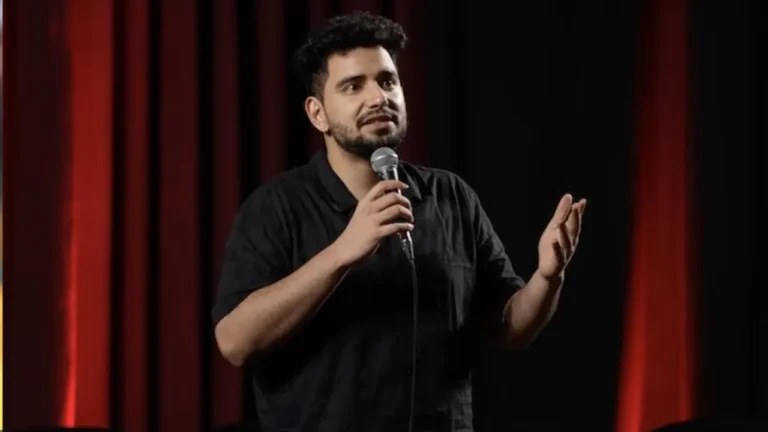
In February 2025, one of India’s most promising young comedians woke up to find his entire life on fire.
Multiple FIRs across states. Summons from the National Commission for Women. A six-hour interrogation by the Maharashtra Cyber Cell. A Supreme Court case. Brand deals evaporating overnight. And a viral show — one that had just topped both the Apple App Store and Google Play Store — scrubbed off the internet entirely.
Samay Raina had built something extraordinary with India’s Got Latent. And in a matter of weeks, the chaos of a single episode threatened to erase everything he had spent years constructing.
What followed is the kind of story that entertainment websites rarely tell with honesty — not just the controversy, but what it cost him personally, how the internet wildly misread what actually happened behind the scenes, how he fought his way back, and why his “Still Alive” special, released on April 7, 2026, with 21 million views in 24 hours, is more than just a comedy comeback. It is a masterclass in how to survive the internet age with your identity intact.
This is the complete, unfiltered story of Samay Raina — from a refugee family in Jammu to Madison Square Garden, from Comicstaan winner to Supreme Court respondent, from engineering dropout to the most-talked-about comedian in India right now.
Samay Raina: The Origin Story Nobody Talks About Enough
Every article about Samay Raina mentions the controversy. Almost none of them start where his story actually begins — in a refugee camp.
Samay was born on October 26, 1997, in Jammu — but his family’s roots are in the Kashmir Valley. He belongs to the Kashmiri Pandit community, the Hindu minority that was forced to flee their homes en masse in the early 1990s amidst widespread violence and ethnic cleansing. His family was among the hundreds of thousands who had to abandon everything overnight.
Samay was barely two years old during the exodus. He has no firsthand memories of Kashmir — but the displacement is woven into his DNA. His family eventually settled in Hyderabad, where he grew up as an outsider in a Telugu-majority city, speaking neither the language nor the culture fluently.
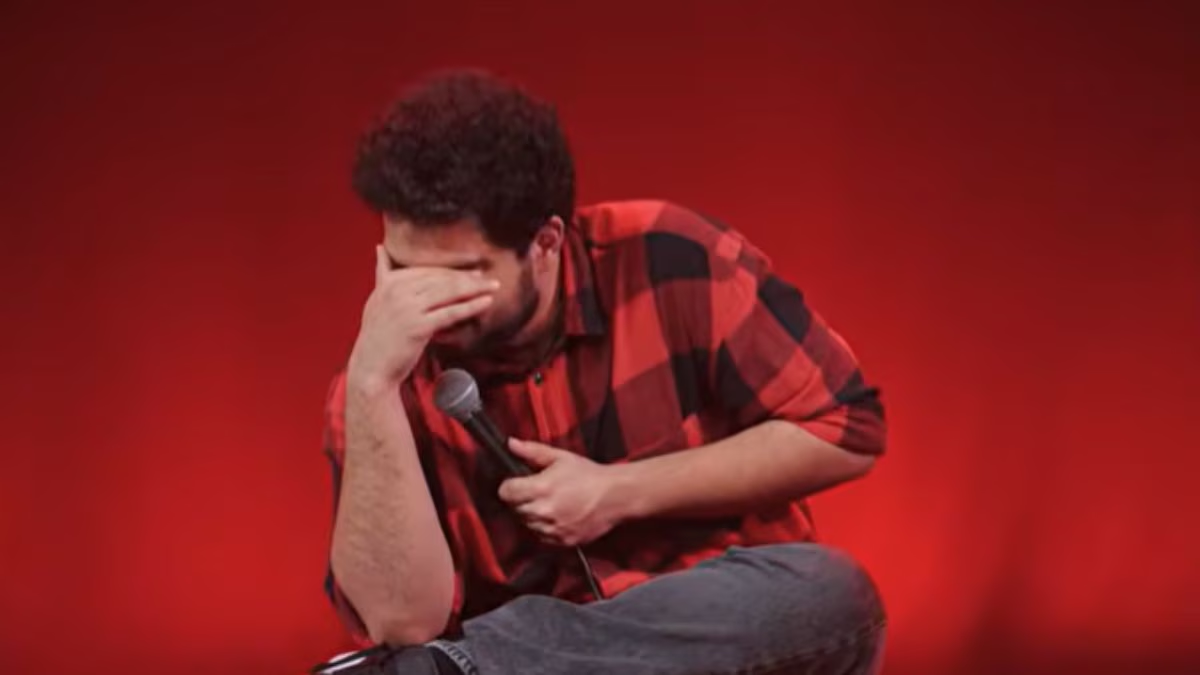
In his “Still Alive” special, Samay revealed for the first time publicly that his early school years in Hyderabad were defined by relentless bullying. He was beaten up on his very first day of school. Classmates stole his snacks, tore his books, and made school a place of daily humiliation. He had no social standing, no group, no language advantage. He was, in every way, the new kid who didn’t belong.
That experience — of displacement, of mockery, of being an outsider who makes people uncomfortable simply by existing — is not incidental to understanding Samay Raina the comedian. It is the foundation of everything he does.
The Engineering Dropout Who Became a National Comedian
Eventually, the family’s path took Samay to Pune, where he enrolled in a print engineering programme at PVG’s College of Engineering and Technology (Vidhyarthi Griha’s COET). He has described this decision, with characteristic bluntness, as a total waste of time.
He tried everything else first — music, poetry, writing, blogging, rapping. Nothing clicked. And then, almost by accident, he tried stand-up comedy at an open mic and something snapped into place.
His first official open mic performance was on August 27, 2017. Within months, he was performing regularly enough in Pune’s small but growing comedy circuit that he was opening for established names like Anirban Dasgupta and Abhishek Upmanyu. In a world where comedy careers take a decade to build, Samay was moving fast.
He relocated to Mumbai, took the stage wherever he could, and in 2019, entered Comicstaan Season 2 on Amazon Prime Video — on the suggestion of his friend (and eventual co-winner) Aakash Gupta. He won. The prize: ₹10 lakh and national recognition. More importantly, a trajectory that was no longer going to wait for anyone’s permission.
Samay Raina: Quick Facts
| Detail | Information |
|---|---|
| Full Name | Samay Raina |
| Date of Birth | October 26, 1997 |
| Age (2026) | 28 years |
| Hometown | Jammu, J&K (raised in Hyderabad) |
| Community | Kashmiri Pandit |
| Education | Print Engineering, PVG’s COET, Pune (described as “a waste of time”) |
| Comedy Debut | Open mic, August 27, 2017 |
| Big Break | Comicstaan Season 2 co-winner (2019) with Aakash Gupta |
| YouTube Subscribers | 7.37 million+ (as of 2025) |
| Instagram Followers | 5.9 million+ |
| Estimated Net Worth | ₹140–195 crore (~$16.5–23.1 million) |
| Chess Rating (peak) | 1942 on Chess.com (August 2023) |
| Notable Shows | Comicstaan 2, Comedy Premium League (Netflix), One Mic Stand, India’s Got Latent |
The Chess Pivot: How a Pandemic Created a Second Career for Samay Raina
Here is a detail that defines Samay Raina better than almost anything else: when COVID-19 shut down the live comedy industry in 2020 and most comedians went quiet, Samay built an entirely new career from scratch — in chess.
The suggestion came from comedian Tanmay Bhat: start streaming chess on YouTube. It sounds simple in hindsight, but at the time, chess streaming in India barely existed as a format. Samay was not a grandmaster. He was an enthusiast with a passion and a camera — and that turned out to be exactly right for the moment.
He launched a series of online chess tournaments called Comedians on Board (COB), inviting fellow comedians and celebrities to compete. The format was chaotic, funny, and oddly compelling. Then he started collaborating with actual chess grandmasters — Viswanathan Anand, Vidit Gujrathi — and with international chess streamers like Croatia’s Antonio Radić (Agadmator), whose appearance on Samay’s channel became a viral crossover event that brought a new global audience to his door.
By 2021, Samay had won the $10,000 Botez Bullet Invitational — a major Chess.com amateur tournament hosted by the Botez sisters — as the only Indian streamer among top international Twitch competitors. He donated $4,000 of his prize to charity, with zero announcement beforehand. At 28, he would later win the SuperPogChamps 2025 tournament hosted by Chess.com, defeating 12 international influencers including Andrea Botez and Sardoche. He won $10,000. He donated all of it — to Lidè Haiti, to support education and well-being for Haitian girls.
These are not PR moves. The donations were quiet, sometimes announced only after the fact. The chess career was built purely on enthusiasm, creativity, and a willingness to try something completely new when life shut every existing door.
His chess content didn’t just grow his audience — it helped popularise chess across India’s young internet generation. When he later launched the Chess Super League in collaboration with ChessBase India and Nodwin Gaming, it became one of the most-watched esports-inspired chess events the country had seen. And his YouTube channel — which had started as a stand-up comedy platform — transformed into one of the most distinctive hybrid creator spaces in the Indian internet ecosystem.
India’s Got Latent: The Show That Changed Everything
In June 2024, Samay Raina launched India’s Got Latent — and immediately, it felt different from anything else on YouTube.
The concept was brilliantly simple and deliberately absurd: ordinary people with bizarre, unconventional, or deeply niche “talents” would compete before a rotating panel of celebrity judges who would rate them. The twist was that the contestants themselves had already rated their own performances — and the comedy came from the gap between self-perception and reality.
The guests were genuine draws: Kunal Kamra, Maheep Kapoor, Ashish Chanchlani, Ranveer Allahbadia, and dozens of others rotated through the panel. Episodes pulled millions of views. The accompanying India’s Got Latent app, launched in January 2025, shot to number one on both the Apple App Store and Google Play Store within hours.
From a business standpoint, the show was generating an estimated ₹1.5–2.5 crore per month for Samay through ad revenue and memberships alone. As a creative achievement, it was arguably the most original format to emerge from India’s YouTube comedy space in years.
And then, in February 2025, everything collapsed.
The Moment That Lit the Fuse: Ranveer Allahbadia’s Question
In the episode featuring podcaster Ranveer Allahbadia (also known as BeerBiceps), something went wrong on camera — and more went wrong off camera than most people know.
Allahbadia asked a contestant: “Would you rather watch your parents have sex every day for the rest of your life, or join in once to make it stop forever?”
The panel — which included Apoorva Mukhija and Ashish Chanchlani — laughed. The clip went viral almost immediately, and what followed was a national moral reckoning that nobody on the show had fully anticipated.
In his “Still Alive” special, Samay revealed the detail that changes the entire story: Ranveer Allahbadia asked that same question eight times during the filming of that episode. Samay edited out all the other instances. He kept one, because he thought — in the context of a chaotic, unfiltered roast format — it was a single punchline moment rather than a pattern of behaviour.
He was wrong about how it would land. He has said so himself. But the context matters enormously: Samay Raina was not the person who asked the question. He was the creator who chose not to edit one instance of it out. That is a legitimate editorial failure. It is not the same as being the one who said it — a distinction that got completely lost in the public conversation.
The Controversy Unpacked: What Really Happened to Samay Raina in 2025
The speed at which Samay Raina’s situation escalated from a viral clip to a legal and institutional crisis is one of the defining digital media stories of recent years. Let’s break it down precisely.
The Psychological Truth: Why Samay Raina’s Response Was Different
Most creators, when caught in a controversy of this magnitude, follow a predictable script: disappear, issue a carefully worded apology drafted by PR teams, wait for the news cycle to move on, and quietly return with a rebrand.
Samay Raina did none of this.
He went on tour. He stood on stages across India and talked about what happened — not to audiences who hated him, but to audiences who had showed up because they still believed in him. And when he finally released “Still Alive,” he addressed everything directly: the FIRs, the Assam CM’s tweet, the Supreme Court proceedings, the six-hour interrogation, what Allahbadia asked eight times, what breaking a colleague’s parents looked like, and what it personally cost him.
“I saw one video that Balraj’s wife sent me, and that broke me completely. That was the final nail in the coffin.” — Samay Raina, Still Alive
That quote is not from a formal apology. It is from a comedy special. He said it on stage, to an audience paying to watch him be funny, while tears were running down his face. That is not how calculated PR rehabilitation works. That is what genuine human accountability looks like — delivered in the medium he knows best.
There is a deeper psychological layer here that most articles miss. Samay Raina grew up as someone who knew what it felt like to be publicly humiliated — bullied daily in school, an outsider in a city whose language he didn’t speak, a refugee community’s kid trying to build something in a world that kept closing doors. When his peers started receiving death threats and elderly parents started pleading on camera for their children’s safety, Samay didn’t experience that as abstract collateral damage. He experienced it as something he intimately understood — and that is why it broke him in a way that pure cynicism or calculation would not have.
His response to the controversy was shaped by that history. The comedy special is not just a comeback vehicle. It is — as he framed it himself, invoking George Orwell — a document about what happens when public outrage exceeds its own proportionality, and what a person does when they have to decide: apologise and shrink, or stand up and say something honest.
Myth vs. Fact: The India’s Got Latent Controversy
Because the controversy moved so fast and so emotionally, a lot of false narratives calcified around it. Let’s separate them.
The Industry Angle: What the Latent Controversy Changed for Indian Digital Comedy
The India’s Got Latent controversy was never just about Samay Raina, even if he was at its centre. It was a pressure point that revealed how completely unprepared India’s legal, regulatory, and platform infrastructure was for the scale of creator-led digital content.
The Supreme Court itself acknowledged the vacuum. Chief Justice Kant asked openly: “So I create my own channel, I am not accountable to anyone. Somebody has to be accountable.” That question — from the highest court in the land — is still unanswered. As of late 2025, the Union government was reportedly finalising new guidelines for online content, but nothing had been formally announced.
From a business standpoint, the fallout was immediate and severe. Brands that had been partnering with Samay ran. Myntra cancelled a Valentine’s Day collaboration. KFC quietly removed a campaign. A near-finalised energy drink partnership evaporated. For a creator whose revenue depended significantly on brand deals, the financial hit was real.
But here is what the media didn’t track carefully: the brands came back. Not quietly — loudly. In January 2026, activewear brand STRCH launched a campaign featuring Samay Raina and Sunil Pal — the same comedian who had publicly called for legal action against Samay at the height of the controversy. The ad was a roast. It hijacked their real-life rift. It went massively viral. This is not a small detail. It tells you exactly where the youth market’s loyalty actually sits.
The “Still Alive” special itself — released free on YouTube, no paywall — reached 21 million views in 24 hours. For context: that is not a comedy number. That is a national event number.
Samay Raina’s “Still Alive”: What the Special Actually Contains
Most write-ups of “Still Alive” have treated it as a comeback announcement. It is much more than that.
The special is structured as a full-length stand-up set, but it operates on multiple registers simultaneously. It is funny — sharply, uncomfortably funny in places. It is also honest in a way that most public figures, comedians or otherwise, rarely allow themselves to be on camera.
What Samay addresses directly in the special:
- The exact details of what Allahbadia said and how many times he said it
- The six-hour Maharashtra Cyber Cell interrogation — described with dark humour and precision
- His schoolhood bullying in Hyderabad and how it connects to the experience of public shaming
- The moment watching a video of Balraj’s elderly parents pleading publicly “broke him completely”
- Amitabh Bachchan’s reaction to the controversy — addressed with a joke that managed to be both self-deprecating and pointed
- Sunil Pal’s public denunciations — also addressed comedically
- Mukesh Khanna and the “Shaktimaan ne bachhe maare hain” remark that sparked yet another feud (with Khanna calling Samay “kutte ki dum tedhi” publicly on April 9, 2026 — just two days after the special dropped)
- The George Orwell invocation — on whether comedians should apologise, and what apology means in an attention economy
- The announcement of India’s Got Latent Season 2
The special ends not with contrition but with defiance — not the arrogant kind, but the kind that comes from a person who has been through something genuinely difficult and has made a considered choice about who they want to be on the other side of it.
“Let’s talk now…” — Samay Raina, Instagram caption announcing Still Alive
Samay Raina and the Madison Square Garden Milestone
Here is a fact that deserves far more attention than it has received: in 2026, during the global leg of his “Still Alive and Unfiltered” tour, Samay Raina became one of the youngest Indian comedians to perform at Madison Square Garden in New York.
Let that land for a moment. A 28-year-old Kashmiri Pandit refugee family’s kid from Jammu — who started his first open mic less than nine years ago, who built a second career in chess during a pandemic, whose biggest show was nearly destroyed by a legal storm — performed at one of the most iconic entertainment venues on the planet.
There is no cleaner summary of what Samay Raina’s story actually is.
India’s Got Latent Season 2: What We Know
At the end of “Still Alive,” Samay confirmed it: India’s Got Latent is coming back.
No specific premiere date had been announced as of April 2026. What Samay did confirm is that the deletion of Season 1 was never intended as a permanent closure. The show’s community on Reddit’s r/IndiasGotLatent has remained active throughout the controversy and fallout — maintaining discussions, tracking legal proceedings, and sustaining a viewer base that, by any metric, has not gone anywhere.
Whether Season 2 will be on YouTube, whether it will carry a content advisory, whether the format will change — none of this has been confirmed. What has been confirmed is the intent. And given what Samay Raina has already survived to get here, betting against his ability to execute on that intent seems unwise.
The Numbers Behind Samay Raina’s Empire
| Revenue Stream | Estimated Figures |
|---|---|
| YouTube Ad Revenue | $4.1–$7.4 million annually (est.) |
| India’s Got Latent (monthly, at peak) | ₹1.5–2.5 crore/month |
| Brand Endorsements | Multiple deals across 5.9M Instagram followers |
| Live Touring | Nationwide + global leg (MSG) |
| Chess Winnings (donated) | $14,000+ (all donated to charity) |
| Total Net Worth (est.) | ₹140–195 crore (~$16.5–23.1 million) |
| Still Alive views (24 hrs) | 21 million |
Related Posts from Popcorn Review
- 📖 Raaka: Allu Arjun’s Most Ferocious Avatar Yet — Atlee’s ₹700 Crore Dream, Deepika Padukone & Everything About Indian Cinema’s Next Blockbuster
- 📖 Palash Muchhal: Who Is He, Smriti Mandhana’s Wedding, Fraud Allegations & The Full Story
- 📖 Rajpal Yadav Controversy Explained: The ₹9 Crore Case, The Tihar Jail Stint, The Screen Awards Debt Joke, Salman Khan’s Support & Everything That Happened
Follow Popcorn Review for More
Want real entertainment journalism — not press releases repackaged as articles? Follow us:
- 📸 Instagram: @pop_cornreview
- 📌 Pinterest: Pinterest / PopcornReview
- 👍 Facebook: Popcorn Review on Facebook
- 🐦 X / Twitter: @popcorn_revieww
Sources
- Wikipedia — Samay Raina
- Laventino — The Samay Raina Issue: India’s Got Latent Controversy Fully Explained
- NewsBytesApp — Samay reveals BeerBiceps asked same question 8 times
- NewsX — Samay Raina Returns With Still Alive
- Hindustan Herald — Still Alive: 14 Months & A Comeback Story
- BuzzInContent — How Samay Raina turned controversy into a 21M views comeback
- Report Bharat — Samay Raina: India’s Most Cancelled Comedian Who Won’t Stay Cancelled
- Deccan Herald — Samay Raina announces India’s Got Latent Season 2
FAQ: Everything You Want to Know About Samay Raina
The Verdict: Why Samay Raina’s Story Matters Beyond Entertainment
Strip away the celebrity and the controversy, and what you have is a story about three things: accountability, survival, and identity.
Samay Raina made real mistakes — editorial ones, as the creator of a platform with millions of viewers. He has never denied that. But what happened after those mistakes is something the internet rarely allows: a person who cooperated with legal authorities, issued genuine apologies, fulfilled court-ordered obligations, went back on stage, was honest about being broken, donated money he had won to people he had never met, and came back not with a rebrand but with the exact same voice he’d always had.
That is not a redemption arc. That is a life — messy, honest, and still moving forward.
The question this story leaves you with isn’t just about Samay Raina. It is about what we actually want from the people who entertain us when they fail, how we calibrate accountability versus punishment, and whether we are capable of distinguishing between someone who said a terrible thing and someone who didn’t edit it out quickly enough.
One of those is a different kind of failure. And maybe — just maybe — it deserves a different kind of response.
Samay Raina is still alive. And apparently, so is India’s Got Latent.
Which moment in this story surprised you the most — was it the eight times Allahbadia asked the question, the 21 million views in 24 hours, or Samay performing at Madison Square Garden? Drop it in the comments. 👇

Popcorn in hand and a opinion ready — Emily covers movie reviews, box office buzz, and all things cinema at Popcorn Review.

