
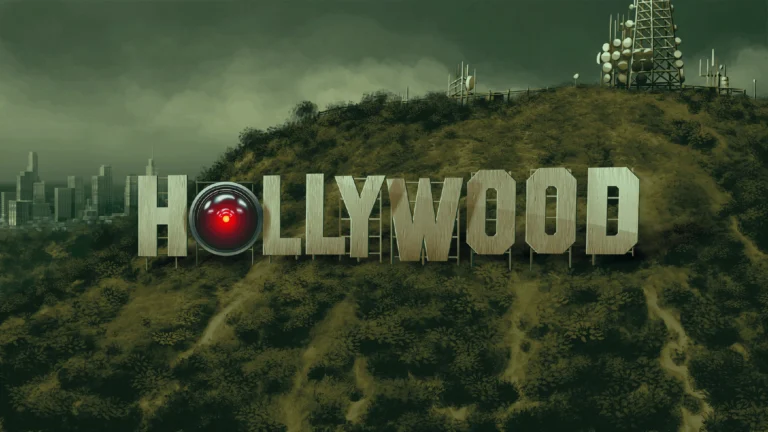
Somewhere in Hollywood right now, a film is being made without a single human performer stepping in front of a camera. The characters are AI-generated. The voices are synthetic. The performances are assembled from vast datasets of real human movement, expression, and speech — trained, in many cases, on the work of the very actors it is replacing. And it will appear in your streaming queue within the year, looking more real than anything you expect.
This is not a hypothetical. It is happening now. And the question that everyone in the entertainment industry — from A-list stars to background extras, from studio heads to union negotiators — is wrestling with is not whether AI will change acting as a profession, but how much, how fast, and whether the humans in the industry can shape those changes before they are overtaken by them. AI in Hollywood
In 2026, the answer is genuinely uncertain in ways that should give everyone pause — whether you are Zendaya considering your next contract, a 25-year-old drama school graduate trying to get their first audition, or a film fan wondering whether the movies you love will still be made by human beings ten years from now.
This is the complete picture: the technology, the cases, the controversy, the fight, and the honest answer to the question Hollywood most wants to avoid.
The Tilly Norwood Moment: The AI “Actress” That Started the Conversation
In early 2026, an AI creator called Tilly Norwood’s creator announced that they had developed a fully synthetic AI actress — and that she was available to star in Hollywood productions. Not as a background extra, not as a digital double for stunts. As a lead actress. With her own “personality,” her own “look,” and a price tag far below any SAG-AFTRA member.
The backlash was immediate and volcanic. Chris Pratt commented on social media, calling the panic about Tilly Norwood “all bulls-” before adding: “I don’t think that’s a good idea at all.” The creator of Tilly Norwood doubled down publicly, telling Variety that AI performers represented “a more ethical way to perform” and urging human actors to “future-proof themselves with AI.”
The controversy ignited a debate that had been building for three years — ever since the 2023 SAG-AFTRA strike made AI the central battleground of Hollywood’s labour wars — but had never previously had a face (literally) to attach to.
Tilly Norwood became that face. And the response from the industry gave you the clearest possible picture of where the lines are being drawn in 2026.
What AI Can Already Do in Film and Television
Before addressing whether actors will be replaced, it is worth being precise about what AI is already doing in production — because the public perception lags significantly behind the current reality.
De-Aging and Digital Resurrection
AI-powered de-aging technology — the kind used to recreate younger versions of Harrison Ford in Indiana Jones and the Dial of Destiny (2023) and Robert De Niro in The Irishman (2019) — has become a standard tool in major productions. What took months of painstaking VFX work in 2019 now takes a fraction of the time. The technology is getting better every year.
More controversially: studios have used AI to recreate the voices and likenesses of deceased performers. James Earl Jones, who voiced Darth Vader for 47 years, authorised the use of his AI-replicated voice before his death in 2024. His estate contracted with Lucasfilm to allow AI-generated Vader dialogue in future productions. SAG-AFTRA filed an unfair labour practice charge in May 2025 against Llama Productions (the Fortnite signatory) when it used an AI-generated version of Jones’s voice without properly bargaining with the union over terms — arguing this deprived living performers of potential work.
Digital Background Performers
In major crowd scenes, AI-generated background performers are now standard. Where a production might previously have hired 500 extras for a stadium scene, it now hires 50 — and fills the rest digitally. The 500 extras who would have worked that day no longer work that day. This is the dimension of AI’s impact that receives the least attention in public discourse, but that union negotiators describe as one of their most pressing concerns: the slow erosion of work at the bottom of the industry.
Voice Replication
AI voice cloning technology has reached a level where, with sufficient training data, a convincing replica of almost any voice can be generated. The implications for voice actors — one of the more financially stable corners of the acting profession — are severe. SAG-AFTRA’s year-long video game strike (ending July 2025) was driven almost entirely by this issue: game companies wanted to use AI-generated voices in place of human voice actors, without consent or compensation.
Synthetic Lead Performers
The most alarming frontier: fully synthetic AI characters designed to play leads in streaming content. These are not digital doubles of real actors. They are entirely manufactured personalities — built from datasets of human performance, designed to generate emotionally resonant screen presence without a human being attached. Tilly Norwood is the most prominent example, but she is not the only one. Multiple companies are developing synthetic performer products aimed at the low-to-mid-budget streaming market.
The Real Cases That Changed Everything
📁 Case 1: Scarlett Johansson vs. OpenAI (2024)
In May 2024, OpenAI released an AI voice assistant called “Sky” that bore a striking resemblance to Scarlett Johansson’s voice. Johansson had previously been approached by OpenAI CEO Sam Altman about licensing her voice for the system — and had declined. She took legal action after the near-identical voice was released without her consent, arguing the use violated her rights of publicity, created false endorsement, and caused reputational harm. OpenAI withdrew the voice option. The case became the defining early legal precedent for AI voice replication disputes, demonstrating that even the world’s most recognisable AI company was not immune to consequences for unauthorised likeness use.
📁 Case 2: The Darth Vader Voice Dispute (2025)
When Fortnite developer Epic Games (via Llama Productions) used an AI-generated version of James Earl Jones’s Darth Vader voice in the game without bargaining with SAG-AFTRA, the union filed an unfair labour practice charge. The case raised a question that the industry had not previously been forced to answer: when a deceased performer’s AI-replicated voice is used in a production, who is owed what, and who must be consulted? The answer — still being worked out in contracts and courts — will determine how the industry handles AI resurrection of performers for generations.
📁 Case 3: Background Actors’ Body Scans (2023–2024)
During the 2023 strikes, multiple background actors reported being asked to participate in full-body scanning sessions — which they were told would be used “for the rest of eternity” — for minimal one-time compensation and no ongoing royalties. The scans would allow studios to generate digital replicas of real human performers without ever hiring them again. This case — perhaps more than any other — galvanised SAG-AFTRA’s membership, because it demonstrated that the technology was not coming for stars first. It was coming for the most economically vulnerable performers.
📁 Case 4: The Tilly Norwood “Tilly Tax” Proposal (2026)
In response to the growing use of fully synthetic performers like Tilly Norwood, SAG-AFTRA is currently negotiating what industry insiders are calling the “Tilly tax” — a proposal that would require studios to pay a royalty into the union’s pension and health fund whenever an AI-generated synthetic performer is used in place of a human. The logic, as explained by union chief negotiator Duncan Crabtree-Ireland: “If synthetics cost the same as a human, studios will choose a human every time.” Union AI task force member Brendan Bradley described it with remarkable candour: “Is that a perfect solution? No. But it’s under the category of the best bad idea we’ve got in 2026.”
SAG-AFTRA’s 2026 Contract Negotiations: The Stakes
The most consequential ongoing story in Hollywood right now — more consequential than any individual film release, arguably — is happening in a series of negotiating rooms between SAG-AFTRA and the Alliance of Motion Picture and Television Producers (AMPTP).
The current contract expires on June 30, 2026. Negotiations began unusually early, on February 9, 2026 — a deliberate choice by both sides to avoid a repeat of the devastating 2023 strikes that cost the industry billions of dollars and shut down production for four months. A one-week extension was announced on March 6, 2026, pushing talks into the week of March 9.
The key AI-related demands from SAG-AFTRA in 2026:
| Issue | SAG-AFTRA Position | Current Status |
|---|---|---|
| Digital Replica Consent | Opt-in only — no actor’s likeness used without explicit, specific written consent | Partially won in 2023; being strengthened in 2026 talks |
| Digital Replica Compensation | Fair ongoing compensation, not one-time buyouts | Active negotiation |
| “Tilly Tax” on Synthetic Performers | Studios pay royalty into pension/health fund when AI replaces human | Proposed — not yet agreed |
| AI Training Data | Studios cannot use covered performances to train AI without consent | Won in Commercials Contract (May 2025); seeking in TV/Film |
| Streaming Residuals | Significant increase — streaming pays ~20% of what broadcast once did | Ongoing dispute since 2023 |
| Exclusivity Limits | Reduce restrictions on actors working other shows during hiatuses | Under discussion |
The AMPTP’s new lead negotiator, Greg Hessinger — a former SAG leader himself — has been described by union officials as more flexible than his predecessor. Early signals suggest a deal before the June 30 expiration is possible, though not certain. If no deal is reached, the threat of another strike — with all of its economic consequences — returns.
The Laws Being Written Right Now: How Government Is Responding
The legislative landscape around AI and performers has shifted significantly in the past two years. Here is where things stand in April 2026:
| Law / Act | What It Does | Status |
|---|---|---|
| NO FAKES Act (Federal) | Prohibits creating or distributing AI replicas of living or deceased persons in performance without consent | Reintroduced in US Senate April 2025 with Google/YouTube support — not yet passed |
| ELVIS Act (Tennessee) | First state law to protect voice, image and likeness against AI deepfakes and audio cloning | Signed March 2024 — in effect |
| California AB 2602 | Requires specific written consent before using a performer’s digital replica; contract must detail intended uses | Signed September 2024 — in effect from January 2025 |
| New York Senate Bill 7676B | Substantially identical to California’s law — extends protections to New York performers | Passed December 2024 |
| Take it Down Act (Federal) | Comprehensive legal protection against nonconsensual intimate digital images and deepfakes online | Signed into federal law May 2025 |
| EU AI Act | Classifies certain deepfake applications as high-risk; requires labelling of synthetic media | In implementation phase across EU |
The legislative picture is moving faster than most observers expected two years ago. California and New York — the two states where most Hollywood production is based — both have active consent laws. Tennessee’s ELVIS Act has become a model for other states. The NO FAKES Act at the federal level, if passed, would establish a nationwide standard.
But legislation always lags technology. Every law currently in effect was written about a version of AI that is already less advanced than the version being used in productions today.
The Debate: Will AI Replace Actors? Both Sides, Honestly Presented
The Case That AI Will Substantially Replace Human Actors
The Case That Human Actors Will Survive and Remain Central
What This Means for Indian Cinema
The AI-in-Hollywood conversation is not only an American one. India’s entertainment industry — Bollywood, Tollywood, the pan-India blockbuster ecosystem — faces the same technological pressures, but with different union structures, different legal frameworks, and different cultural attitudes toward performers.
In Bollywood, AI de-aging technology has already been used in several high-profile productions. Remastered AI versions of classic songs — including Asha Bhosle and Kishore Kumar recordings — have appeared in recent blockbusters like Dhurandhar. The question of consent and compensation for these remastered uses is not being addressed with anything like the contractual rigour of SAG-AFTRA.
India has no equivalent of SAG-AFTRA. Indian performing artists do not have the same collective bargaining infrastructure. Which means that the exploitative practices that American actors are fighting against contractually — body scans stored forever for minimal payment, voice replication without ongoing compensation, digital replicas used without specific consent — are more likely to go unchallenged in Indian productions.
As Bollywood’s ambitions become genuinely global — with Ramayana targeting worldwide IMAX release and Raaka being built for international audiences — the contract standards that apply to American performers will increasingly be the standards that apply to everyone who works in those productions. Indian actors who work in large international co-productions will find themselves inside the American regulatory and contractual framework whether they navigate it intentionally or not.
The Verdict: Honest and Complicated
🎬 Popcorn Review’s Assessment: AI in Hollywood 2026
Will AI replace actors entirely? No. Not in the foreseeable future, not for the performances that matter most to audiences, and not without a legal and industrial battle that Hollywood studios have good reason to be cautious about re-entering.
Will AI eliminate significant categories of acting work? It already has. Background performers, voice actors in games and animation, digital stunt doubles — these are categories where displacement is happening now, not eventually. For the hundreds of thousands of working actors who sustain careers in the middle tier of the industry, this is not a theoretical future concern. It is a present economic reality.
What determines how far this goes? The outcome of the 2026 SAG-AFTRA contract negotiations. The passage or failure of the NO FAKES Act. The degree to which audiences consistently choose authentically human storytelling over technically adequate synthetic content. And whether the “Tilly Tax” concept — making AI performers financially equivalent to human ones — becomes contractual reality.
The most honest answer: “Is that a perfect solution? No. But it’s under the category of the best bad idea we’ve got in 2026.” — Brendan Bradley, SAG-AFTRA AI task force. The industry is not solving this problem. It is managing it, imperfectly, one contract at a time, while the technology advances faster than the solutions.
Variety — Unable to Stop AI, SAG-AFTRA Mulls a Studio Tax on Digital Performers
Fortune — Actors Union Is Bargaining for ‘Tilly Tax’ on AI Film Characters
SAG-AFTRA Extends 2026 Contract Talks: AI & Streaming Pay at Stake
SAG-AFTRA — Official AI Bargaining and Policy Work Timeline
The Hollywood Reporter — SAG-AFTRA Commercials Contracts Refine Union’s Approach to AI
Rodriques Law — AI & Deepfake Contracts: Legal Protection for Actors and Producers
Davis Wright Tremaine — State Laws Regulating AI in Entertainment Industry
SAG-AFTRA — Future Shock: AI Goes to Hollywood
Frequently Asked Questions (FAQ)
Final Word: The Industry Is Not Solving This. It’s Managing It.
Here is the honest conclusion that the data, the contracts, and the people inside this industry all point toward: AI is not going to replace acting. And AI is already replacing actors. Both of those statements are true simultaneously, and the tension between them is where the entire future of the entertainment industry currently lives.
The star system will survive. Great performances will remain human. The films and shows that audiences love most — the ones that move them, that they remember ten years later, that they watch again and again — will be made by human beings telling human stories with human bodies and human feelings.
But the vast ecosystem of working actors below the star tier — the background performers, the voice actors, the character actors who fill the 47-second scene that makes everything else work — that ecosystem is under genuine, active pressure. And the people who built their careers in that ecosystem deserve better than to be told that their concerns are exaggerated while the contracts that might protect them are still being negotiated.
The “Tilly Tax” is the best bad idea they’ve got in 2026. That description — honest, slightly bleak, genuinely trying — is also the most accurate description of where the entire industry stands with this question. Making it work, imperfectly, one negotiation at a time.
Do you think AI will ever fully replace human actors — or will audiences always choose the real thing? Drop your opinion in the comments. 👇

Popcorn in hand and a opinion ready — Emily covers movie reviews, box office buzz, and all things cinema at Popcorn Review.

