
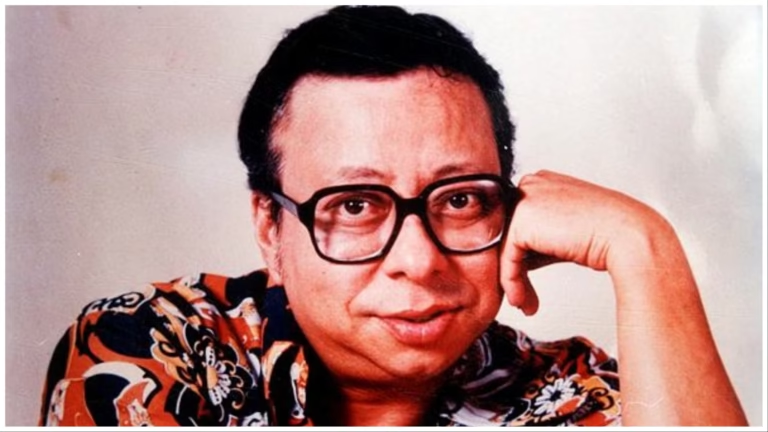
There is a story that Indian composer MM Keeravani (then known as MM Kreem) — the man who would later win an Oscar for RRR — heard that RD Burman had not won a single Filmfare Award during the entire decade of the 1970s despite composing the music for Sholay, Amar Prem, Yaadon Ki Baaraat, Hare Rama Hare Krishna and dozens of other landmark soundtracks that defined Indian popular music. Keeravani was so outraged that he threw away the Filmfare Awards he himself had won and has not attended a Filmfare function since.
That single anecdote tells you everything you need to understand about RD Burman.
He was the composer who gave Bollywood its most thrilling decade of music, who was simultaneously overlooked by the industry’s most prestigious award for the entirety of that decade, who then faced a humiliating career decline in the 1980s when the industry decided he was no longer relevant, who suffered two heart attacks, who was quietly dropped by producers who had once fought over him — and who then, in the final weeks of his life, completed the score for 1942: A Love Story, died before its release, and watched it become one of the best-selling Bollywood albums of 1994, winning him the posthumous Filmfare Award that made the industry’s decade of neglect feel like one of music history’s great injustices.
This is the complete story of RD Burman — Pancham Da — the genius behind India’s greatest Bollywood music era, and the man who, even in death, proved everyone wrong.
R.D. Burman: The Quick Facts
| Detail | Information |
|---|---|
| Full Name | Rahul Dev Burman |
| Nickname | Pancham / Pancham Da |
| Born | June 27, 1939 — Calcutta (now Kolkata), India |
| Died | January 4, 1994 — Mumbai, India (age 54) |
| Cause of Death | Cardiac arrest (second heart attack; first in 1988) |
| Father | Sachin Dev Burman (legendary film composer) |
| Mother | Meera Dev Burman (lyricist) |
| Education | Ballygunge Government High School, Kolkata; St. Xavier’s School, Kolkata |
| Training | Sarod: Ustad Ali Akbar Khan; Tabla: Samta Prasad; also played harmonica, piano, guitar |
| Films Composed | 331 films (292 Hindi, 31 Bengali, 3 Telugu, 2 Tamil, 2 Oriya, 1 Marathi) |
| First Independent Film | Chhote Nawab (1961) |
| Breakthrough Film | Teesri Manzil (1966) |
| Peak Era | 1970–1983 |
| Filmfare Awards Won | 3 (Sanam Teri Kasam 1982, Masoom 1983, 1942: A Love Story 1994 — posthumous) |
| Filmfare Nominations | 16 (won 0 during entire 1970s peak decade) |
| First Marriage | Rita Patel (1966–1971) |
| Second Marriage | Asha Bhosle (1980–1994, until his death) |
| Legacy Award | Filmfare RD Burman Award for New Music Talent (established 1995 — first winner: A.R. Rahman) |
RD Burman’s Origin: The Boy Who Was Born Into Music and Had to Escape It
The paradox at the heart of RD Burman‘s story is this: he was born into one of Indian cinema’s greatest musical dynasties, and yet building his own identity meant spending years stepping out from the shadow of the man he loved most in the world.
He was born Rahul Dev Burman on June 27, 1939, in Calcutta — the only son of Sachin Dev Burman, one of the most revered composers in Hindi film music, and Meera Dev Burman, who was a lyricist. Music was not a career choice in this family. It was the air they breathed.
The nickname “Pancham” arrived early. One version of the story: as an infant, he cried in the fifth note (Pa) of the Indian musical scale — and the name “Pancham” (meaning five in Sanskrit) stuck. Another version credits veteran actor Ashok Kumar, who reportedly heard the baby Rahul repeatedly babble “Pa, Pa, Pa” during a visit and declared him Pancham on the spot. Whatever the origin, the nickname tells you something — even before he had composed a single bar of music, his ear for pitch was already being noticed.
His musical education was extraordinary. He studied sarod with Ustad Ali Akbar Khan — one of the greatest sarod players in Indian history. He studied tabla with Samta Prasad. He taught himself harmonica to a level of genuine proficiency. He absorbed everything around him: the Western jazz and swing records his father brought home, the Indian classical raga sessions happening in the family’s living room, the folk music of Bengal, the film scores his father was working on across the corridor.
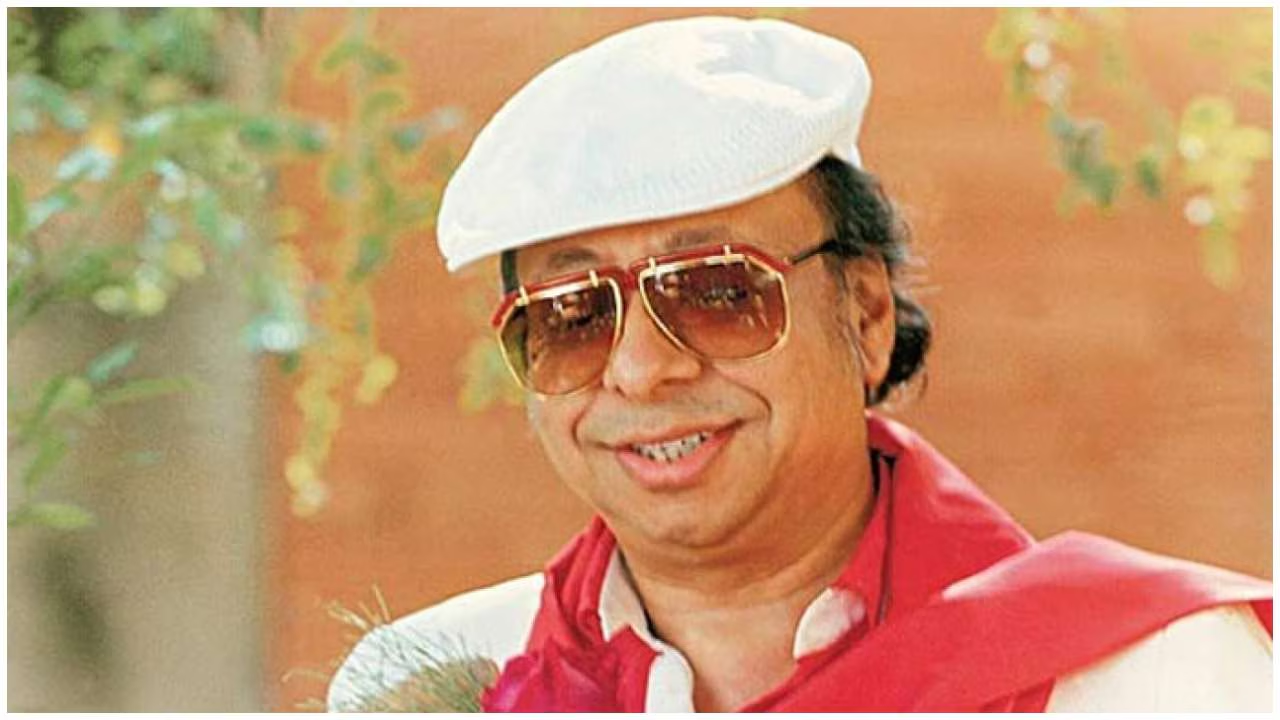
At nine years old, he composed his first song: “Aye Meri Topi Palat Ke Aa.” His father was so taken with it that he used it in the film Funtoosh (1956). This is not a fond family legend — it is documented fact. At nine, RD Burman had his first Bollywood credit.
His second composition, “Sar Jo Tera Chakraye” — written at roughly the same age — ended up in Guru Dutt’s masterpiece Pyaasa (1957). It was credited to S.D. Burman in the film. The son’s tune appeared in one of Indian cinema’s most celebrated works, anonymous in the credits. That particular irony would follow Pancham Da for a long time.
Growing Up in His Father’s Recording Sessions
From his early teens, RD Burman was present at virtually every recording session his father conducted. Not as a passive observer — as a participant. He played mouth organ on “Hai Apna Dil To Awara” while the credit went to S.D. Burman. He assisted on Chalti Ka Naam Gaadi (1958), Kaagaz Ke Phool (1959), Bandini (1963), Guide (1965). He was learning the craft at the highest possible level — from India’s best, in real time, on actual films.
But he was also, quietly, forming a musical philosophy that was entirely his own.
Where his father drew primarily from classical Indian traditions and Bengali folk, the younger Burman was fascinated by everything he was not supposed to love: Western rock, jazz, Latin rhythms, Brazilian bossa nova, European cabaret. In Calcutta’s cultural ferment of the 1950s, these sounds were arriving — on vinyl, on radio, through the cinemas showing Hollywood films — and RD Burman absorbed all of it without apology.
He was not trying to make Western music. He was trying to make Indian music that could hold both worlds inside it simultaneously. That turned out to be the most revolutionary idea in the history of Bollywood.
The Teesri Manzil Moment: When India First Heard the Future
In 1966, a story about how RD Burman got the music direction job for Teesri Manzil became one of Bollywood’s most retold anecdotes — because it captures exactly what kind of composer he was.
Director Vijay Anand arranged an audition for him with producer Nasir Hussain. Actor Shammi Kapoor was present in the session. Pancham sat down and played some of his tunes. The story goes that Shammi Kapoor, upon hearing the music, screamed “Yahoo!” in sheer appreciation — the same exclamation that had become his trademark on screen. Hussain immediately signed Burman to a six-film contract.
Teesri Manzil changed Indian film music. Songs like “O Haseena Zulfon Wali,” “Aaja Aaja Main Hoon Pyar Tera,” and “O Mere Sona Re” introduced rock ‘n’ roll energy — heavy brass, electric guitar, jazz rhythms — to a Hindi film audience that had never quite heard Bollywood sound like this. The youth of 1966 did not know the term “Pancham Da.” By the end of the year, they knew his music by instinct.
Producer Nasir Hussain was so satisfied that he handed Burman five more films as promised, including Baharon Ke Sapne (1967), Pyar Ka Mausam (1969), and the one that would become a landmark: Yaadon Ki Baaraat (1973). Each partnership deepened Pancham’s understanding of how to marry a composer’s instincts with a director’s vision.
The Golden Era: 1970–1975 — When Pancham Da Was Unstoppable
The early 1970s are, by almost any measure, the greatest sustained period in Bollywood music history. And RD Burman was the reason.
Consider what he composed in a single five-year window. 1971: Hare Rama Hare Krishna (Dum Maro Dum), Amar Prem (Raina Beeti Jaaye, Chingari Koi Bhadke), Caravan (Piya Tu Ab To Aaja, Dilbar Dil Se Pyaare). 1972: Apna Desh, Seeta Aur Geeta. 1973: Yaadon Ki Baaraat (Chura Liya Hai Tumne Jo Dil Ko), Jugnu. 1974: Aap Ki Kasam (Zindagi Ke Safar Mein), Ajnabee. 1975: Sholay (Mehbooba Mehbooba, Yeh Dosti), Deewaar (Kehdoon Tumhe Ya Chup Rahoon), Aandhi (Tere Bina Zindagi Se, Is Mod Se Jaate Hain).
These are not just hit songs. They are India’s emotional furniture. The songs people play at every kind of gathering — weddings, road trips, late nights, first heartbreaks. Songs that three generations have learned to sing without knowing the lyrics had to be memorised because the melody already lived in them.
The Sholay Paradox: Biggest Film, Zero Award
Sholay (1975) remains the biggest commercial hit in the history of Indian cinema. Its music — entirely composed by RD Burman — topped the Binaca Geetmala year-end charts. “Mehbooba Mehbooba,” “Yeh Dosti Hum Nahin Todenge,” “Koi Haseena Jab Rooth Jaati Hai” — all became cultural immortals.
The Filmfare Award for Best Music Director that year went to someone else.
This was not an aberration. Across the entire 1970s, RD Burman received 16 Filmfare nominations and won exactly zero awards. The industry that was built on his music was not prepared to acknowledge it with its most visible prize. When MM Keeravani learned this, he threw away his own awards in protest — and that act of principled fury speaks more eloquently to Pancham’s status than any acceptance speech ever could.
Why the Awards Didn’t Come: The Industry Psychology
This is where the industry/business angle becomes genuinely fascinating. The Filmfare Awards in the 1970s were guided by a particular aesthetic conservatism — a preference for what was considered “sophisticated” in Indian classical or semi-classical terms. RD Burman‘s music was too modern, too Western-influenced, too deliberately populist in its energy to fit that framework.
The cruel irony is that the very qualities that made Pancham’s music revolutionary — the rock rhythms, the jazz brass, the cabaret energy, the electric guitars — were precisely what the award establishment couldn’t categorise as “serious” music. He was making something they didn’t have a box for. And rather than expand the box, they gave the prize to people who fit inside it.
Meanwhile, every producer in Bollywood was signing him for their biggest films, every hero wanted his songs, and every music-buying household in India owned at least ten of his records.
The Secret Ingredient: How RD Burman Made Sounds Nobody Else Imagined
Most articles about RD Burman list his famous songs. What they rarely explain is the technical and creative wizardry that made those songs sound like nothing that existed before them. This is where Pancham Da’s genius was most completely itself.
This approach to composition — treating the entire world as a potential sound source, refusing to be limited by what a traditional orchestra could do — made R.D. Burman not just a great Bollywood composer but a genuine sonic innovator. Thirty years before experimental producers would speak about “found sound” as an avant-garde technique, Pancham was doing it in Bollywood recording studios with beer bottles and motorcycles.
The Partnerships That Built the Golden Era
No composer works alone — not really. The songs that defined RD Burman‘s era were the product of creative collaborations so finely calibrated that they became ecosystems of their own.
🎤 R.D. Burman × Kishore Kumar
If any single artistic partnership defines the sound of 1970s Bollywood, it is this one. Kishore Kumar’s voice — mercurial, technically unconventional, capable of everything from operatic sadness to pure comedy — was the perfect instrument for Burman’s compositions, which demanded a singer who could move between registers without warning. Songs like “Yeh Shaam Mastani,” “Roop Tera Mastana,” “O Mere Dil Ke Chain,” and “Zindagi Ke Safar Mein” showcase a partnership so intuitive that it sounds like a single creative mind split into composer and singer. It was Pancham who played an instrumental role in making Kishore Kumar the definitive playback voice for Rajesh Khanna in Aradhana (1969) — a decision that simultaneously made Khanna a superstar and launched Kishore into his greatest decade.
🎤 R.D. Burman × Asha Bhosle
The professional relationship became personal — and the personal relationship deepened the professional. Asha Bhosle’s voice, with its extraordinary range from classical ghazal to Western-influenced cabaret to playful folk, was the only voice that could fully inhabit the entire width of Burman’s compositional imagination. Their creative partnership began in the late 1960s and produced songs that are still astonishing in their range: “Dum Maro Dum,” “Piya Tu Ab To Aaja,” “Chura Liya Hai Tumne,” “Mera Kuch Saaman,” “Dum Maro Dum,” “In Aankhon Ki Masti,” “Humne Tumko Dekha.” In 1980, they married. When Pancham died in 1994, Asha described the loss as the most profound of her life. She would never remarry.
✍️ R.D. Burman × Gulzar
If Pancham’s partnership with Kishore was about energy and joy, his partnership with lyricist Gulzar was about depth and poetry. The films they made together — Aandhi (1975), Ijaazat (1987), Kinara (1977), Parichay (1972), Khushboo (1975) — are among the most lyrically and musically ambitious works in Bollywood history. Songs like “Tere Bina Zindagi Se Koi Shikwa,” “Is Mod Se Jaate Hain,” “Mera Kuch Saaman” (from Ijaazat, sung by Asha), and “Raina Beeti Jaaye” have the quality of literature set to sound. Gulzar’s metaphor-dense, image-rich Urdu poetry needed a composer who could honour its complexity without flattening it. Burman was that composer.
✍️ R.D. Burman × Anand Bakshi
Where Gulzar was Pancham’s literary soulmate, lyricist Anand Bakshi was his populist one. Bakshi’s direct, emotionally accessible style matched Burman’s most commercially ambitious compositions perfectly. Songs like “Yeh Dosti Hum Nahin Todenge” (Sholay), “Kya Hua Tera Wada” (Hum Kisise Kum Naheen), and “Bachna Ae Haseeno” (Hum Kisise Kum Naheen) showcase how Burman could write a song that was simultaneously a melody people could hum and a rhythmic structure that held a dancefloor.
The R.D. Burman Timeline: From Nine-Year-Old Prodigy to Posthumous Legend
The Career Decline: What Really Happened to R.D. Burman in the 1980s
The story of R.D. Burman‘s 1980s decline is one of the most important and under-examined episodes in Indian music history — because it was not about talent, and it was not about the music. It was about the industry’s relationship with its own past.
The problem was structural. The late 1970s and early 1980s saw Bollywood music shift dramatically toward disco, synthesizer-heavy arrangements, and the kind of Western-influenced sound that Bappi Lahiri was delivering with enormous commercial success. Burman had pioneered Western influences in Bollywood — he had done it first, most inventively, and with the deepest musical intelligence. But the industry did not credit him for the foundation he had built. Instead, it chased the new surface and found someone else to provide it.
There is a bitter irony in the fact that Bappi Lahiri’s disco era was, in many respects, a simplified version of what Burman had been doing with far greater sophistication for fifteen years. The student had become the market leader while the teacher was being told he was out of date.
From 1984 onward, film after film failed. Producers who had once competed for his signature were suddenly unavailable. The man who had defined the decade was being quietly erased from it. In 1988, he suffered his first heart attack. Even after surgery, even after recovery, the offers didn’t fully return.
What is psychologically remarkable is what Burman did during this period: he kept composing. He composed 2,000 tunes mentally while recovering from heart surgery. He accepted whatever work came, finished it with full commitment, and continued to generate musical ideas that would have made any other composer’s decade. The humiliation was real. The genius was unaffected by it.
Myth vs. Fact: What People Get Wrong About R.D. Burman
R.D. Burman’s Most Iconic Songs: The Definitive List
| Song | Film / Year | Singer(s) |
|---|---|---|
| Dum Maro Dum | Hare Rama Hare Krishna (1971) | Asha Bhosle |
| Piya Tu Ab To Aaja | Caravan (1971) | Asha Bhosle, R.D. Burman |
| Raina Beeti Jaaye | Amar Prem (1972) | Lata Mangeshkar |
| Chura Liya Hai Tumne Jo Dil Ko | Yaadon Ki Baaraat (1973) | Asha Bhosle, Mohammed Rafi |
| Mehbooba Mehbooba | Sholay (1975) | R.D. Burman |
| Yeh Dosti Hum Nahin Todenge | Sholay (1975) | Kishore Kumar, Manna Dey |
| Tere Bina Zindagi Se Koi Shikwa | Aandhi (1975) | Lata Mangeshkar, Kishore Kumar |
| Is Mod Se Jaate Hain | Aandhi (1975) | Lata Mangeshkar, Kishore Kumar |
| Kya Hua Tera Wada | Hum Kisise Kum Naheen (1977) | Mohammed Rafi |
| Bachna Ae Haseeno | Hum Kisise Kum Naheen (1977) | Kishore Kumar |
| Tujhse Naraz Nahi Zindagi | Masoom (1983) | Anup Ghoshal |
| Mera Kuch Saaman | Ijaazat (1987) | Asha Bhosle |
| Ek Ladki Ko Dekha To Aisa Laga | 1942: A Love Story (1993/94) | Kumar Sanu |
| Kuch Na Kaho | 1942: A Love Story (1993/94) | Kumar Sanu |
| O Haseena Zulfon Wali | Teesri Manzil (1966) | Mohammed Rafi |
| Yeh Shaam Mastani | Kati Patang (1970) | Kishore Kumar |
The Legacy: How R.D. Burman Still Shapes Bollywood Today
More than three decades after his death, RD Burman‘s influence on Indian music is not historical — it is active and ongoing.
Every major Bollywood composer of the post-1994 era has cited Pancham as a formative influence. A.R. Rahman — who won the first R.D. Burman Award and went on to win two Academy Awards — has spoken extensively about Pancham’s role in shaping his musical thinking. Shankar-Ehsaan-Loy, Vishal-Shekhar, Amit Trivedi, Shantanu Moitra — all recipients of the RD Burman Award, all openly grateful debtors to his legacy.
The Kronos Quartet — the American classical string ensemble — compiled the album You’ve Stolen My Heart (2005) as a tribute to Burman’s and Asha Bhosle’s musical partnership, bringing Asha back into the recording studio for a project that introduced Pancham’s compositions to a new international classical audience. The Black Eyed Peas sampled his songs in “Don’t Phunk with My Heart.” British South Asian DJs in the UK and North America built entire careers on remixing his catalogue in the 1990s and 2000s. The 2003 film Jhankaar Beats was made as an explicit tribute to his style. The music of Lootera (2013) is a Pancham homage. The 2012 song “Balma” from Khiladi 786 was another direct tribute.
His songs have been remixed, resampled, re-recorded, and reimagined so many times that they have become genuinely generational currency — heard by people who have no idea who composed them, absorbed into the musical DNA of listeners who were not yet born when he died.
“It was not just the end of the life of a musician but was the end of a music civilisation.” — Euphony, on January 4, 1994
That sentence is not hyperbole. RD Burman did not just compose songs for Bollywood. He built the language that Bollywood’s most creative decades spoke in. He heard sounds in beer bottles and motorbike engines and combs and breath. He merged ragas with rock and jazz with folk and disco with classical. He worked with Kishore Kumar and Asha Bhosle and Lata Mangeshkar and Mohammed Rafi and made each of them sound like the best version of themselves. He was overlooked by the industry that consumed him, declined by the producers who had once courted him, reduced by circumstances that had nothing to do with his talent — and he never stopped composing, not once, right up until his heart gave out at 54.
And then, fourteen days after his death, India heard “Ek Ladki Ko Dekha To Aisa Laga” for the first time, and understood — again, too late, always too late — what it had been sitting next to all along.
Related Posts from Popcorn Review
Follow Popcorn Review
- 📸 Instagram: @pop_cornreview
- 📌 Pinterest: Pinterest / PopcornReview
- 👍 Facebook: Popcorn Review on Facebook
- 🐦 X / Twitter: @popcorn_revieww
Sources
- Wikipedia — R.D. Burman
- Encyclopaedia Britannica
- Film Companion — Filmfare’s Strange Relationship With RD Burman
- Encyclopedia.com — Rahul Dev Burman
- Euphony — R.D. Burman Complete Biography
- ChandraKantha.com — Biography of R.D. Burman
- Curious Indian — R.D. Burman: The Maverick Maestro Who Changed Bollywood’s Tune
- Grokipedia — R.D. Burman Filmography
FAQ: Everything You Want to Know About R.D. Burman
The Final Word
There is a question worth sitting with: what would Indian music sound like today if RD Burman had lived to seventy? To eighty?
A man who was still composing masterpieces at 54 while his second heart was failing him. A man who claimed to have composed 2,000 tunes in his head while recovering from his first attack. A man who made a Latin rock album while Bollywood told him he was finished. Who collaborated with Boy George. Whose compositions the Kronos Quartet travelled to India to record. Who, in his final weeks, wrote “Ek Ladki Ko Dekha To Aisa Laga” — a melody so perfect that it sounded like it had always existed, like it had been waiting for him to find it.
He died at 54. The music keeps going. It always was going to.
If there is one thing Pancham Da proved — not with words, but with 331 films and 2,000 unrecorded tunes and a career that the industry tried to end and couldn’t — it is that a genuinely original musical mind is not the property of the industry that attempts to manage it. The industry moves on. The music remains.
Which RD Burman song do you think best captures what made him a once-in-a-century genius — and why? Drop it in the comments. Pancham Da’s music deserves to keep finding new ears. 🎵

Popcorn in hand and a opinion ready — Emily covers movie reviews, box office buzz, and all things cinema at Popcorn Review.

