
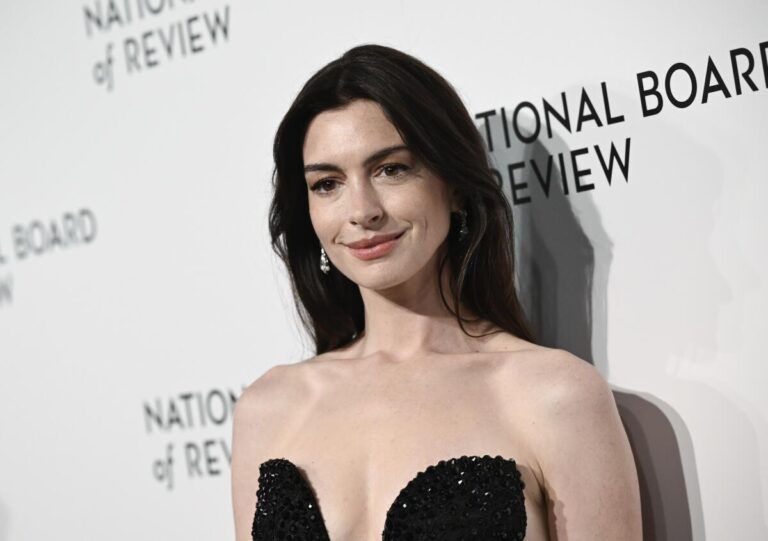
Anne Hathaway comeback, The internet declared Anne Hathaway the most irritating woman in Hollywood at the exact moment she won an Oscar. It called her a liar, a try-hard, and a fake — for reasons that, examined honestly, dissolve into nothing. And now, in 2026, it is writing the apology it spent a decade avoiding. This is the complete story of how one woman outlasted the mob — and what it says about all of us.
On the evening of February 24, 2013, Anne Hathaway walked to the podium at the 85th Academy Awards, took the Oscar for Best Supporting Actress in both hands, looked at it, and said three words: “It came true.”
She had worked toward this moment for years. She had shaved her head for the role. She had lost weight to the point that her health was commented upon in the press. She had given what many critics called the finest few minutes of screen acting in a film full of excellent performances — her version of “I Dreamed a Dream,” shot in a single take, devastating in its unsparing physical and emotional honesty.
And the internet decided to hate her for it.
Not privately. Not quietly. With the specific, organised, gleeful intensity that the early social media era was discovering it could mobilise against individual targets. “Hathahate” became a trending term. Websites ran articles about why she was “annoying.” A San Francisco Chronicle columnist named her the most irritating celebrity of the year. Her Oscar co-host, James Franco, went on Howard Stern and agreed, when asked, that “everyone sort of hates Anne Hathaway.”
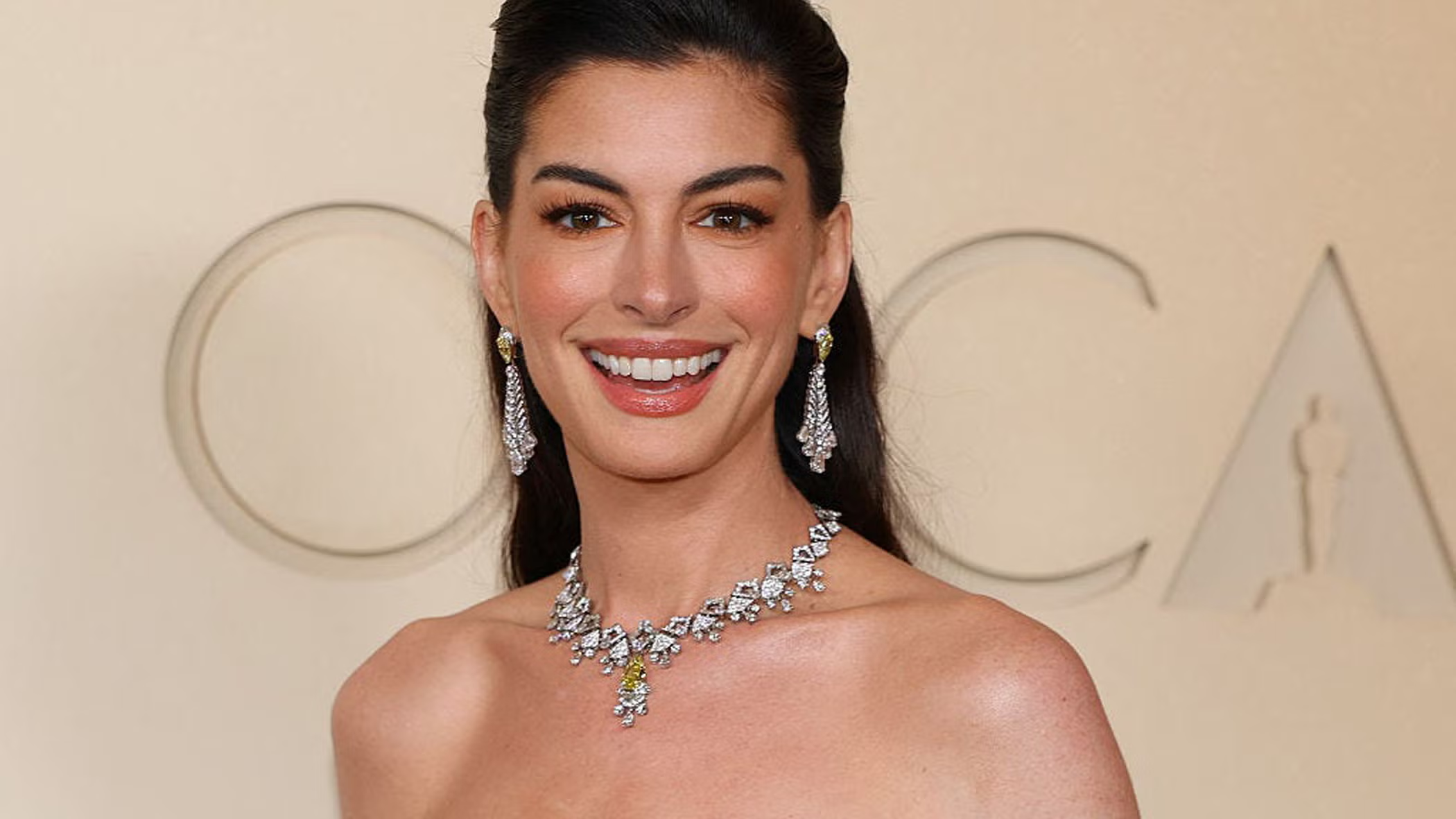
She had just won an Oscar. She had not done anything wrong. And yet.
What did Anne Hathaway actually do wrong?
This is the question that, asked plainly, has no satisfying answer. The prosecution’s case against her — assembled from thousands of tweets, comment sections, magazine columns, and late-night jokes over approximately three years — amounts to the following:
- CHARGE: Her Oscar speech felt “rehearsed” and “too perfect.”
REALITY: She had been rehearsing acceptance speeches her entire life. She is an actress. Rehearsing things is literally her job. - CHARGE: She said “It came true!” which people interpreted as fake humility.
REALITY: She was saying the wish she made came true. This is a human response to achieving something you have wanted. It is also three words. - CHARGE: She came across as “actressy” and “try-hard.”
REALITY: She is an actress. The specific energy people called “try-hard” was thoroughness, preparation, and visible enthusiasm for her work. These are professional virtues, not character defects. - CHARGE: She was “too perfect” — too gracious, too grateful, too articulate in interviews.
REALITY: This is the argument in its purest form. The charge is that she was too good at being publicly pleasant. The indictment is competence. - CHARGE: She was “annoying.” Full stop. No elaboration provided.
REALITY: This is not a charge. This is a feeling, presented as a verdict.
Examined this way, the prosecution’s case is not a case at all. It is a mood. It is the internet deciding, collectively and without evidence, that it no longer enjoyed the feeling of being reminded of someone’s existence — and then dressing that feeling up as a moral judgment.
What the Hathahate actually was — what historians of internet culture and feminist critics have been saying for years, and what has become increasingly obvious with the benefit of a decade of distance — was something considerably more uncomfortable to acknowledge.
It wasn’t about Anne Hathaway.
It was about what the internet does to women who are too visible.
The Pattern
Anne Hathaway is not the only name in this story. She is the most instructive example, partly because the Hathahate was so extreme and so documented, and partly because her arc — from beloved to vilified to rehabilitated — has been so clean. But she sits in a lineage.
Katherine Heigl. Megan Fox. Victoria Beckham. Jennifer Lawrence — turned on because she asked people not to look at her stolen nude photographs. Rachel Zegler and Brie Larson, targeted for “making harmless statements about modernising old stories.” The specific trigger changes each time. The underlying mechanism does not.
“The pop culture corner of the Internet is toxic. Not saying that misogyny didn’t exist before, but the Internet has amplified these voices. Some male actors go through it too, but if they reach the ‘Internet boyfriend’ status, they’re practically untouchable. Anne Hathaway has been nothing but likable, and the ‘hate campaign’ against her was crazy.”
The mechanism is this: a woman becomes very visible, very quickly. She becomes popular enough that her face and name are inescapable for a period. And then — not because she has done anything differently, but because overexposure is itself the trigger — the cultural mood turns. She is “too much.” Too earnest. Too present. Too grateful. Too something. The something shifts with each target. The too never changes.
What is particularly sharp about the Hathahate is that it peaked at the moment of her greatest professional achievement. She did not become more of a public presence before the backlash — she won an Oscar. The awards campaign, the visibility, the ubiquity of her face and name during that season: this was the fuel. The achievement was the occasion. And the punishment was administered at the exact moment the reward arrived.
“Accused of faux humility, it seemed as though the entire internet suddenly found her intensely unlikable. ‘Hathahaters’ became a trending term, with criticisms ranging from Anne being too rehearsed, self-absorbed or, hilariously, too perfect. Can you ever imagine a man receiving backlash for seeming overly emotional, or humble, at winning an Oscar?”
The Cost Was Real
Here is the part that is easy to dismiss and important not to. This was not just bad press. This had material consequences.
“A lot of people wouldn’t give me roles, because they were so concerned about how toxic my identity had become online.”
She won an Oscar in February 2013. Directors were afraid to cast her by March 2013. The speed of that collapse is remarkable and horrifying in equal measure. A performer at the absolute peak of critical recognition, whose talent was not in any serious doubt, found that the internet’s assessment of her likability was a stronger commercial signal than the Academy’s assessment of her craft.
She has described what followed: a period of deliberate public withdrawal. A decision to stay quiet, stay out of the cycle, wait for the tide to shift. She told the Huffington Post that year, with characteristic intelligence: “My impression is that people needed a break from me.” She was not wrong. She was also not the one who needed the break.
“Ten years ago, I was given an opportunity to look at the language of hatred from a new perspective. For context — this was a language I had employed with myself since I was seven. And when your self-inflicted pain is suddenly somehow amplified back at you at, say, the full volume of the internet… It’s a thing.”
How do you rebuild something the internet decided to burn down?
Anne Hathaway comeback — How It Actually Happened
The rehabilitation of Anne Hathaway’s public image was not a PR campaign. It was not a crisis communications strategy. It was something less systematic and more interesting: it was a series of cultural moments that reminded people why they had liked her in the first place, deployed over time, until the critical mass of goodwill exceeded the critical mass of the backlash’s residual energy.
The 2026 Met Gala Look — Why It Matters Beyond Fashion
Fashion criticism can seem trivial from the outside. And a Grecian pottery-inspired Michael Kors gown at a celebrity event is, on the surface, exactly that — trivial. But the 2026 Met Gala appearance is not primarily a fashion story. It is a cultural thermometer.
The Met Gala is the most visible, most photographed, most culturally scrutinised annual fashion event in the world. Who attends, what they wear, and how the press responds functions as a real-time readout of where any given celebrity stands in the public imagination. For Anne Hathaway to be called the belle of the ball at the 2026 event — not merely present, not merely acceptable, but genuinely celebrated — represents the completion of a cycle that began when the internet decided to turn on her thirteen years earlier.
And then there is the question of Miranda.
The Devil Wears Prada 2 is, among other things, a film about what happens to women who built their careers inside powerful institutions when those institutions start to decline. It is about power, and ageing, and what legacy means in a world that has moved on. And Anne Hathaway is in it — back as Andy Sachs, back at Runway, back opposite Meryl Streep’s Miranda Priestly.
The cultural layering is almost too neat. Hathaway, who spent years being told she was too much, returning to the role that first made her “too much” — beloved — in a film about women navigating environments that spent years defining their worth by someone else’s standards. The resonance is not accidental. It is the kind of coincidence that art produces when life has been paying attention.
The Devil Wears Prada 2 has already grossed $254 million globally. Anne Hathaway is in it. The critics like her in it. The audiences are watching.
The internet’s rehabilitation of Anne Hathaway is often framed as a generous act — the culture recognising that it got something wrong and correcting it. This framing is self-congratulatory in a way that deserves scrutiny. The culture did not graciously change its mind. It ran out of energy to sustain the campaign, moved on to other targets (Jennifer Lawrence, Brie Larson, Rachel Zegler — the list is long and current), and then retroactively reframed its earlier cruelty as a mistake rather than a pattern.
The pattern has not ended. It has only found new subjects. Anne Hathaway’s rehabilitation is real and deserved and worth celebrating. The mechanism that required the rehabilitation has not been dismantled. It is currently active, pointed at someone else.
The internet does not owe Anne Hathaway an apology. It owes her a reckoning with why it did what it did and whether it has actually stopped.
Her Met Gala Looks — The Full Fashion Arc
| Year | Designer | Theme | Reception |
|---|---|---|---|
| 2009 | Marc Jacobs | The Model as Muse | Bubble dress — Y2K, widely noted as a product of its era |
| 2010 | Valentino (ballgown) | American Woman | Champagne ballgown — classic, praised |
| 2014 | Two-piece strapless set | Charles James: Beyond Fashion | Elegant but conventional — pre-fashion-evolution period |
| 2015 | Ralph Lauren (liquid gold) | China: Through the Looking Glass | Gold hood and gown — runner-up for best look of the year per several outlets |
| 2018 | Armani Privé | Heavenly Bodies | Beginning of the Walsh-era fashion reinvention. First serious fashion statement. |
| 2023 | Versace × Chanel fusion | Karl Lagerfeld: A Line of Beauty | White tweed gown — “blended Versace’s sexiness with Chanel’s elegance.” Considered the moment her fashion rehabilitation was confirmed. |
| 2026 | Michael Kors | Costume Art / Fashion Is Art | Grecian pottery-inspired gown — called her “best look to date” by multiple outlets. “Belle of the ball.” Career-moment fashion arrival. |
Anne Hathaway said something in 2013 that has proved to be exactly right: “You have to remember in life that there’s a positive to every negative and a negative to every positive. Things tip in the scale of the positive.” They did. The scale tipped. It should not have had to. But it did.

Popcorn in hand and a opinion ready — Emily covers movie reviews, box office buzz, and all things cinema at Popcorn Review.

