
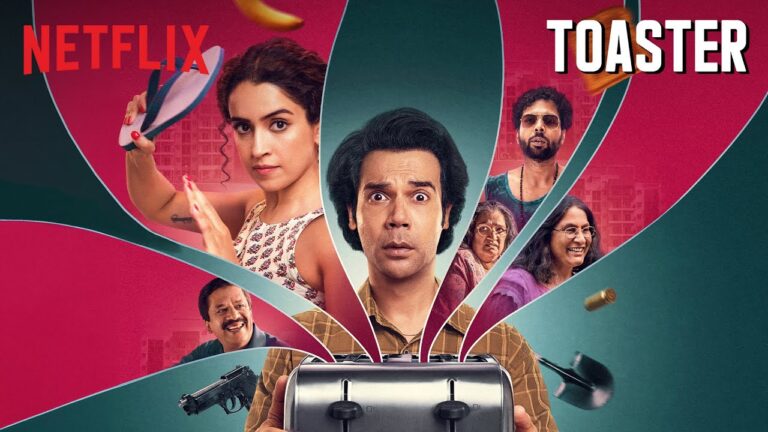
A ₹5,000 toaster. A cancelled wedding. One middle-class miser who absolutely cannot let it go.
This is the premise of Toaster — Rajkummar Rao’s new Netflix dark comedy that dropped today, April 15, 2026 — and honestly, the fact that this premise exists as a 2-hour-plus film is itself a minor act of creative courage in an OTT landscape filled with formulaic thrillers and predictable romances.
Within hours of release, Toaster was trending on social media and splitting the internet beautifully. One camp is calling it “dark comedy done right” and praising Rao’s comic precision. Another is tweeting about pacing problems and Sanya Malhotra being criminally underused. A third, smaller but vocal contingent has declared it outright bizarre and moved on with their evening.
So: is Toaster worth streaming tonight? Is this the Rajkummar Rao Netflix performance people have been waiting for since Monica O My Darling? Does the premise that sounds utterly ridiculous — a man’s obsession with a kitchen appliance escalating into murder — actually work as a film?
We’ve watched it. We’ve read the reactions. We’ve dug into what makes this film tick and where it runs out of steam. Here is the complete, honest verdict.
Toaster: The Fast Facts
| Detail | Information |
|---|---|
| Title | Toaster |
| Release Date | April 15, 2026 (Netflix) |
| Platform | Netflix (Direct-to-digital, no theatrical) |
| Director | Vivek Daschaudary |
| Lead Cast | Rajkummar Rao, Sanya Malhotra |
| Supporting Cast | Archana Puran Singh, Abhishek Banerjee, Farah Khan, Seema Pahwa, Upendra Limaye, Jitendra Joshi, Vinod Rawat |
| Producers | Rajkummar Rao, Patralekhaa, Tarun Bali (KAMPA Films) |
| Screenplay | Akshat Ghildial, Anagh Mukherjee, Parveez Shaikh |
| Story | Parveez Shaikh |
| Cinematography | Jishnu Bhattacharjee |
| Editor | Chandrashekhar Prajapati |
| Music | Aman Pant |
| Genre | Black Comedy Thriller |
| Language | Hindi (also dubbed in 10+ languages; subtitled in 31+ languages) |
| Runtime | 2 hours 5 minutes |
| Rating (US) | TV-14 |
| IMDb Rating | 7.3/10 (early) |
| Announced | May 22, 2024 |
| Notable Firsts | Rajkummar Rao’s debut as producer; Patralekhaa’s debut as film producer; Vivek Daschaudary’s debut as feature film director |
The Story: When a ₹5,000 Toaster Becomes a Murder Weapon (Sort Of)
The genius and the risk of Toaster live in exactly the same place: its premise.
Meet Ramakant (Rajkummar Rao) — a middle-class man who runs a perfume shop and whose entire personality is organised around one principle: not spending money. He is not careful with money. He is not frugal. He is pathologically, irrationally, beautifully kanjoos — the kind of miser for whom every rupee spent is a small personal tragedy and every rupee saved is a victory worth commemorating.
He lives with his wife Shilpa (Sanya Malhotra) in a society full of elderly neighbours, and his penny-pinching ways are a daily source of exasperation for everyone around him. Shilpa, in particular, has developed a coping mechanism: she is obsessed with crime shows on television and has quietly decided that she would make an excellent amateur detective if she ever got the chance.
The chance comes in the worst possible way.
At the wedding of Shilpa’s guru’s daughter, the couple gifts a brand-new ₹5,000 toaster — a purchase that required an unusually long and painful internal negotiation on Ramakant’s part. The next day, the marriage collapses. The toaster is now sitting in the household of a couple who are no longer married, which means — in Ramakant’s accounting — his ₹5,000 investment has been wasted.
He wants it back.
What follows is the film’s central escalation: every attempt Ramakant makes to retrieve this appliance makes the situation worse. The toaster becomes connected to a murder. There is a political secret involved. Multiple people begin chasing the same object for reasons that none of them can explain to each other. Shilpa’s amateur-detective instincts activate at entirely the wrong moment. And Ramakant, whose only goal is to recover a kitchen appliance, finds himself navigating a murder investigation, police trouble, and a web of lies that his ₹5,000 decision has directly triggered.
This is — on paper — a perfect dark comedy premise. A tiny, domestic, entirely relatable obsession (who hasn’t felt the specific pain of a wasted expensive gift?) becoming the chaos butterfly whose wings generate a hurricane. The question is whether the execution matches the idea.
The Crew Behind Toaster: Three Impressive Writing Pedigrees and a Debut Director
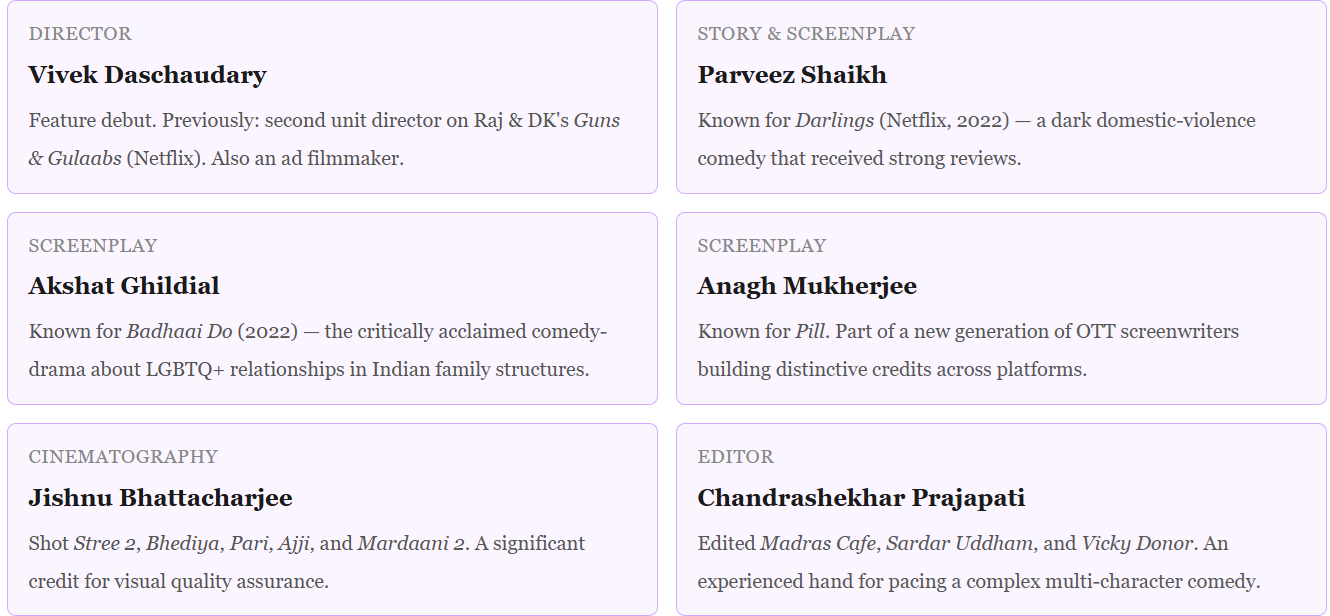
The pedigree here is genuinely impressive. Parveez Shaikh (Darlings), Akshat Ghildial (Badhaai Do), and Jishnu Bhattacharjee (Stree 2) are all established names with distinctive credits in exactly the kind of character-driven, socially-aware Bollywood storytelling that Toaster is attempting. The concern that multiple reviews have raised is whether the screenplay delivers on what the story promises — a question we’ll address directly in the review section.
The Complete Cast Deep-Dive
🎭 Rajkummar Rao — Ramakant (Lead)
This is Rao’s fifth Netflix film after Ludo, Monica O My Darling, The White Tiger, and Guns and Gulaabs — making him arguably the single most important male talent in Netflix India’s original Hindi content strategy. As Ramakant, he plays a character defined by a single, obsessively consistent trait: miserliness. The character doesn’t evolve, doesn’t learn, doesn’t become wiser — his stubbornness is the engine of all the chaos, and Rao plays this with the kind of committed, unsentimental comic precision that is his signature. Critics are divided on whether this represents his best recent work or an echo of previous performances, but there is very little disagreement that he is the film’s most watchable element.
🎭 Sanya Malhotra — Shilpa (Lead)
The couple’s reunion on screen after HIT: The First Case (2022) and before that, Ludo. Sanya Malhotra plays Shilpa — the long-suffering wife whose obsession with TV crime shows becomes her way of coping with (and inadvertently worsening) the situation. The character has genuine comic potential — an armchair detective who activates at the worst possible moment is a strong concept. The criticism from multiple reviewers is that the screenplay does not give Malhotra enough to do, constraining a performer who has demonstrated in Dangal, Pagglait, and Mrs. that she is capable of carrying complex emotional and comedic material. The word “underutilised” appears in virtually every review of her performance.
🎭 Archana Puran Singh — Mala Aunty (Supporting)
Perhaps the most interesting casting story attached to this film. Archana Puran Singh — best known to younger audiences as the laughing judge on The Great Indian Kapil Show — has called this role the best of her career. She plays a neighbour in Ramakant’s society, and by all accounts her character is bizarre, memorable, and a genuine tonal departure from her mainstream image. The fact that she suffered a wrist fracture during production (requiring surgery) and completed her portions with the cast concealed on screen is its own testament to her commitment. Reviews are genuinely mixed on whether her performance lands, but the unanimous agreement is that she swings big.
🎭 Abhishek Banerjee — Supporting (Cameo)
The scene-stealer. Abhishek Banerjee appears in a cameo — agreed to the role at Rao’s personal request, continuing a working relationship that goes back to Stree (2018) — and has been specifically called out in audience reactions as the film’s most entertaining supporting presence. Several X users have declared him funnier than the leads in his limited screen time, which is both a compliment to Banerjee and a mild concern about the film’s balance. His ability to steal scenes with minimal screen time has been one of the consistent highlights of Netflix India’s recent slate.
🎭 Seema Pahwa — D’Souza Aunty (Supporting)
Another Rao regular — previously in Bareilly Ki Barfi (2017). Pahwa plays D’Souza Aunty, an elderly neighbour whose presence adds warm texture to the society backdrop. Her naturalistic comic timing in smaller roles has been a reliable quality signal in Hindi films for years, and her inclusion here reflects the care Rao took in building the film’s ensemble.
🎭 Farah Khan — Orphanage Owner (Cameo)
One of the film’s most unexpected and apparently welcome cameos. Farah Khan — the legendary choreographer and director of Om Shanti Om and Happy New Year — plays an orphanage owner. The meta-humour of Farah Khan appearing in a dark comedy about a kitchen appliance is not accidental, and reviews describe her brief appearance as a genuinely funny breather in the film’s more chaotic stretches.
🎭 Upendra Limaye & Jitendra Joshi — Supporting
Two serious, acclaimed Marathi film actors — Limaye known for Choked and Joshi for Thar — whose presence in a dark comedy suggests the film has more dramatic depth than the kitchen-appliance premise implies. Both are capable of playing characters who are funny precisely because they are being entirely serious.
🎭 Patralekhaa — Producer (and brief appearance on screen)
Rao’s wife and co-producer on KAMPA Films makes a brief on-screen appearance (credited as “Parnalekha” on Netflix). Her primary role on this project is as producer — a deliberate choice to understand the filmmaking process from behind the camera rather than in front of it. Their joint production debut is one of the film’s broader significance markers.
The Production Story: Sonakshi, a Wrist Fracture, and a Production Debut
One broader context worth noting: this film is the maiden production of KAMPA Films — the banner Rajkummar Rao and Patralekhaa have built together. Patralekhaa has spoken publicly about deliberately stepping away from acting on this project to focus entirely on understanding production, saying: “Stepping into production with Kampa Film has been an incredibly meaningful milestone for us, and beginning this journey with Netflix — who have consistently championed distinctive and unconventional stories — makes it even more special.”
For anyone tracking Bollywood’s creative ecosystem, the emergence of actor-producer ventures with genuine creative ambition (as opposed to vanity productions) is a significant trend. KAMPA Films’ debut with a film as genuinely risky as Toaster suggests they are not playing it safe.
The Rajkummar Rao–Netflix Partnership: Five Films Deep
It is worth pausing to note what Toaster represents in the context of Rajkummar Rao’s relationship with Netflix specifically.
| Film | Year | Genre | Notable For |
|---|---|---|---|
| Ludo | 2020 | Dark Comedy Anthology | Anurag Basu’s ensemble masterwork; Rao in a career-best dark comedy performance |
| The White Tiger | 2021 | Drama / Satire | International acclaim; Academy Award nomination for Adapted Screenplay |
| Guns & Gulaabs | 2023 | Crime Comedy Series | Raj & DK-directed; defined the style of Netflix India’s prestige crime-comedy slate |
| Monica O My Darling | 2022 | Dark Comedy Thriller | Probably his most acclaimed Netflix film performance; sharp Bollywood-noir satire |
| Toaster | 2026 | Black Comedy Thriller | His first project as producer; his fifth Netflix original; the most absurd premise of all five |
Looking at this filmography, the trajectory is clear: Rao has positioned himself as the definitive face of Netflix India’s unconventional, character-driven, dark-comedy space. Toaster is both a continuation of that identity and its most extreme expression. No previous Netflix film had a premise this domestic, this mundane, this specifically about the very Indian middle-class psychology of not wasting money on anything.
The Critical Verdict: What the Reviews Are Actually Saying
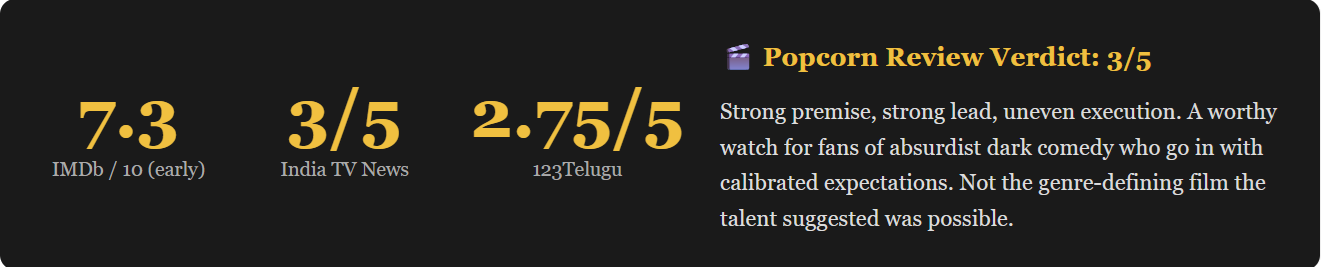
Strong premise, strong lead, uneven execution. A worthy watch for fans of absurdist dark comedy who go in with calibrated expectations. Not the genre-defining film the talent suggested was possible.
What Works
What Doesn’t Work
The Audience Reactions: What the Internet Is Actually Saying
The X (Twitter) discourse on Toaster has been one of the more entertaining aspects of its release day — a genuinely divided conversation that cuts across the usual fan/anti-fan binary.
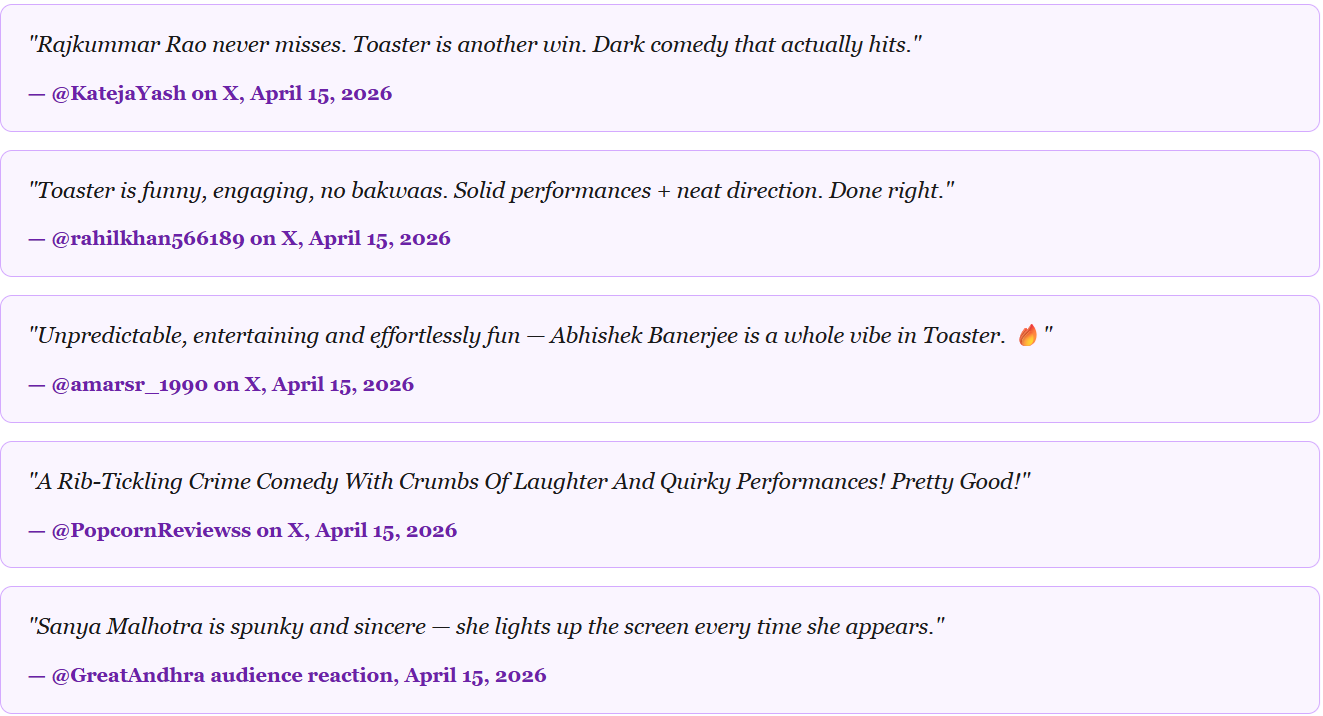
And from the other side of the discourse:
What is genuinely interesting about the reaction split is where it falls. General audiences — particularly those who enjoy light, accessible dark comedy — are responding positively. The more critical/analytical crowd, who came in expecting something as structurally precise as Andhadhun or as emotionally sharp as Darlings, are disappointed. Both responses are internally consistent and both are valid.
The Deeper Question: What Does Toaster Say About the State of Hindi Dark Comedy?
This is the question that makes Toaster interesting beyond its individual review score.
Hindi cinema has been circling dark comedy seriously for the past decade — Andhadhun, Blackmail, Ludo, Monica O My Darling, Darlings, Badhaai Do (in different registers). Some of these work brilliantly. Some don’t. The genre is hard because it requires two things to function simultaneously: the comedy has to be genuinely funny, and the dark undercurrent has to be genuinely unsettling. When only one of these works, the film falls into the gap between them.
Toaster‘s specific problem is that the “dark” in its dark comedy doesn’t really land as dark. The murder plot — which should provide the tension that makes the comedy feel dangerous — is handled more as a plot driver than as a genuinely disturbing event. The result is a film that is comfortable where it should be uncomfortable, and that comfort is ultimately what prevents it from reaching the heights its premise suggested.
Compare it to Monica O My Darling — probably Rao’s best Netflix film to date — where the darkness was real and the comedy was genuinely uncomfortable precisely because the consequences felt serious. Toaster never quite generates that discomfort. Ramakant’s worst fear is losing a toaster. He is never in danger of losing anything that actually matters, which means the audience is never in real tension about him.
And yet — and this is important — Toaster is still a film worth watching. Not because it achieves everything it attempts, but because what it does achieve is genuinely entertaining, the lead performance is excellent, and the concept is original enough to justify your two hours on a Wednesday night when the alternative is a rewatch.
Myth vs. Fact: What People Are Getting Wrong About Toaster
Should You Watch Toaster Tonight? The Honest Answer
Yes, if:
- You enjoy Rajkummar Rao’s specific energy in offbeat dark comedy roles
- You want something genuinely original in its premise rather than another thriller template
- You are willing to forgive a slightly repetitive second half in exchange for a consistently entertaining first act and a committed central performance
- You’ve watched Ludo, Monica O My Darling, and Guns & Gulaabs and want to complete the Netflix-Rao set
- You are curious about what a ₹5,000 toaster has to do with murder (a legitimate reason)
Wait, if:
- You are expecting the precise structural dark comedy of Andhadhun or the emotional depth of Darlings
- You need Sanya Malhotra to be given material that matches her ability (watch Mrs. or Pagglait instead for that)
- Your tolerance for escalating situational comedy without emotional stakes is limited
Related Posts from Popcorn Review
Follow Popcorn Review
- 📸 Instagram: @pop_cornreview
- 📌 Pinterest: Pinterest / PopcornReview
- 👍 Facebook: Popcorn Review on Facebook
- 🐦 X / Twitter: @popcorn_revieww
Sources
- Wikipedia — Toaster (film)
- Netflix Official — Toaster
- What’s on Netflix — Complete Guide to Toaster
- 123Telugu — Toaster OTT Review (2.75/5)
- Caleidoscope — Toaster Movie Review & Rating
- Koimoi — Toaster Movie Review
- FilmiBeat — Toaster Twitter/X Reactions
- Asianet Newsable — Rajkummar Rao on Toaster Interview
- The Week — Toaster Netflix Streaming Details
- Republic World — Toaster X Review
FAQ: Everything You Want to Know About Toaster
The Final Verdict: Toast Well Buttered, But Could Have Been Crispier
Here is what Toaster ultimately is: a film that proves the concept and struggles to sustain it.
The first thirty minutes are delightful. Ramakant is immediately one of the most enjoyable characters Rajkummar Rao has played — specific, consistent, and genuinely funny in a way that feels true to a type of person that exists and that Indian audiences recognise viscerally. The premise clicks. The ensemble starts to assemble. You settle in.
And then the second half comes, and the escalation that should feel cumulative starts to feel circular instead. The same dynamic repeats with modest variation. The murder plot, which should provide the tension that makes the comedy feel dangerous, never really generates that danger. The toaster becomes less of a brilliant satirical device and more of a plot prop.
But here is what Toaster is not: boring. It is never boring. Rao keeps you watching even when the script gives him less to work with. Abhishek Banerjee’s cameo is an event. Farah Khan’s appearance is a genuine surprise. And the fundamental premise — one man’s refusal to accept a ₹5,000 loss pulling him into murder and mayhem — is so perfectly Indian in its specific middle-class psychology that it generates goodwill the film doesn’t entirely deserve.
This is Netflix’s best Original Hindi film of April 15, 2026, which is an easy claim to make when it is also the only one. But it is a worthy successor to the offbeat dark comedy tradition that Rajkummar Rao has built on this platform — even if it doesn’t quite reach the heights of Monica O My Darling or the anarchic joy of Ludo.
Watch it. Enjoy it. Then argue with your family about whether they would also have tried to get the toaster back.
(They would have. You know they would have.)
Would you have tried to get the toaster back? And more importantly — did Toaster live up to your expectations or disappoint? Drop your honest take in the comments. 🍞

Popcorn in hand and a opinion ready — Emily covers movie reviews, box office buzz, and all things cinema at Popcorn Review.

