

Akshay Kumar first spoke about the incident at a Cyber Awareness event in Maharashtra in October 2025. On April 24, 2026, the Maharashtra Cyber department confirmed an arrest. This is the complete story — what happened, what the law says, and the seven things every parent of a child who games online needs to do today.
On April 24, 2026, Additional Director General of Police Yashasvi Yadav of the Maharashtra Cyber department stood at a cyber awareness session at R.D. National College in Mumbai and confirmed — on the record, to assembled press — that an arrest had been made in the online harassment case involving Akshay Kumar’s daughter, Nitara Kumar. The announcement came approximately six months after Akshay Kumar first shared the incident publicly. An investigation had begun. An accused had been identified. A case had been built. An arrest had followed.
That process — complaint, investigation, arrest — is itself newsworthy, because it demonstrates something that Indian families are frequently told but rarely see proven: that reporting works, that cyber cells act, and that the law, when properly engaged, has teeth.
But before the legal outcome, there is the incident itself. And the incident — the specific sequence of events that Akshay Kumar described in Akshay Kumar’s own words at the Cyber Awareness Month 2025 event — is worth understanding fully, because it is not an unusual story. It is, by every available measure, an extraordinarily common one. The only thing unusual about it is that the parent of the targeted child is one of India’s most famous actors, which meant that when he chose to speak about it publicly, the country listened.
In October 2025, at a Cyber Awareness Month event in Maharashtra, Akshay Kumar shared what had happened in his own home. His account, in his own words:
“I would like to share a small incident with you, which happened at my home a few months ago. My daughter was playing a video game. There are some video games that you can play with someone — you are playing with an unknown stranger. When you are playing, you get a message saying, ‘Thank you, that was great’ or ‘You are doing so good’ — very courteous messages.”
“Suddenly, the person said, ‘Where are you from?’ She wrote, ‘Mumbai’. And then everything was normal again. The person told her, ‘Well played. You did very well.’ Very courteous, it felt respectful.”
“Then a message came, ‘Are you male or female?’ She replied, ‘Female.’ It went on. And then he sent a message, ‘Can you send me a nude picture of yours?'”
“She immediately switched off her device and informed her mother.”
Akshay Kumar used this account to argue for cyber safety education in schools — placing it alongside regular academic subjects, not as an optional extra. He called the incident a wake-up call, not just for his family but for every parent whose child uses a gaming device or online platform that allows communication with strangers.
Nitara Kumar was 13 years old at the time.
Who confirmed it: Yashasvi Yadav, Additional Director General of Police, Maharashtra Cyber department.
What was confirmed: An arrest has been made in the cyber harassment case involving Nitara Kumar.
His exact words: “He (Akshay Kumar) had a very shocking story to share with us. He said that his own daughter was being sextorted. The girl was very brave and informed her parents. Through her parents, we received this information, and that is how we handled the case.”
What was NOT confirmed: The identity or details of the accused have not been publicly released. Investigation details are ongoing.
Accompanying action: The Maharashtra Cyber Department held a cyber awareness session at R.D. National College on the same day, covering online financial fraud, social media security, phishing, and cyberbullying.
The incident Akshay Kumar described follows a documented pattern that law enforcement, child safety organisations, and academic researchers refer to as online grooming — a deliberate, structured process by which a predator builds trust with a child before attempting sexual exploitation. Understanding the pattern is the first step toward recognising it.

In Nitara’s case, the process ended at Step 4. She did not comply. She immediately turned off her device and told her mother. Yadav called her actions explicitly: “The girl was very brave.” Her instinct — to disengage and immediately tell a trusted adult — is precisely what child safety education is designed to produce, and precisely what most children, without that education, do not do.
Parents who monitor their children’s social media often miss what happens on gaming platforms — and this gap is exactly what makes gaming platforms a preferred channel for online predators.
Online gaming platforms that allow in-game chat with strangers give predators direct access to children in an environment that feels safe, fun, and entirely supervised (because it is gameplay). Many parents who would not allow their child to chat with strangers on Instagram or WhatsApp are entirely unaware that their child’s gaming device provides equivalent or greater access.
Solicitation of explicit images from minors, when conducted through digital means in India, is an offence under Section 67B of the Information Technology Act, 2000 and under Sections 11 and 13-15 of the POCSO Act, 2012. The conduct Akshay Kumar described — soliciting nude photographs from a 13-year-old — is a criminal offence under Indian law.
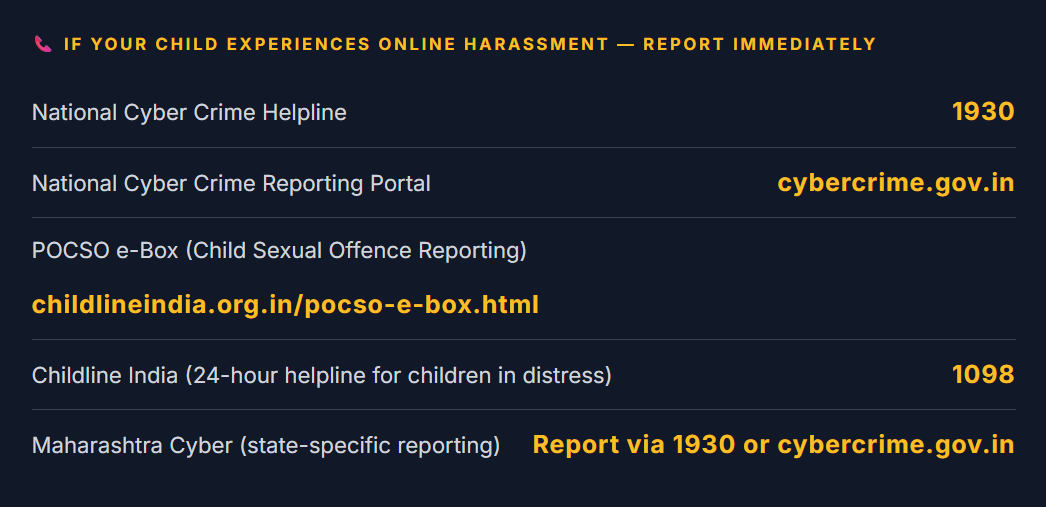
The POCSO e-Box (childlineindia.org.in/pocso-e-box.html) is India’s online mechanism for reporting sexual offences against children anonymously.
| Law / Provision | What It Covers | Punishment |
|---|---|---|
| IT Act Section 67B — Online Grooming | Enticing a child into an online relationship for sexually explicit acts; soliciting nude images from a minor online; facilitating child sexual abuse online | First conviction: Up to 5 years imprisonment + ₹10 lakh fine. Subsequent: Up to 7 years + ₹10 lakh fine. |
| POCSO Act Section 11 — Sexual Harassment | Soliciting sexually explicit material from a child; making sexually explicit remarks or requests to a child; grooming a child for sexual purposes | Up to 3 years imprisonment + fine |
| POCSO Act Sections 13–15 — Child Pornography | Using a child for pornographic purposes; storing, possessing, or distributing child sexual abuse material (CSAM) | Up to 5 years (usage); up to 3 years (storage/distribution) |
| IT Act Section 66E — Privacy Violation | Capturing or sharing images of a private area without consent | Up to 3 years imprisonment + ₹2 lakh fine |
| Bharatiya Nyaya Sanhita (BNS) Section 79 | Cyberstalking; sending obscene or sexually harassing messages | Varies by nature and severity of offence |
Key point for parents: online solicitation of explicit images from a child under 18 is a criminal offence in India regardless of whether the child complied. The request itself — the attempt — is the crime. You do not need to wait for harm to be caused before reporting to a cyber cell.
The detail that Yadav and Akshay Kumar both emphasised most forcefully was Nitara’s response: she immediately switched off her device and told her mother. This response — instinctive, immediate, without shame or hesitation — is the exact outcome that effective online safety education produces.
Most children do not do this. Most children, when approached by an online contact in a way that confuses or frightens them, experience a combination of shame, self-blame, and fear that the adult they tell will confiscate their device or restrict their access. These concerns — irrational from a safety standpoint, entirely rational from an adolescent’s perspective — are the primary reason that most online grooming and sextortion cases are not reported to parents until significant harm has occurred.
Creating the conditions in which a child will tell you immediately — before rather than after — is the most protective thing a parent can do. It requires ongoing conversation, not a single talk. It requires a demonstrated absence of punitive reaction to the child sharing digital difficulties. It requires the child to believe, from experience, that the adult will help rather than punish.
Nitara Kumar believed that. And the arrest on April 24, 2026 is the consequence of that belief being acted upon.
- Know which games allow communication with strangers.Any multiplayer game with in-game chat permits contact with unknown adults. Check every game on your child’s device. Ask: can my child talk to strangers in this game? If yes, that game needs explicit parental discussion.
- Have the conversation about “normal person, wrong question.”Teach children that kind, friendly, courteous behaviour from an online stranger does not make a sudden inappropriate request any less wrong. The Nitara incident illustrates this exactly: the person was polite, complimentary, and courteous — until they weren’t. Children need to understand that courtesy does not equal safety.
- Establish an absolute, non-punitive reporting rule.Tell your child, explicitly and repeatedly: “If anyone online says anything that makes you uncomfortable — no matter what it is — tell me immediately. I will not take away your device. I will help you.” Mean it. Enforce it consistently.
- Enable privacy and parental controls on gaming platforms.Most major gaming platforms (PlayStation Network, Xbox, Nintendo Switch, Steam) have parental control settings that can restrict or disable in-game chat. Enable them for children under 16. Review the settings on every device your child uses to game.
- Check age ratings and chat features before purchase.In-game communication features are not always visible in game ratings. Research the specific game before your child plays it. Common Sense Media (commonsense.org/media) provides detailed breakdowns of communication features in games.
- Report, do not ignore.If your child receives an inappropriate message online from an unknown contact, report it. Maharashtra Cyber’s helpline is 1930. The national cybercrime portal is cybercrime.gov.in. Reporting leads to investigations. Investigations lead to arrests. The Nitara case proves this.
- Talk about grooming without using that word.Explain to children that some people online pretend to be friendly in order to ask for things no adult should ever ask from a child. Frame it in simple, non-frightening language. Make it part of a regular conversation, not a scary one-time talk.
📌 FAQ — Akshay Kumar Daughter Cyber Case
❓ What exactly happened to Akshay Kumar’s daughter?
At a cyber awareness event (Oct 2025), Akshay revealed his 13-year-old daughter Nitara received inappropriate messages from an unknown person while gaming. The individual asked for a nude photo. She immediately stopped, informed her mother, and the case was reported to Maharashtra Cyber. An arrest was confirmed on April 24, 2026.
❓ Has the accused been publicly identified?
No. Authorities have confirmed an arrest, but no identifying details have been released yet.
❓ Is this a crime under Indian law?
Yes. It falls under:
- IT Act, 2000 (Section 67B) — online grooming/sexual solicitation of a minor
- POCSO Act, 2012 (Section 11) — sexual harassment of a child
These are serious criminal offences.
❓ Where should parents report similar incidents?
- 📞 Cyber Crime Helpline: 1930
- 🌐 Website: cybercrime.gov.in
- 🧒 POCSO e-Box: childlineindia.org.in
- ☎️ Childline: 1098 (24/7)
❓ What should a child do in such a situation?
- Stop immediately (close app/device)
- Do not respond
- Inform a trusted adult right away
Children should know they won’t be punished for reporting.
❓ Are gaming platforms safe for children?
They can be—with safeguards. Enable parental controls, restrict chat with strangers, and regularly discuss online safety. Risks usually come from in-game communication with unknown users.

Popcorn in hand and a opinion ready — Emily covers movie reviews, box office buzz, and all things cinema at Popcorn Review.

