
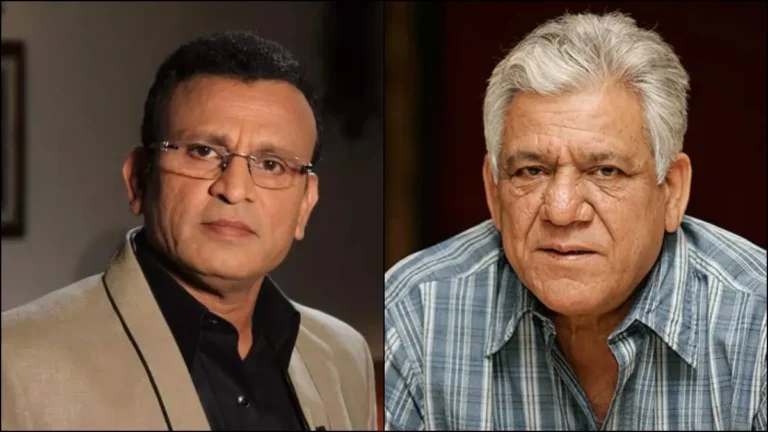
A viral interview. A decades-old wound reopened. The story of Om Puri’s first marriage — to Seema Kapoor, Annu’s sister — her pregnancy, the betrayal, the miscarriage, and how the brother who could not protect her finally spoke about it in public. Everything you need to know, in one place.
On April 24, 2026, a clip from Annu Kapoor’s recent interview went viral across social media. In it, the veteran actor-host spoke about the late Om Puri — celebrated as one of India’s finest screen performers — with a combination of genuine admiration and undisguised personal grief. The grief was not about Om Puri’s death in 2017. It was about something that happened more than three decades ago, and about a sister’s life that Annu Kapoor believes was irreversibly altered by a man he could not stop.
The interview has been clipped, shared, debated, and misunderstood in roughly equal measure across Instagram, X, and YouTube. Some are calling it an “explosive accusation.” Others are calling it “old news dragged up.” Neither framing fully captures what Annu Kapoor actually said, or what the full story behind it actually is.
This is that full story.
What Annu Kapoor Said — In His Own Words
Read together, the quotes form a portrait of a man navigating multiple, contradictory loyalties at once: his artistic admiration for Om Puri, his personal fury as a brother, his reported anger at his own sister for taking Om Puri back during his final years, and his present-day generosity toward Om Puri’s son and second wife. None of these feelings cancel each other out. All of them appear to be genuine.
Who Is Seema Kapoor, and What Actually Happened?
Seema Kapoor — sister of Annu Kapoor, Ranjit Kapoor, and Nikhil Kapoor — is a filmmaker, writer, and language coach with a significant career of her own. Born into a family deeply connected to theatre (her father Madanlal Kapoor was associated with Parsi theatre; her mother was an Urdu poet and classical singer), she began her career in puppet theatre at the Shri Ram Centre for Performing Arts in Delhi. She later wrote the screenplay for Abhay (1994), which won the National Film Award for Best Children’s Film, and directed films including Mr. Kabadi (2017) — a film featuring Om Puri in one of his final roles, with a story she wrote and directed.
She is not, in other words, simply defined by her marriage to Om Puri. She has a life and a body of work that exists independently of that chapter. But the chapter itself is one of the more painful in any Bollywood personal history.
Seema Kapoor and Om Puri had been in a relationship for approximately 11 years before their marriage in 1990–91.
The marriage lasted less than a year. According to Seema, during the marriage Om Puri became involved with journalist Nandita, who would later become his second wife. Seema says she was pregnant when the relationship ended. She was aware of the affair. She initially hoped it was a phase.
She lost the child — a miscarriage in the fifth month of her pregnancy. She has described this in her own words in interviews and in her 2025 memoir, Yoon Guzri Hai Ab Talak.
The divorce settlement included ₹6 lakh in alimony. When Seema lost the child after the separation, Om Puri reportedly sent ₹25,000 through his secretary. She refused it.
Om Puri married Nandita Puri in 1993. They had a son, Ishaan. In 2013, Nandita filed a domestic violence complaint against Om Puri; the couple separated judicially.
Over a decade later, Om Puri re-established contact with Seema Kapoor. They remained on cordial terms until his death on January 6, 2017. Seema, per Annu’s account, cared for Om Puri in his final years when his health declined.
Seema’s memoir was released in March 2025, at an event attended by Boney Kapoor, Annu Kapoor, Anupam Kher, Paresh Rawal, Raghubir Yadav, Divya Dutta, and others. In her memoir, Seema called Om Puri not a curse but a blessing in her life, writing: “Puri sahab was not a curse for my life but a blessing.”
The Thing That Makes Annu Kapoor’s Account Complicated
The easy read of this story is: a man wronged a woman, her brother is angry, the brother is speaking out. But the full picture is considerably more layered than that.
Annu Kapoor says he was angry at his sister, too — angry that she took Om Puri back in his final years and cared for him when his health deteriorated. That particular sentence is the one that cuts deepest: “I was also angry and upset with my sister.” It is not the anger of a man who has only one grievance. It is the anger of a man who felt doubly helpless — unable to protect his sister from the person who hurt her, and unable to understand why she chose, years later, to be present for that person’s decline.
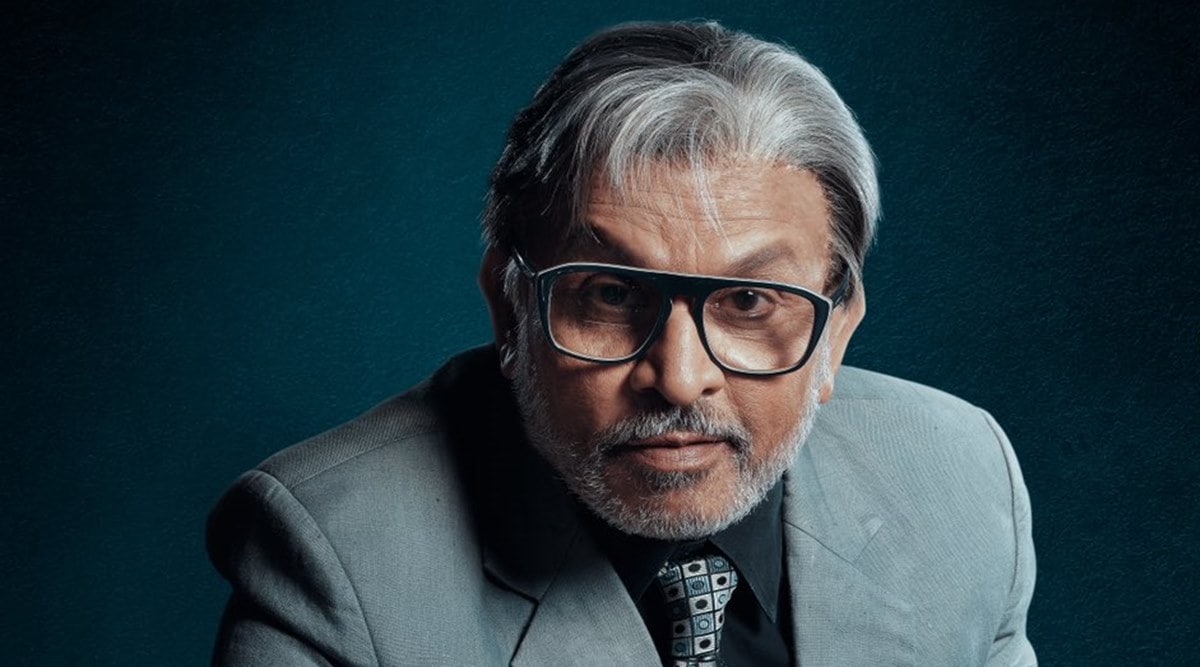
Seema herself has given a different account of what Om Puri meant to her. Her memoir is not a condemnation. It is a reckoning — a woman processing a painful chapter and arriving, apparently, at something closer to peace than bitterness. Her choice of words — blessing, not curse — is significant. She is not the same character in her own story as she is in her brother’s telling.
Who Was Om Puri? The Actor the World Lost
Any honest account of this story has to hold two things simultaneously: the personal pain Annu Kapoor is describing, and the extraordinary scale of what Om Puri contributed to Indian and world cinema. These are not in conflict. Great artists are not made better or worse people by the quality of their work. Om Puri was, by almost any measure, one of the finest actors the Indian subcontinent has ever produced — and he was, by the account of his own family, capable of causing serious harm in the people closest to him. Both are true.
Om Prakash Puri (October 18, 1950 – January 6, 2017) was born in Ambala, Haryana, into a modest Punjabi Hindu family. He trained at the Film and Television Institute of India (FTII) in Pune and the National School of Drama in Delhi, where he became close friends with Naseeruddin Shah — a friendship that would define both their careers and their social world for decades. He taught at the Actors’ Studio in Mumbai before his own career took off, with students including a young Anil Kapoor and Gulshan Grover.
His filmography is staggering in its range. He won two National Film Awards for Best Actor — for Aakrosh (1980) and Ardh Satya (1983). He starred in British and American productions including City of Joy (1992, opposite Patrick Swayze), Wolf (1994, with Jack Nicholson), East is East (1999), and Charlie Wilson’s War (2007, with Tom Hanks). He received India’s Padma Shri in 1990 and was made an Honorary Officer of the Order of the British Empire (OBE) in 2004 — one of the very few Indian actors to receive that distinction.
He also starred in some of the most beloved mainstream Hindi comedies ever made: Jaane Bhi Do Yaaro (1983), Hera Pheri (2000), Chachi 420 (1997). He was, in short, the rare actor who commanded absolute respect across parallel cinema, mainstream Bollywood, British Asian filmmaking, and international Hollywood productions. He has been compared to Marlon Brando, to Laurence Olivier — by filmmakers who had worked with both.
And he died on January 6, 2017, at the age of 66, of a cardiac arrest in his Mumbai apartment. He was found alone. The circumstances of his final years — separated from his second wife, in declining health, eventually cared for by the first wife he had left — are as complicated as the rest of his personal story.
The Chronology: A Complete Account
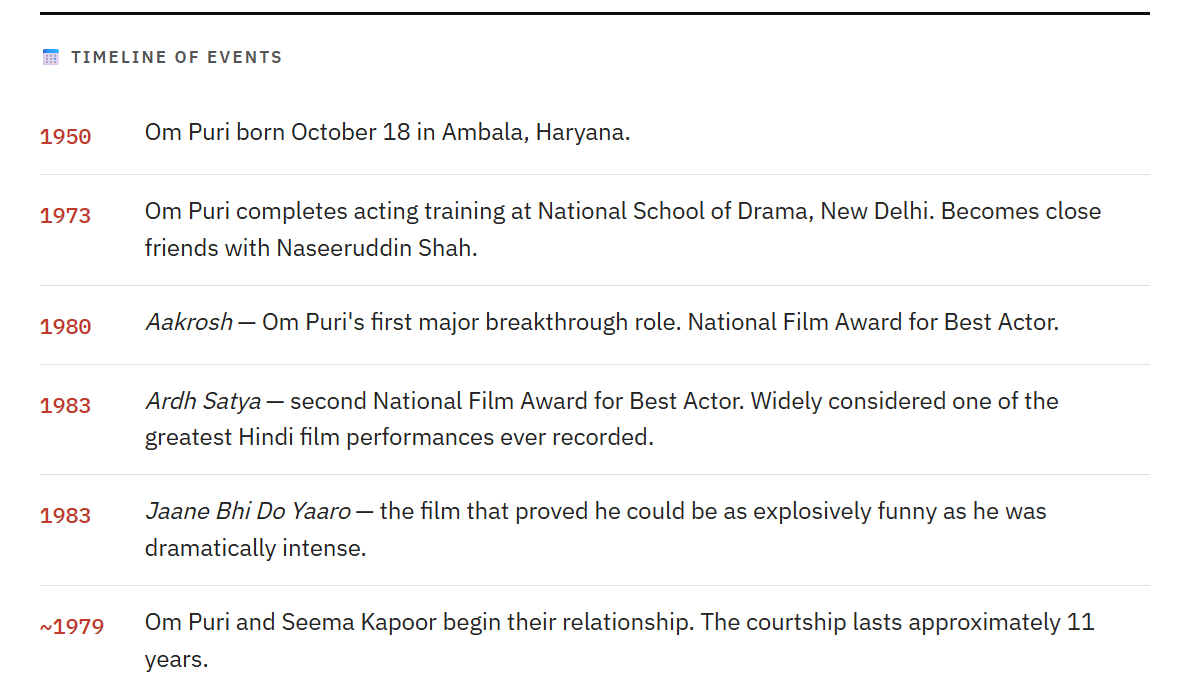
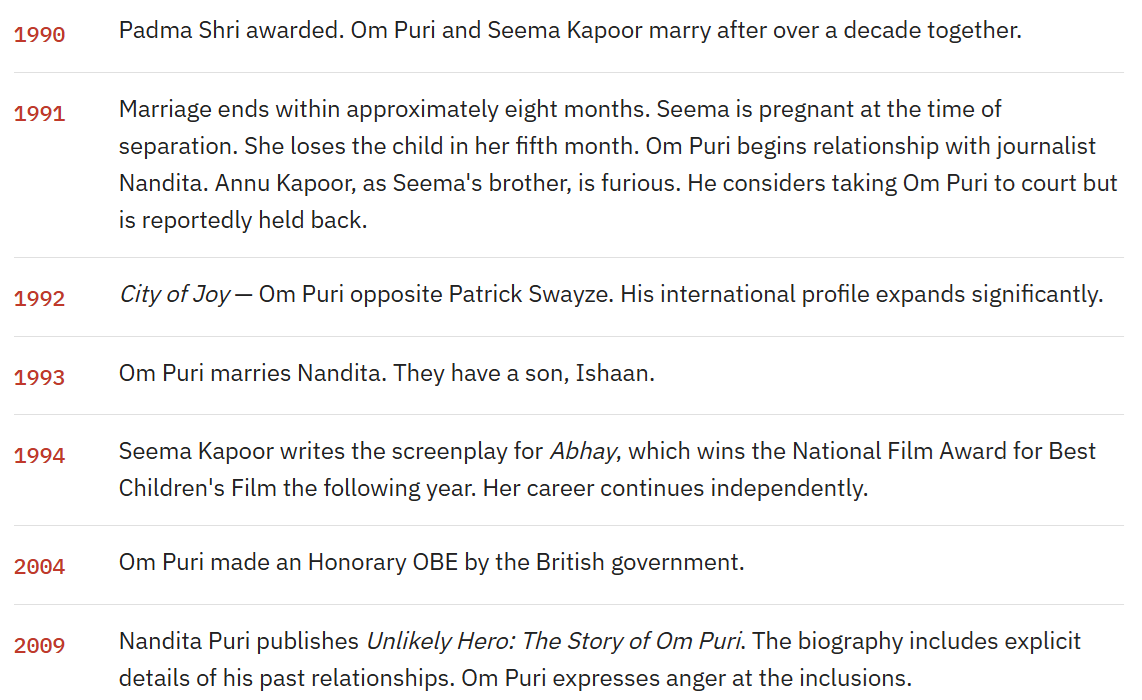
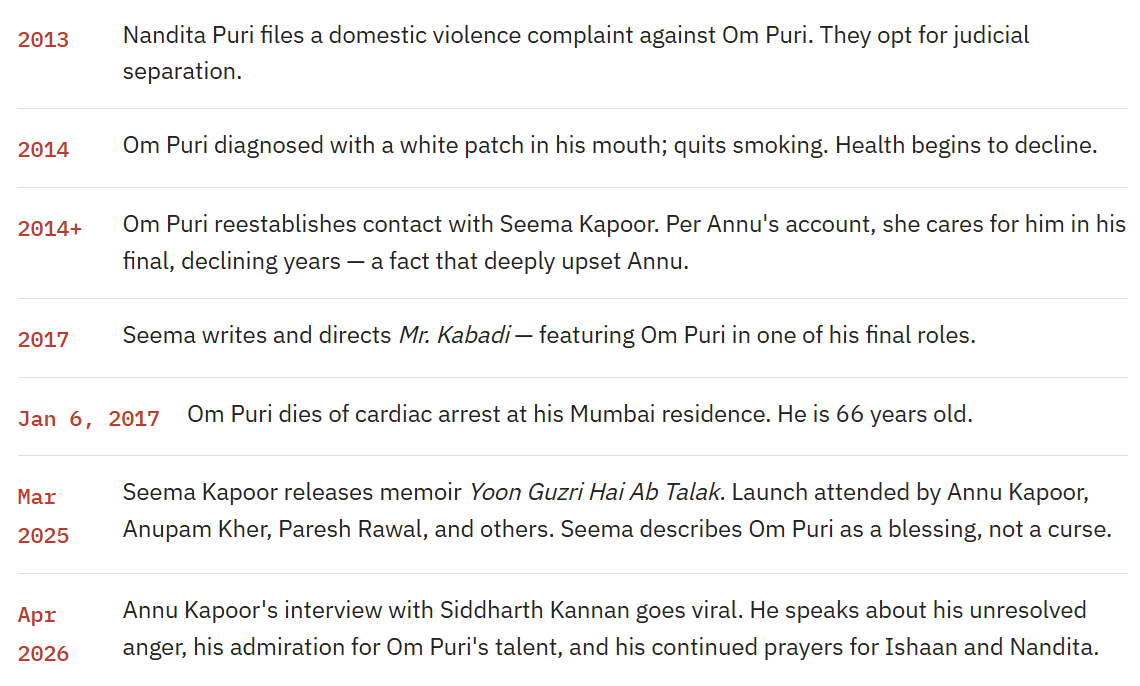
The Larger Question This Raises
Annu Kapoor’s interview went viral not because it revealed genuinely new information — the broad outlines of Om Puri and Seema Kapoor’s story have been in the public domain for years, including in Seema’s own memoir. It went viral because of how Annu said what he said: the rawness of the emotion, the specific phrase “I was helpless, I could not do anything,” the admission that he was also angry at his sister, the controlled restraint of a man who says he is holding back because “the brother inside me will come out.”
There is something deeply human in what Annu Kapoor is expressing — the particular helplessness of watching someone you love be hurt by someone you cannot reach. The fact that Om Puri was also a public figure, also widely admired, also celebrated as a great artist, does not make the personal pain less real. The fact that Seema herself has made a kind of peace with the past does not mean her brother has to, or should.
FAQ:
❓ Why is Annu Kapoor talking about Om Puri in April 2026?
Answer:
Annu Kapoor appeared in a conversation with interviewer Siddharth Kannan in which the topic of his relationship with Om Puri came up.
Given that Seema Kapoor released her memoir in March 2025 and the relationship between the two families has been periodically discussed since Om Puri’s death in 2017, the subject is part of an ongoing, slowly resurfacing conversation rather than a sudden new disclosure.
❓ Is what Annu Kapoor said a new accusation against Om Puri?
Answer:
No. The facts Annu referred to — his sister’s marriage, Om Puri’s affair with Nandita Puri, the pregnancy, the loss of the child — have all been publicly known for years and were documented in both Seema Kapoor’s 2025 memoir and in various interviews she and others gave over the preceding decade.
What is new is Annu Kapoor speaking about it with this level of personal directness in a viral-format interview.
❓ What did Seema Kapoor herself say about Om Puri?
Answer:
In her 2025 memoir Yoon Guzri Hai Ab Talak, Seema Kapoor described Om Puri as a blessing rather than a curse in her life.
She wrote that every sorrow is an opportunity to refine oneself from within. She and Om Puri had re-established cordial contact in the final years of his life, and she is reported to have cared for him during his health decline.
She also wrote and directed the film Mr. Kabadi, which featured Om Puri in one of his final roles.
❓ What happened to Om Puri and Nandita Puri‘s marriage?
Answer:
Om Puri married journalist Nandita in 1993. They had a son, Ishaan.
In 2013, Nandita filed a domestic violence complaint against Om Puri; the couple subsequently opted for judicial separation.
In 2009, Nandita had published a biography of Om Puri titled Unlikely Hero: The Story of Om Puri, which Om Puri was reportedly angry about due to its explicit personal disclosures.
❓ What awards and recognition did Om Puri receive?
Answer:
Om Puri received two National Film Awards for Best Actor (Aakrosh; Ardh Satya), two Filmfare Awards, the Padma Shri in 1990, and an Honorary Officer of the Order of the British Empire (OBE) in 2004.
He is widely regarded as one of the finest screen actors in world cinema. He appeared in over 300 films across multiple languages and industries, including British and Hollywood productions.
❓ How did Om Puri die?
Answer:
Om Puri died of a cardiac arrest on January 6, 2017, at his residence in Mumbai.
He was 66 years old. He was found alone at his home. His death came approximately two years after he had been diagnosed with a white patch in his mouth and quit smoking.
❓ Does Annu Kapoor hold a grudge against Om Puri now?
Answer:
Annu Kapoor said in the interview that he no longer harbours resentment, and specifically stated that he prays for Om Puri’s son Ishaan and his ex-wife Nandita.
But he was also candid that the wound of what happened to his sister has not fully healed, and that speaking about it in detail would make “the brother inside me come out.”
His position appears to be one of partial — but not complete — resolution.

Popcorn in hand and a opinion ready — Emily covers movie reviews, box office buzz, and all things cinema at Popcorn Review.

